
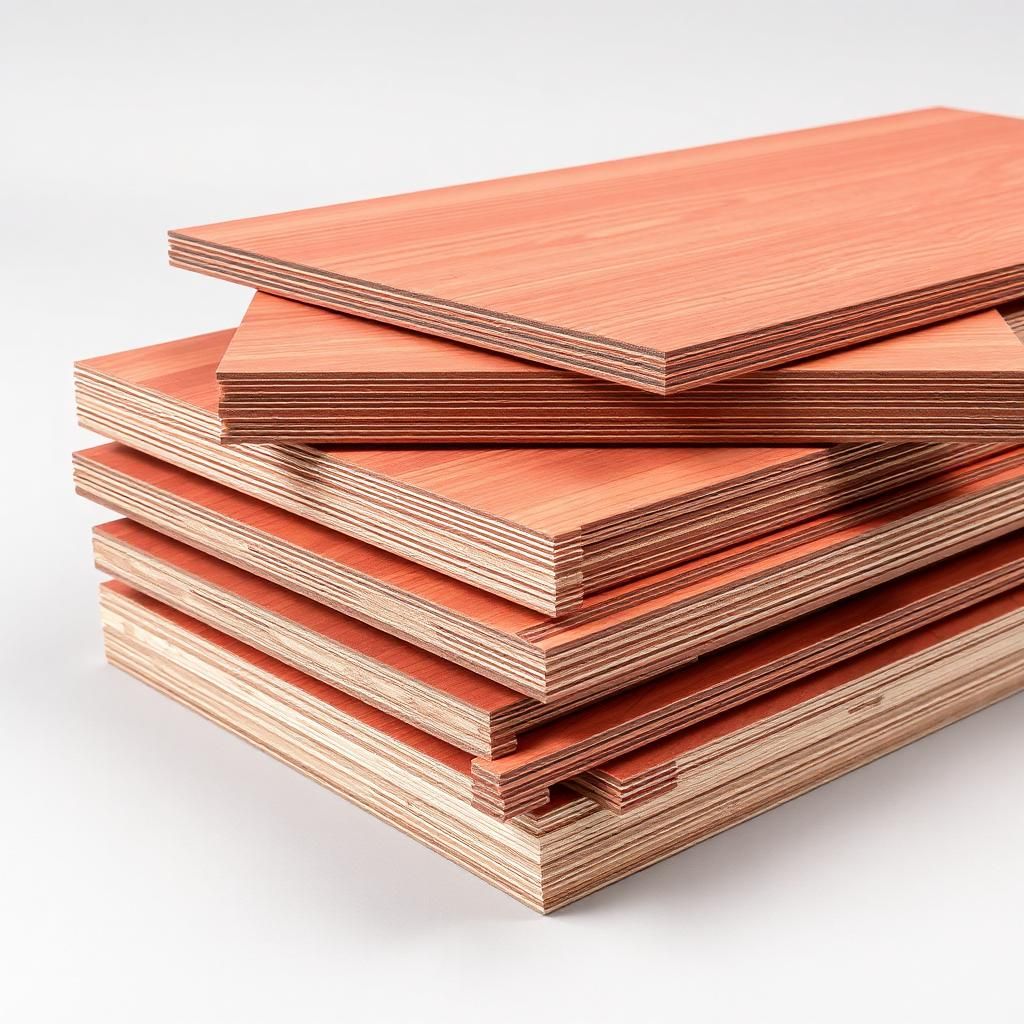
Plywood: commercial, marine, structural and decorative.
One sourcing partner for every plywood grade across the GCC, sourced from Indonesian, Malaysian, Chinese, Indian and Vietnamese mills supplying commercial, marine, MR, BWR, BWP, WBP, flexible, decorative, structural and industrial plywood.
A cross-laminated panel, engineered for strength and stability.
Plywood is an engineered wood panel made by bonding three or more thin veneers (plies) together with their grain running at 90° to each adjacent layer. This cross-graining gives plywood its characteristic dimensional stability, screw-holding and bending strength, properties that solid timber of the same thickness cannot match.
The performance of a plywood panel is defined by four independent variables: the glue line (MR, BWR, BWP, WBP), the core species (hardwood, poplar, birch, eucalyptus, combi), the face veneer grade (A, B, C, D), and the dimensional tolerance. Every commercial enquiry must address all four.
Every grade. One supplier.
Commercial Plywood
General-purpose interior plywood for joinery, fit-out, carcass and packaging.
Marine Plywood (BS 1088)
Tropical hardwood throughout, WBP glue, exterior and waterborne applications.
MR Plywood
Moisture-resistant urea-formaldehyde glue plywood for dry interior work.
BWR Plywood
Boiling Water Resistant, phenol-modified glue for kitchens and wet areas.
BWP Plywood
Boiling Water Proof, IS 710 specification for marine and exterior-grade use.
WBP Plywood
Weather & Boil Proof phenolic glue, full exterior durability.
Flexible Plywood
Bendable plywood for curved joinery and bespoke architectural shapes.
Decorative Plywood
Veneered, pre-laminated or polished plywood for visible interior surfaces.
Structural Plywood
Stress-graded plywood for structural diaphragms, bracing and engineered builds.
Industrial Plywood
Project-grade plywood for crating, packaging, OEM and manufacturing.
Five mill networks. One contract.
Tropical hardwood cores, the long-standing reference for premium plywood and WBP grades.
Hardwood and combi-core commercial plywood with a strong value/quality balance.
Poplar, eucalyptus, birch and combi-core plywood for scaled supply across grades.
Indian hardwood commercial, MR and BWR plywood for domestic-spec joinery work.
Acacia and eucalyptus combi-core commercial plywood with a growing export programme.
Glue lines explained.
| Type | Glue | Exposure | Standard | Typical use |
|---|---|---|---|---|
| MR | Urea Formaldehyde (UF) | Dry interior | IS 303 | Furniture, carcass, joinery |
| BWR | Phenol-modified (MUF) | Wet interior | IS 303 | Kitchens, bathrooms |
| BWP | Phenol-Formaldehyde (PF) | Exterior / wet | IS 710 | Marine, exterior joinery |
| WBP | Phenol-Formaldehyde (PF) | Exterior | BS EN 314-2 Class 3 | Formwork, exterior joinery |
| Marine (BS 1088) | WBP + hardwood core | Waterborne / exterior | BS 1088 | Marine, boat building |
When BS 1088 actually matters.
| Specification | Marine (BS 1088) | Commercial |
|---|---|---|
| Core species | Tropical hardwood throughout | Mixed core, may include softwood |
| Glue line | WBP phenolic to BS 1088 | MR or BWR |
| Voids | No voids permitted | Minor voids permitted |
| Veneer quality | All plies sound, no overlaps | Patches and minor overlaps permitted |
| Use | Marine, exterior, persistent wetting | Interior joinery and packaging |
What's inside the panel.
Hardwood core
Tropical hardwood veneers throughout: heaviest, stiffest, best screw-holding and durability. Preferred for marine, structural and heavy-duty joinery.
Poplar core
Full poplar core, the lightest option with cleanest machining, common in furniture, decorative panels and high-end fit-out.
Birch core
European birch, dense, fine-grained, knot-free plies with the highest screw-holding and bending strength. Specified for premium furniture and CNC work.
Eucalyptus core
Dense, stable Chinese and Vietnamese eucalyptus for strong commercial and value film-faced applications.
Combi core
Hardwood faces with softwood/poplar inner plies, giving a lighter, cost-effective panel for general joinery and packaging.
Face grades & decorative veneers.
Face grades
A, B, C, D faces define knot, patch and colour allowances. A is paint-grade clean, D is unrestricted.
Decorative veneers
Sapele, oak, walnut, teak, maple veneered plywood for visible architectural and joinery surfaces.
Pre-laminated
Melamine and phenolic pre-laminated plywood for kitchens, wardrobes and shopfitting.
Standard thicknesses & uses.
- 3.6 mm: back panels, drawer bottoms
- 5.5 mm: light joinery, paneling
- 9 mm: internal partitions, packaging
- 12 mm: carcass, joinery, light formwork
- 15 mm: kitchen carcass, wardrobes
- 18 mm: shelving, structural carcass, formwork
- 21–25 mm: heavy structural and infrastructure
- 28–30 mm: heavy industrial, machine bases, conveyors
Plywood and humidity in the GCC.
UAE and Saudi interiors run at 6–10% equilibrium MC year-round inside air-conditioned space. Plywood arriving above 14% MC will move significantly as it equilibrates, risking warping, joint failure and finish defects. Always specify and verify MC at delivery.
| MC Range | Recommended Use |
|---|---|
| 6–10% | Air-conditioned interior joinery (UAE, Saudi Arabia) |
| 10–14% | Non-air-conditioned interior, general construction |
| 14–18% | Exterior shaded use, formwork, packaging |
| >18% | Reject, risk of warping, fungal growth, glue failure |
What goes wrong, and why.
Delamination
Glue line failure between plies. Root cause: under-cured press, insufficient resin, or sub-spec glue. Always reject, cannot be repaired on site.
Core gaps
Voids between core veneer strips, visible on edges. Grade B and above should be near-void-free. Causes telegraphing and weak screw fixings.
Warping & bow
Caused by uneven moisture, asymmetric face/back veneers or poor stacking. Reject panels with >5 mm bow on 2440 mm length.
Face checks
Surface cracks following grain on rotary-cut faces. Cosmetic on industrial grade, defect on decorative grade.
Overlaps & gaps
Veneer plies overlapping or short, visible on edges and on lacquered finish. Tolerated only on D grade.
Telegraphing
Core gaps showing through face after sanding/finishing. Common on cheap commercial plywood with wide core gaps.
10-point inspection checklist.
Used by our QC team on every shipment before dispatch from origin. Apply the same checklist on container opening.
- Visible face grade matches order (A, B, C, D)
- Glue line type confirmed (MR / BWR / BWP / WBP)
- Thickness within ±0.3 mm of nominal
- No edge delamination on boil test (BWP/WBP)
- Core gaps and overlaps within grade tolerance
- Moisture content 8–14% on delivery
- Panel dimensions match 1220×2440 or 1250×2500
- Mill stamp, batch number and certification visible
- Veneer thickness consistent across plies
- No telegraphing (core pattern showing through face)
- Store flat on bearers, never on edge or unsupported
- Cover with breathable sheeting to prevent direct sun and water
- Maintain 8–14% MC; do not stack on damp slabs
- Allow 48 hours acclimatisation before machining in air-conditioned interiors
- Restack with stickers if humidity exceeds 70% RH
- Rotate stock FIFO to avoid yellowing on aged stock
Protect the panel before it reaches the joinery.
More plywood is ruined by poor on-site storage than by mill defects. Six rules cover 95% of site failures.
Container yield by thickness.
Indicative 40 ft HC loadings for 1220×2440 mm sheets. Volumes vary with mill packing density and packaging thickness.
| Panel | Sheets per 40 ft HC |
|---|---|
| 1220×2440×6 mm | ~1,800 sheets |
| 1220×2440×9 mm | ~1,200 sheets |
| 1220×2440×12 mm | ~900 sheets |
| 1220×2440×15 mm | ~720 sheets |
| 1220×2440×18 mm | ~600 sheets |
| 1220×2440×25 mm | ~430 sheets |
Where our plywood ships.
Six decisions before you sign the PO.
Specify the glue line first
MR for dry interior, BWR for kitchens/bathrooms, BWP/WBP for exterior and marine. The glue is the single most important specification, never compromise.
Match core to the application
Birch core for premium furniture, hardwood for marine/structural, poplar for decorative, combi for general joinery.
Confirm face grade
A for paint-grade visible surfaces, B for stained/lacquered, C for hidden joinery, D for industrial backing.
Lock thickness tolerance
Specify ±0.3 mm for visible joinery; loose ±0.5 mm is acceptable only for packaging and crating.
Volume planning
1×40HC carries ~600–650 sheets of 18 mm 1220×2440. Plan factory dispatch in 20–40 ft container modules.
Certification
FSC/PEFC, CARB, E0/E1 formaldehyde emission and BS 1088 marine certification available, specify at enquiry stage.
Hardwoods across the GCC and Middle East
African and North American hardwoods for premium architectural projects.
Shipments routed through Jebel Ali, Khalifa, Hamad, King Abdulaziz Dammam, Sohar and other major regional ports, coordinated with contractor and procurement schedules.
Sapele, Iroko, Meranti, White Oak, American Walnut, Ash and other premium hardwoods are supplied (kiln-dried, graded and packed) for joinery workshops, luxury fit-out contractors, hotel developers and yacht builders across the UAE, KSA, Qatar and the wider GCC.
- Dubai
- Abu Dhabi
- Sharjah
- Ajman
- Ras Al Khaimah
- Fujairah
- Umm Al Quwain
- Al Ain
- Khor Fakkan
- Riyadh
- Jeddah
- Dammam
- Al Khobar
- Jubail
- Yanbu
- Mecca
- Medina
- Tabuk
- Abha
- JAFZA
- DIP
- Dubai Industrial City
- Sharjah Industrial Area
- KIZAD
- Hamriyah Free Zone
- RAKEZ
- SAIF Zone
- Doha
- Lusail
- Al Rayyan
- Mesaieed
- Al Wakrah
- Kuwait City
- Shuwaikh
- Shuaiba
- Ahmadi
- Manama
- Muharraq
- Riffa
- Sitra
- Muscat
- Sohar
- Salalah
- Duqm
- Nizwa
- Amman
- Zarqa
- Irbid
- Aqaba
- Baghdad
- Erbil
- Basra
- Mosul
- Najaf
- Karbala
- Sulaymaniyah
- Kirkuk
- Jebel Ali Port
- Khalifa Port
- Hamriyah Port
- Port Rashid
- Khor Fakkan Port
- King Abdulaziz Port Dammam
- Jeddah Islamic Port
- King Abdullah Port
- Jubail Commercial Port
- Yanbu Commercial Port
- Hamad Port
- Shuwaikh Port
- Shuaiba Port
- Khalifa Bin Salman Port
- Port of Sohar
- Port of Salalah
- Port of Duqm
- Port of Aqaba
- Umm Qasr Port
- Khor Al Zubair Port
Complete the wood package.
Shuttering plywood for concrete formwork, Korinplex and Superform.
Natural and engineered decorative veneers for premium fit-out.
Indonesian WBP, Ordinary, Superform and Korinplex flagship plywood.
20+ African, American, European and Asian hardwood species.
European whitewood, SPF and Nordic softwood timber.
European steamed and unsteamed beech for furniture and joinery.
Round pine logs for industrial milling and panel production.
HT-stamped boards, stringers, blocks and EPAL Euro pallets.
Raw, HMR, FR, melamine and veneer MDF, the smoothest panel face.
Plywood: technical reading.
Specification, procurement, on-site guidance and origin context from the TIC Knowledge Center.
Film Faced Plywood Specification Guide for Consultants
A technical reference for engineering consultants writing formwork specifications for GCC concrete projects, covering every parameter that matters.
Film Faced Plywood: A Contractor's Guide for the UAE
Choosing film-faced plywood is about reuse economics: what density, glue line and film weight buy you on a real GCC pour schedule.
How to Evaluate Film Faced Plywood Quality Before Purchase
A pre-purchase inspection protocol that protects contractors from buying under-spec film-faced plywood on GCC projects.
How Many Reuses Should You Expect From Film Faced Plywood?
Real-world reuse data from UAE and Saudi sites: how density, film weight, handling and concrete type determine panel lifespan.
Common Film Faced Plywood Buying Mistakes
The ten most expensive mistakes GCC contractors make when buying film-faced plywood, and how to avoid them.
Superform by Korindo: When the Premium Grade Pays Back
Superform sits at the top of Korindo's range. Where it earns its premium on real GCC pour schedules.
Plywood FAQ
What is the difference between MR, BWR and WBP plywood?
MR uses urea-formaldehyde glue and is for dry interior use. BWR uses a phenol-modified glue with improved moisture resistance for kitchens and bathrooms. WBP uses pure phenol-formaldehyde glue and is fully exterior-rated.
What is BWP plywood?
BWP (Boiling Water Proof) is the Indian Standard IS 710 specification for marine-grade plywood. It uses 100% phenol-formaldehyde glue and is equivalent in performance to WBP/marine plywood.
Is marine plywood the same as WBP?
No. WBP describes the glue line only. Marine plywood (BS 1088) is a complete specification requiring tropical hardwood core throughout, no voids and WBP glue. All marine plywood is WBP, but not all WBP plywood is marine.
Which plywood origin should I specify?
Indonesia and Malaysia for premium hardwood and WBP grades, China for scaled combi-core and birch supply, India for local-spec joinery, Vietnam for acacia commercial. TIC Dubai supplies all five mill networks.
What plywood thickness do I need for kitchen carcass?
15 mm or 18 mm BWR or MR plywood is standard for kitchen carcass. 18 mm is preferred for wide cabinets and where heavier loadings or appliance support is expected.
What plywood thickness should I use for flush doors?
Door skins are 3–4 mm decorative plywood; the core uses 35 mm tubular chipboard, blockboard or solid timber framing with 9–12 mm internal lipping.
Do you supply decorative and pre-laminated plywood?
Yes, veneered plywood (Sapele, oak, walnut, teak, maple), melamine pre-laminated and phenolic-faced decorative plywood for joinery, fit-out and shopfitting.
What is the difference between hardwood, poplar, birch and eucalyptus cores?
Hardwood is heaviest and strongest (marine/structural), birch is densest with best screw-holding (premium furniture), poplar is lightest and cleanest machining (decorative), eucalyptus is dense and stable (commercial and film-faced).
Why is birch plywood preferred for premium furniture?
Birch core has the highest density, fewest voids, and best screw-holding of any commercial plywood core. The fine, even grain machines cleanly and accepts paint and stain consistently.
How do I tell genuine WBP plywood from commercial?
Boil a 50×50 mm sample for 4 hours. WBP plywood will not delaminate. Commercial MR/BWR plywood will separate at the glue line within 1–2 hours of boiling.
What causes plywood delamination?
Under-cured press, insufficient resin, sub-spec glue, prolonged water exposure, or boil-test failure. Delaminated plywood cannot be repaired on site and must be rejected.
What moisture content should plywood have on delivery?
Plywood should arrive at 8–14% MC. Higher than 14% indicates poor kiln drying or wet shipping; this risks warping, glue failure and fungal growth.
How long can plywood be stored before use?
Properly stored plywood (flat, dry, covered, FIFO rotation) maintains specification for 12+ months. Stock stored on damp slabs or unprotected will warp within weeks in GCC humidity.
How should plywood be stored on site?
Store flat on bearers spaced no more than 600 mm apart, cover with breathable sheeting, off the ground, away from direct sun and water. Never store on edge unsupported.
What is the standard plywood sheet size?
International standard is 1220×2440 mm (4×8 ft). European standard is 1250×2500 mm. Custom sizes available on full-container orders.
What is the thickness tolerance for commercial plywood?
±0.3 mm is the trade tolerance for finished joinery work; ±0.5 mm is acceptable for crating and packaging. Specify at enquiry stage.
How many sheets of 18 mm plywood fit in a 40 ft HC container?
Approximately 600 sheets of 1220×2440×18 mm plywood fit in a 40 ft HC container, equivalent to ~17,800 sq ft of panel surface.
What is the difference between rotary cut and sliced face veneer?
Rotary cut produces wide, wild-grain leaves and is the default for industrial and commercial plywood faces. Sliced veneer produces narrower, architectural-grade leaves used for decorative plywood.
What are E0, E1, E2 formaldehyde emission grades?
E0 (<0.5 mg/L) is the lowest emission, suitable for hospitals, schools and air-conditioned interiors. E1 (<1.5 mg/L) is the European standard for residential. E2 (<5 mg/L) is industrial-grade only.
Is plywood CARB Phase 2 compliant?
Most premium plywood from Indonesia, Malaysia, Vietnam and China is available in CARB Phase 2 compliant grades on request. Specify at enquiry stage.
Can plywood be used for concrete formwork?
Yes, but only film faced plywood (FFP) with phenolic film coating and WBP glue. Plain plywood is unsuitable for formwork. See our dedicated Film Faced Plywood page.
Is FSC or PEFC certified plywood available?
Yes. FSC and PEFC certified plywood is available from most Indonesian, Malaysian and Vietnamese mills. Lead times are typically 4–6 weeks longer for certified material.
What is the difference between BS 1088 marine and IS 710 BWP?
BS 1088 (British) is the international marine standard with strict hardwood-throughout and no-void requirements. IS 710 (Indian BWP) tests the glue line under boiling water but allows variation in core species.
Can plywood be used for truck bodies and trailers?
Yes, 18 to 25 mm WBP or film faced plywood is standard for truck floors, trailer linings and transport applications. Phenolic faces add abrasion resistance.
What is flexible plywood?
Flexible plywood (also called bendy plywood or wiggle board) is 4–8 mm panels with grain running across the panel, allowing curves down to 100 mm radius for columns, curved cabinetry and architectural shapes.
How is plywood graded?
Plywood is graded on face quality (A/B/C/D), glue line (MR/BWR/BWP/WBP), core type (hardwood/poplar/birch/eucalyptus) and dimensional tolerance. All four must be specified at enquiry.
What are common plywood defects to inspect for?
Delamination, core gaps, overlaps, telegraphing, bow/warp, face checks, thickness variation and moisture content above 14%. We share a 10-point inspection checklist on this page.
Why does my plywood face show core pattern (telegraphing)?
Core gaps showing through the face after sanding or finishing, caused by wide core gaps or thin face veneers. Specify face grade B+ with continuous core to eliminate.
Can plywood be painted, stained or lacquered?
Yes. Plywood with A or B face grade accepts paint, stain, PU lacquer and polyester finishes. Industrial C/D grades are typically left raw or sealed only.
What is the difference between plywood and blockboard?
Plywood has thin cross-laminated veneer plies throughout. Blockboard has a core of solid softwood battens between two veneer faces. Blockboard is lighter and used for door cores and large flush panels.
What is the difference between plywood and MDF?
Plywood is cross-laminated veneer (strong, screw-holds well, lighter). MDF is engineered fibre (smoother face, better for paint, no grain, denser). Plywood for structure; MDF for visible interior surfaces.
What is the lead time for plywood from your mills?
Standard commercial: 30–35 days FOB. Marine and certified grades: 45–60 days. Stock items available ex-Dubai on selected sizes and grades.
What MOQ do you require?
Minimum order is typically one 40 ft HC container (~600 sheets of 18 mm). Stock-and-ship from Dubai available on smaller volumes for selected grades.
Do you ship outside the UAE?
Yes. We supply Saudi Arabia, Qatar, Oman, Kuwait, Bahrain, Jordan, Iraq, Egypt and East Africa from Indonesian, Malaysian, Chinese, Indian and Vietnamese mills, plus ex-Dubai stock.
What is the warranty on plywood?
Marine BS 1088 plywood carries a written mill warranty against delamination (typically 3–10 years depending on mill). Commercial grades are sold to specification with batch traceability.
Can I get a sample before ordering?
Yes. We provide 300×300 mm cut samples on request, with mill stamp, batch number and glue-line test certificate. Sample lead time is typically 7 working days.
Birch plywood for the Egyptian market
Egyptian joineries and specifiers source Baltic-origin birch plywood from TIC on CFR terms to Alexandria, Damietta and Port Said. B/BB, BB/BB and CP grades ship factory-direct in full or mixed containers.
Egypt supply pageGet a plywood quotation.
Tell us type, glue line, core, face grade, thickness, volume and destination. We revert with mill options, lead times and indicative pricing within one working day.