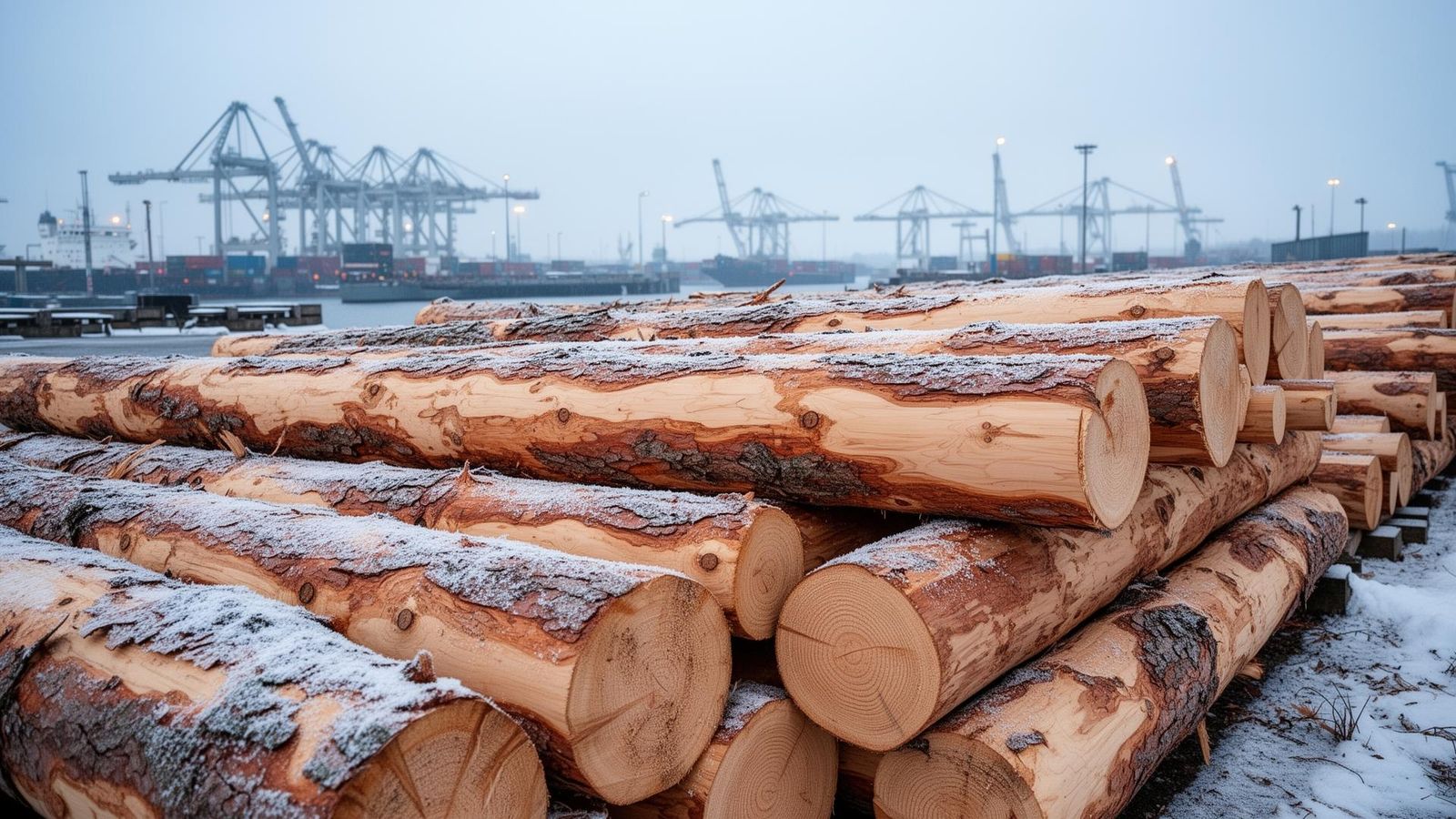
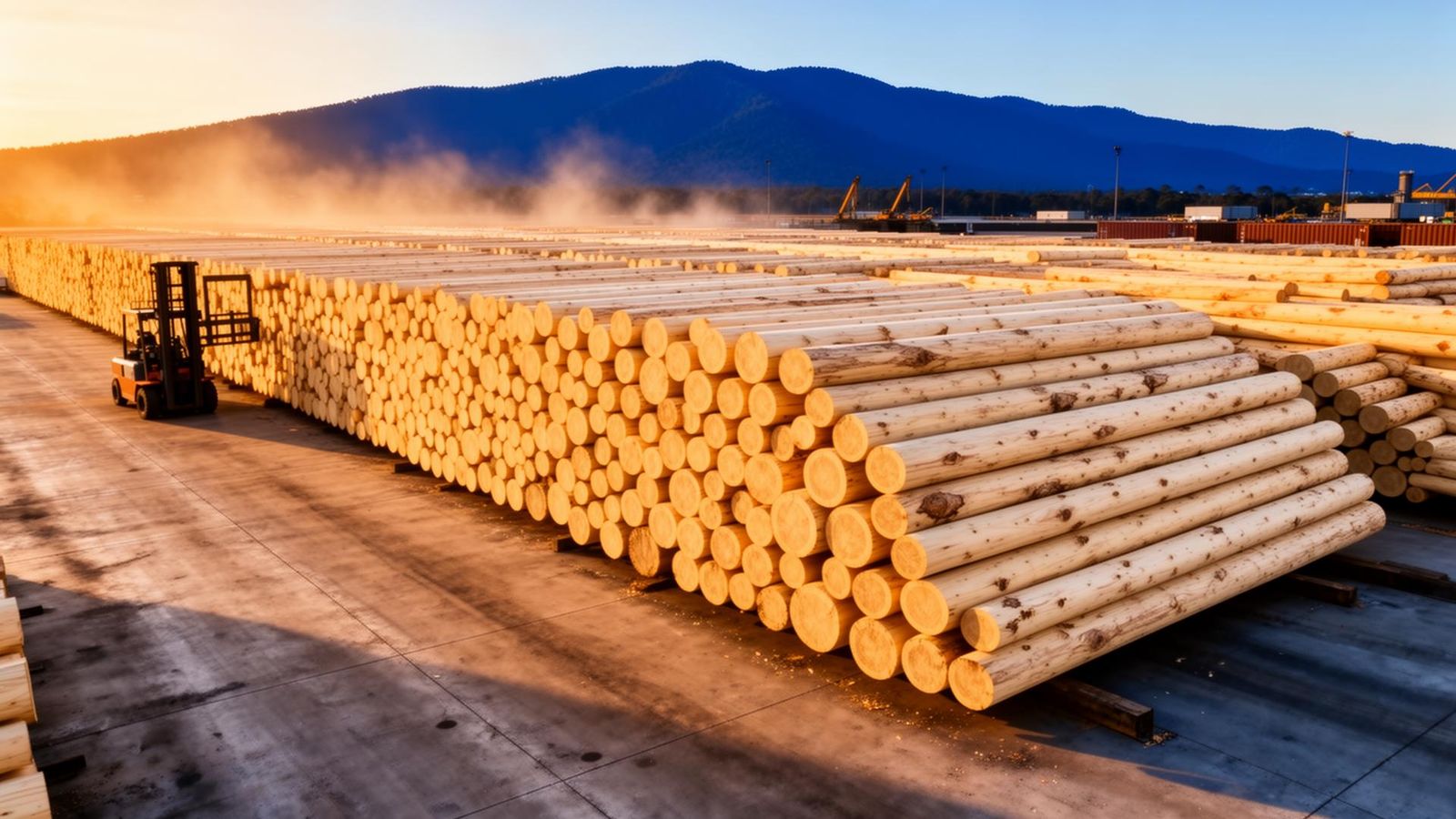
Vast industrial pine log yard at golden hour with stacked radiata pine sawlogs awaiting export to the Middle East
    Pine Logs

    Radiata, Scots & industrial pine logs, bulk-carrier-direct to the GCC.

    Plantation radiata pine from New Zealand, Chile and Brazil; Scots pine from Northern Europe, sawlog, peeler and pulp grades shipped in bulk and break-bulk to Jebel Ali, Hamriyah, Sohar, Dammam and Umm Qasr for sawmills, plywood plants and engineered wood manufacturers across the Middle East.

    What Are Pine Logs?

    Round softwood, ready for the sawmill, peeler or chipper.

    Pine logs are debarked, cross-cut sections of pine tree trunks supplied in their round form for downstream sawmilling, peeling, chipping and engineered wood production. Plantation-grown radiata pine (Pinus radiata) from New Zealand, Chile, Brazil and Uruguay is the dominant traded volume worldwide; Scots pine (Pinus sylvestris) from Russia, the Baltics and Northern Europe is the dominant traded softwood across EMEA.

    TIC Dubai consolidates origin-direct shipments via bulk carrier, break-bulk and container, with FSC® and PEFC chain-of-custody, third-party inspection and full phytosanitary documentation handled load-port to discharge across the UAE, Saudi Arabia, Qatar, Oman, Kuwait, Bahrain, Iraq and the wider Middle East.

    Close-up cross-section of a freshly sawn radiata pine log showing tight concentric growth rings and honey-coloured heartwood
    Species Guide

    Four pine species, three continents of supply.

    Plantation radiata (New Zealand, Chile, Brazil), naturally durable Scots pine (Russia and Northern Europe), Brazilian loblolly and tropical Caribbean pine, supplied in sawlog, peeler and pulp grades to GCC sawmills and panel mills.

    Radiata Pine (Pinus radiata) log close-up showing colour and growth-ring structure
    New Zealand, Chile, Brazil, Uruguay, Australia

    Radiata Pine

    Pinus radiata

    The global plantation softwood. Pale honey heartwood, exceptional treatability, the default sawlog and peeler species worldwide.

    Density
    480–520 kg/m³
    Janka
    3,300 N
    Rotation
    25–30 years
    Scots Pine (Pinus sylvestris) log close-up showing colour and growth-ring structure
    Russia, Baltics, Finland, Sweden, Poland, Germany

    Scots Pine

    Pinus sylvestris

    Slower-grown European workhorse. Reddish heartwood, denser, more naturally durable, preferred for high-spec joinery and pressure-treated outdoor timber.

    Density
    510–560 kg/m³
    Janka
    4,000 N
    Rotation
    60–100 years
    Brazil, USA South

    Loblolly / Taeda Pine

    Pinus taeda

    Brazilian plantation pine. Denser and knottier than radiata, robust sawmilling and engineered wood feedstock.

    Density
    510–540 kg/m³
    Janka
    3,500 N
    Rotation
    20–25 years
    Tropical plantations

    Caribbean Pine

    Pinus caribaea

    Tropical plantation pine. Higher density, used for structural lumber, pallet stock and pressure-treated outdoor timber.

    Density
    540–620 kg/m³
    Janka
    4,200 N
    Rotation
    20–28 years
    Log Grading

    Five tiers, from pruned clears to pulpwood.

    New Zealand-standard grading rules dominate global radiata trade. European Scots pine grades follow ABC sawlog and D pulp conventions. We supply both, with origin grading rules attached to every offer.

    GradeTypical End Use
    A / Pruned (Clear)Peeler logs for plywood face veneer, premium clear joinery, LVL face stock
    K / KI (Knotty Industrial)Mid-grade peeler and sawmill workhorse for general lumber
    KIS (Knotty Industrial Sawlog)Standard sawmill grade for framing, scantlings and pallet stock
    S / Structural SawlogStructural lumber and engineered wood billets
    Pulp / IndustrialChip, MDF, particleboard, OSB and pulp & paper feed
    Swipe to view more
    Dimensions & Documentation

    SED bands, standard lengths, JAS-m³ volume.

    Small-end diameter sets sawmill recovery; length sets vessel and yard handling; volume method sets the chargeable quantity. Specify all three on the RFQ.

    Small-End Diameter (SED) Bands14–19, 20–29, 30–39, 40+ cm, defined per contract
    Standard Lengths2.4 m, 3.0 m, 3.6 m, 4.0 m, 5.0 m, 6.0 m+
    Length Tolerance±5 cm typical, ±10 cm for break-bulk programmes
    Volume MethodJAS-m³ (NZ standard) or Smalian's formula, specified in contract
    DebarkingMechanical drum or ring-debarked at origin
    End MarkingPainted grade and SED stamp on butt end per shipping tally
    PhytosanitaryOrigin phytosanitary certificate; fumigation/HT where required
    CertificationFSC® and PEFC chain-of-custody available across NZ, Chile, Brazil and Europe
    Swipe to view more
    Radiata vs Scots

    Two pines, two industrial profiles.

    AspectRadiata PineScots Pine
    OriginNew Zealand, Chile, Brazil, UruguayRussia, Baltics, Finland, Sweden, Northern Europe
    Density (12% MC)480–520 kg/m³510–560 kg/m³
    Janka Hardness~3,300 N~4,000 N
    Rotation25–30 years (plantation)60–100 years
    TreatabilityExceptional, full-cell CCA penetrationVery good (sapwood); heartwood more refractory
    Heartwood ColourPale cream to honeyPinkish-red to light brown
    Lead Time to GCC40–55 days (bulk carrier from NZ/Chile)25–35 days (container/break-bulk from EU)
    Best ForPressure-treated outdoor, MDF, plywood veneer, palletsJoinery, fenestration, utility poles, premium framing
    Swipe to view more
    Sawlog vs Peeler vs Pulp

    Three log types, three downstream industries.

    AspectSawlogPeelerPulp
    FormStraight, medium-large SED, acceptable knotsLarge SED, very straight, low-taper, knot-controlledSmall SED, defects acceptable
    ProcessingTwin band-saw breakdown to lumberRotary peeled into 1.5–3.0 mm veneerChipped, screened, refined
    End ProductDimensional lumber, framing, palletsPlywood, LVLMDF, particleboard, OSB, pulp & paper
    Price (Relative)Mid-tierPremiumLowest
    Swipe to view more
    Applications

    From the bulk carrier to the finished product.

    Sawmilling

    Primary breakdown into dimensional lumber, framing, scantlings, pallet stock and packaging timber.

    Plywood & LVL

    Rotary peeling of larger-diameter logs into veneer for plywood and laminated veneer lumber.

    MDF & Particleboard

    Chip and fibre furnish for pine-based MDF, particleboard and OSB production.

    Pressure-Treated Timber

    CCA, ACQ and MCA treatment for outdoor decking, fencing, landscape and utility poles.

    Pulp & Paper

    Pulp-grade logs and chips for kraft pulp, paper, and fluff pulp markets.

    Industrial & Construction

    Formwork lumber, construction framing, packaging, crates and OEM manufacturing.

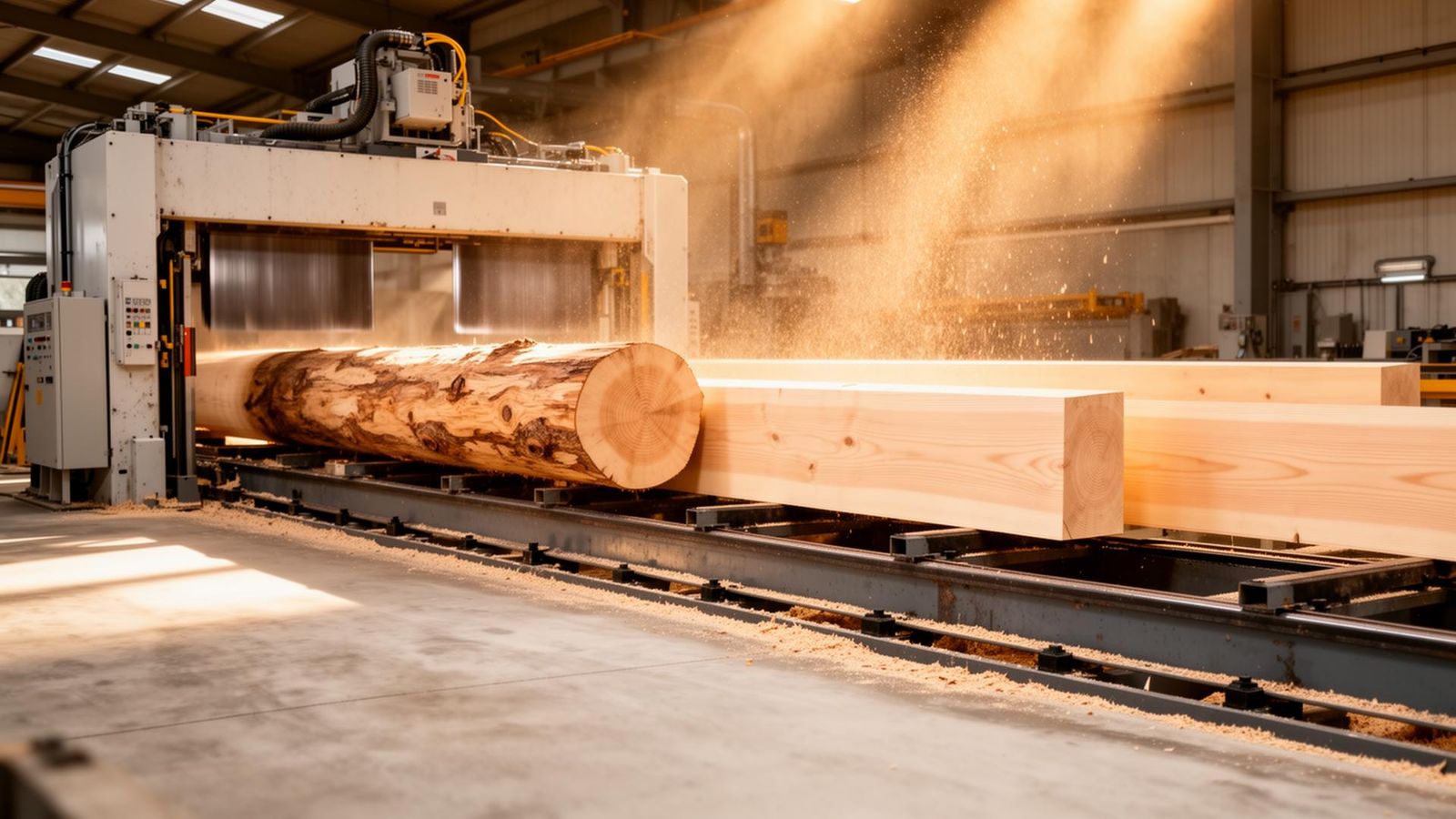
    Pine log being broken down on a sawmill twin band-saw with fresh pale cants emerging
    Sawmilling

    Primary breakdown into framing, scantlings & pallet stock.

    Modern softwood sawmills run head rigs at high feed speeds, breaking pine logs down into cants and resawing into dimensional lumber. Radiata recovery 45–58%, Scots pine 48–62%, with chip and sawdust routing to pulp and panel mills, total wood utilisation exceeds 90%.

    Engineered Wood

    Pine fibre feeds the panel industry.

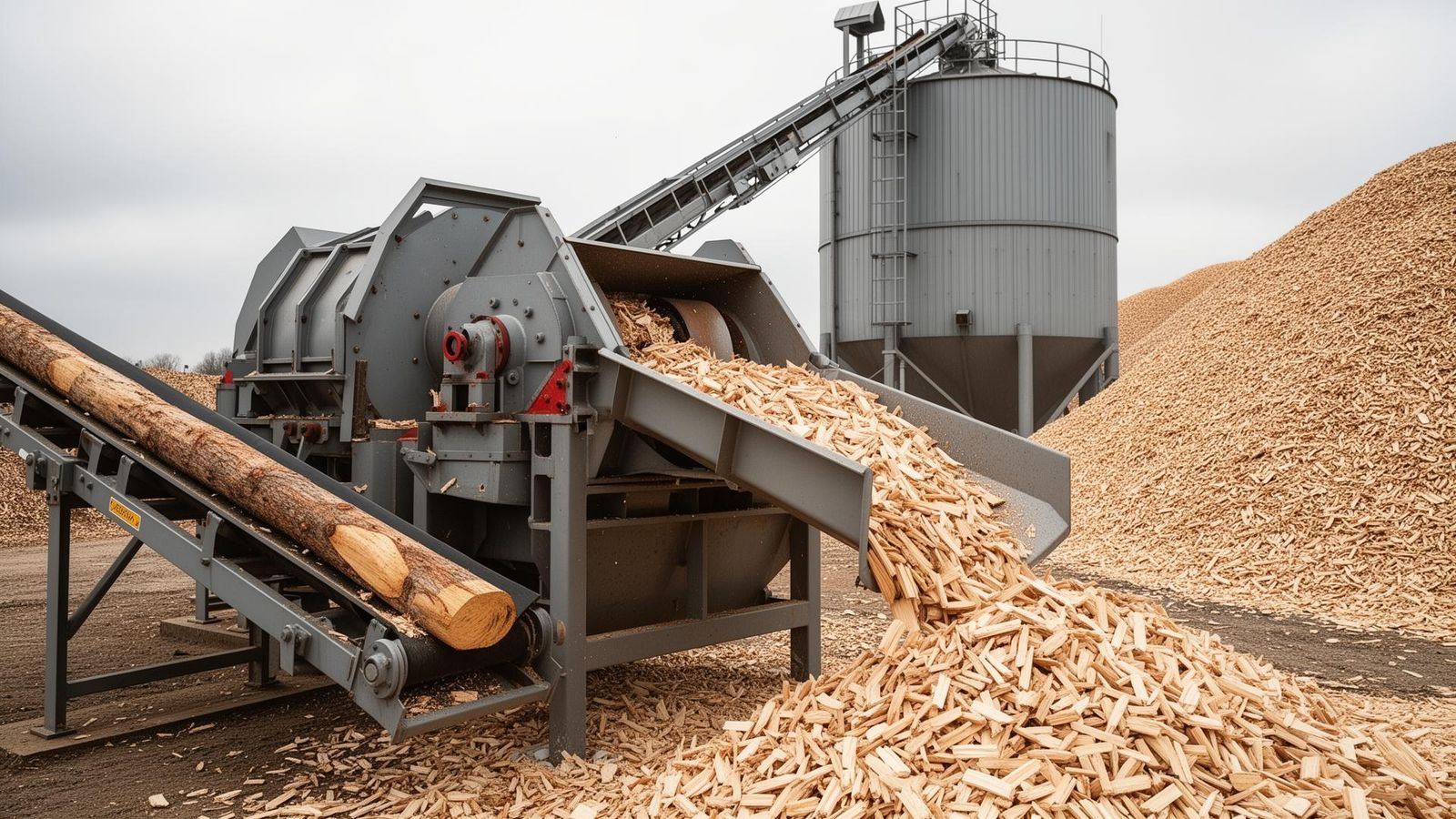
    Pulp-grade and lower-quality logs feed MDF, particleboard and OSB plants worldwide. Consistent pine fibre delivers predictable panel density, colour and machining, the reason pine dominates engineered wood feedstock.

    • MDF & HDF furnish, pine fibre for furniture and joinery panels.
    • Particleboard & OSB, pine flakes and chips for structural panels.
    • Plywood & LVL, rotary-peeled radiata veneer.
    • Pulp & paper, kraft pulp, fluff pulp and packaging fibre.
    Industrial wood chipper feeding pine pulpwood into a conveyor for MDF and OSB furnish production
    Bulk pine log carrier loading at an export wharf at blue hour with crane lifting bundled logs
    Shipping & Logistics

    Bulk carrier, break-bulk, open-top container.

    • Bulk carrier: dominant mode for NZ/Chile-to-GCC, 25,000–60,000 m³ per vessel, 5–10 day discharge at Jebel Ali, Hamriyah, Sohar or Dammam.
    • Break-bulk: 5,000–15,000 m³ general cargo shipments via Liner services for smaller programmes.
    • Container: 20'/40' open-top containers for niche or specialty shipments, ~22–26 m³ per 40' OT.
    • Lead time: NZ/Chile 40–55 days; Brazil 45–55 days; Scots pine from Northern Europe 25–35 days.
    • Discharge supervision: independent tally surveyor (SGS, BV, TUV) at port of discharge, with quantity reconciliation and damage protest where applicable.
    • Phytosanitary handling: fumigation, heat treatment or kiln drying coordinated at origin per destination requirements.
    Inspection Checklist

    Ten checks before the vessel sails.

    • Species verification against shipping documents (botanical name + trade name)
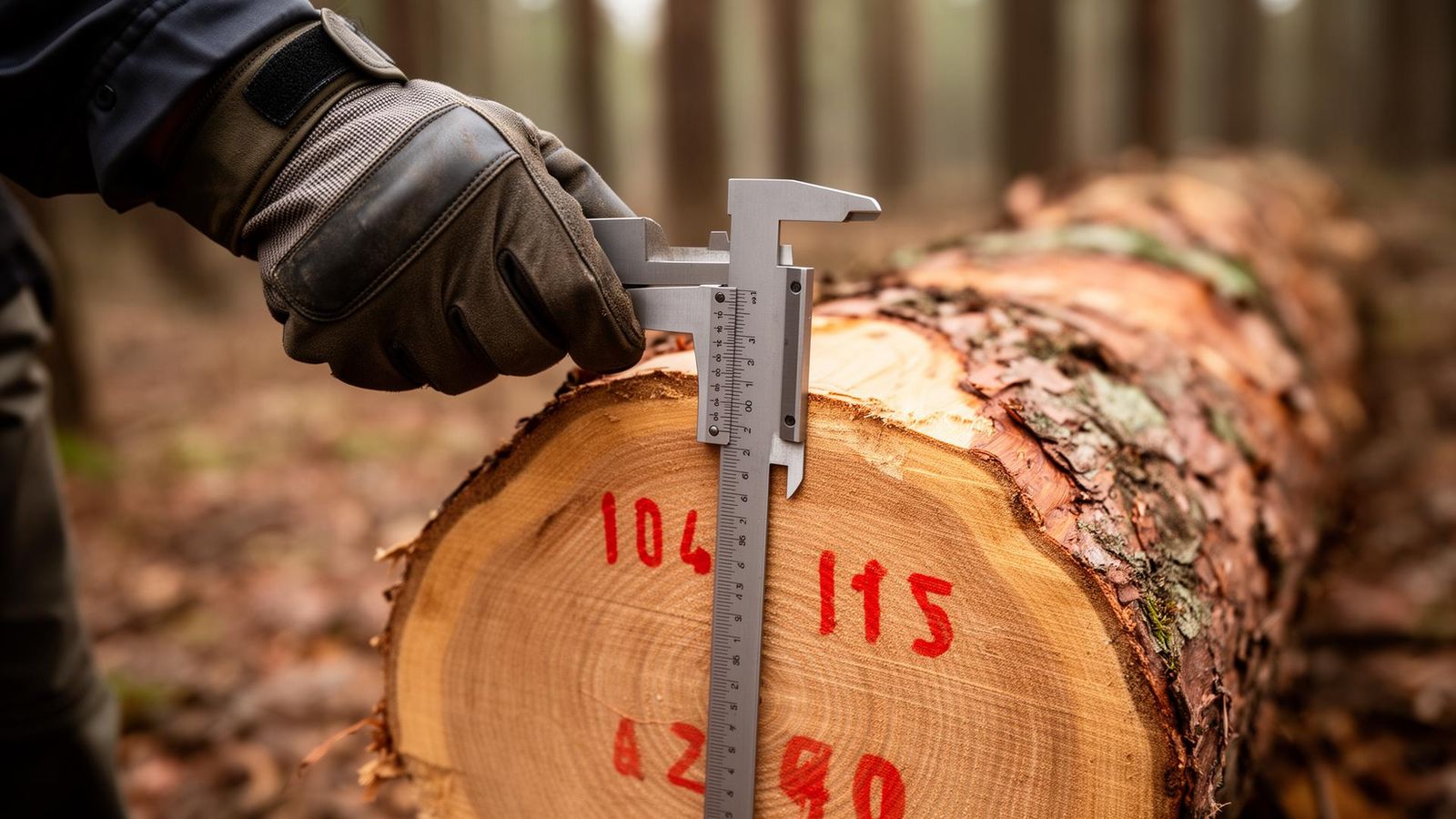
    • Small-end diameter measurement on a statistically valid log sample
    • Length verification against contract specification (±5 cm tolerance)
    • Grade classification against the contract grading rules (NZ KIS/KI/A or EU ABC)
    • Quantity reconciliation by tally count and JAS-m³ or Smalian volume
    • Defect classification: sweep, taper, ovality, ring shake, end checks, decay, insect activity
    • Phytosanitary certificate, certificate of origin and tally documents complete
    • FSC® / PEFC chain-of-custody documentation (where applicable)
    • Fumigation / heat-treatment certificate where destination requires it
    • Vessel hold or container loading photographs and seal numbers
    Forestry inspector using a steel diameter caliper on the small end of a freshly cut pine log
    Origin Spotlight

    New Zealand: the global radiata powerhouse.

    1.7 million hectares of plantation forest, 90% Pinus radiata, 18–22 million m³ of log exports annually. Port of Tauranga is the largest log export port globally; a single vessel moves 40,000–60,000 m³ to Jebel Ali in 40–55 days. Over 60% of the plantation estate is FSC® or PEFC certified.

    Chile, Brazil and Uruguay provide origin diversification for buyers spreading risk across multiple plantation belts. Scots pine from Russia, the Baltics, Finland, Sweden and Germany ships in faster (25–35 days) at a slight premium.

    New Zealand pine log export terminal at blue hour with snow-capped Southern Alps in the background and stacks of radiata pine sawlogs
    Procurement Guide

    Eight RFQ lines that get the right offer back.

    • 01Confirm species (Pinus radiata / Pinus sylvestris / Pinus taeda) on the RFQ.
    • 02State grade reference (NZ KIS, NZ A/P, EU ABC) and SED band (e.g. 25–30 cm).
    • 03Specify length distribution and tolerance.
    • 04State volume method: JAS-m³ or Smalian, drives the chargeable quantity.
    • 05Confirm FSC® / PEFC certification requirement.
    • 06Request load-port inspection (SGS, Bureau Veritas, TUV or NZ-licensed graders).
    • 07Confirm discharge port (Jebel Ali, Hamriyah, Sohar, Dammam, Umm Qasr) and clearing agent.
    • 08Lock incoterms (FOB / CFR / CIF) and payment terms (LC, DP, advance).
    Regional Supply Coverage

    Hardwoods across the GCC and Middle East

    African and North American hardwoods for premium architectural projects.

    Shipments routed through Jebel Ali, Khalifa, Hamad, King Abdulaziz Dammam, Sohar and other major regional ports, coordinated with contractor and procurement schedules.

    Sapele, Iroko, Meranti, White Oak, American Walnut, Ash and other premium hardwoods are supplied (kiln-dried, graded and packed) for joinery workshops, luxury fit-out contractors, hotel developers and yacht builders across the UAE, KSA, Qatar and the wider GCC.

    United Arab Emirates
    • Dubai
    • Abu Dhabi
    • Sharjah
    • Ajman
    • Ras Al Khaimah
    • Fujairah
    • Umm Al Quwain
    • Al Ain
    • Khor Fakkan
    Saudi Arabia
    • Riyadh
    • Jeddah
    • Dammam
    • Al Khobar
    • Jubail
    • Yanbu
    • Mecca
    • Medina
    • Tabuk
    • Abha
    UAE Industrial Zones
    • JAFZA
    • DIP
    • Dubai Industrial City
    • Sharjah Industrial Area
    • KIZAD
    • Hamriyah Free Zone
    • RAKEZ
    • SAIF Zone
    Qatar · Kuwait · Bahrain · Oman
    • Doha
    • Lusail
    • Al Rayyan
    • Mesaieed
    • Al Wakrah
    • Kuwait City
    • Shuwaikh
    • Shuaiba
    • Ahmadi
    • Manama
    • Muharraq
    • Riffa
    • Sitra
    • Muscat
    • Sohar
    • Salalah
    • Duqm
    • Nizwa
    Jordan · Iraq
    • Amman
    • Zarqa
    • Irbid
    • Aqaba
    • Baghdad
    • Erbil
    • Basra
    • Mosul
    • Najaf
    • Karbala
    • Sulaymaniyah
    • Kirkuk
    Regional Ports & Logistics
    • Jebel Ali Port
    • Khalifa Port
    • Hamriyah Port
    • Port Rashid
    • Khor Fakkan Port
    • King Abdulaziz Port Dammam
    • Jeddah Islamic Port
    • King Abdullah Port
    • Jubail Commercial Port
    • Yanbu Commercial Port
    • Hamad Port
    • Shuwaikh Port
    • Shuaiba Port
    • Khalifa Bin Salman Port
    • Port of Sohar
    • Port of Salalah
    • Port of Duqm
    • Port of Aqaba
    • Umm Qasr Port
    • Khor Al Zubair Port
    Frequently Asked Questions

    Pine log questions, answered.

    What are pine logs?

    Pine logs are debarked, cross-cut sections of pine tree trunks (genus Pinus) supplied in round form for sawmilling, peeling, chipping and engineered wood production. Plantation-grown radiata pine (Pinus radiata) and Northern European Scots pine (Pinus sylvestris) are the dominant traded species globally.

    Which species do you supply?

    Radiata pine (Pinus radiata) from New Zealand, Chile, Brazil, Uruguay and Australia; Scots pine (Pinus sylvestris) from Russia, the Baltics, Finland, Sweden, Poland and Germany; loblolly pine (Pinus taeda) from Brazil; and Caribbean pine from tropical plantations on request.

    What is the difference between radiata pine and Scots pine?

    Radiata is a fast-grown plantation softwood (25–30 year rotation, 480–520 kg/m³) with exceptional treatability and a pale honey heartwood, used worldwide for sawmilling, plywood and pressure-treated timber. Scots pine is slower-grown (60–100 year rotation, 510–560 kg/m³), denser, more naturally durable, with reddish heartwood, preferred for high-spec joinery and fenestration.

    What grades are available?

    Five tiers in the NZ system: A/P (Pruned clears) for peeler veneer, K/KI (Knotty Industrial) for mid-grade peeler/sawmill, KIS (Knotty Industrial Sawlog) for primary sawmilling, S (Structural Sawlog) for structural lumber, and Pulp for chip/MDF/OSB. European grades follow ABC sawlog and D pulp conventions.

    What log diameters do you supply?

    Small-end diameters from 14 cm to 40+ cm in defined bands. Sawmill grades typically run 20–35 cm SED; peeler and high-grade joinery logs run 40+ cm. Contracts specify either a single band or a defined distribution (e.g. 20% 20–25 cm, 50% 25–30 cm, 30% 30–35 cm).

    What lengths are available?

    Standard lengths 2.4 m, 3.0 m, 3.6 m, 4.0 m, 5.0 m and 6.0 m. Length tolerance ±5 cm typical, ±10 cm for break-bulk programmes.

    What volume calculation method do you use?

    JAS-m³ (Japanese Agricultural Standard, the New Zealand export standard: V = SED² × π × L / 40,000) is the dominant method. Smalian's formula (V = (Asmall + Alarge) / 2 × L) is also used. The contract specifies which method applies.

    Can you supply FSC certified pine logs?

    Yes, FSC® and PEFC certification is available across NZ, Chile, Brazil and European origins. EUDR (EU Deforestation Regulation) due-diligence statements supplied where required.

    Do pine logs need ISPM-15 heat treatment?

    Round pine logs are typically not ISPM-15 heat-treated; ISPM-15 applies to wood packaging materials, not round timber. Phytosanitary certification at origin covers pest and disease risk for log shipments. Some destinations require methyl bromide fumigation or HT, confirm with your clearing agent per shipment.

    Can you supply mixed-grade log parcels?

    Yes. Most sawmill programmes purchase mixed-grade parcels (sawlog + industrial + pulp) to optimise log yield and run economics. We coordinate origin, grading, length mix and shipping.

    Which ports do you ship pine logs to?

    Pine logs typically discharge at Jebel Ali (Dubai), Hamriyah (Sharjah), Khorfakkan, Sohar and Salalah (Oman), Dammam and Jeddah (KSA), Hamad (Qatar), Shuwaikh and Shuaiba (Kuwait), Khalifa Bin Salman (Bahrain), and Umm Qasr (Iraq) for onward distribution.

    What lead time should I plan for?

    Bulk carriers from New Zealand 40–55 days, Chile 45–60 days, Brazil 45–55 days, Northern Europe 25–35 days. Add 10–14 days for production lock-in and load-port inspection coordination.

    How much volume can a bulk carrier move?

    A typical NZ-to-Dubai bulk carrier moves 25,000–60,000 m³ per voyage, discharging at Jebel Ali, Hamriyah or Sohar over 5–10 days. Smaller break-bulk shipments range 5,000–15,000 m³.

    Do you provide third-party inspection?

    Yes. SGS, Bureau Veritas, TUV and NZ-licensed log graders coordinate species verification, SED measurement, length verification, grade classification, quantity reconciliation, defect classification and vessel hold supervision at the load port.

    What is the recovery from pine logs at the sawmill?

    Radiata pine to dimensional lumber: 45–58% by volume. Scots pine: 48–62%. Chip and sawdust route to pulp, MDF or biomass, lifting total wood utilisation above 90%.

    Can pine logs be pressure-treated?

    Yes, pine has exceptional permeability, especially radiata sapwood. CCA, ACQ, MCA and copper-azole systems lift durability from class 4–5 (untreated) to class 1 (H4–H5 ground-contact). Treatment is performed on sawn lumber, not round logs.

    What documentation accompanies a pine log shipment?

    Original Bill of Lading (or Mate's Receipt for break-bulk), commercial invoice, packing list with log tally, certificate of origin, phytosanitary certificate, fumigation/HT certificate where required, inspection report, species verification and FSC®/PEFC chain-of-custody documentation where applicable.

    Which origin is the cheapest for GCC delivery?

    Bulk carrier economics typically favour New Zealand and Chile to GCC discharge. Brazil is comparable. Scots pine via container/break-bulk from Northern Europe carries faster transit but per-cubic-metre freight is higher. Best-value origin depends on quantity, lead time and grade mix.

    Can I order radiata pine and Scots pine in one shipment?

    Different origin, different vessel, generally no. We can stagger shipments from each origin to arrive close together at your discharge port and consolidate at your yard.

    What payment terms do you accept?

    Letter of Credit at sight, Documents against Payment (DP), advance payment, and open-account for established repeat buyers. We work with project bankers across the UAE, Saudi Arabia and GCC to structure terms that fit your treasury policy.

    Are pine logs the same as pine lumber?

    No. Pine logs are round, debarked sections of trunk timber sold to a sawmill. Pine lumber is the dressed, dimensional product (2×4, 4×4, scantlings, boards) sawn from the log. Buying logs gives the destination sawmill control over the cut pattern and yield.

    Can you supply pine peeler logs for plywood mills?

    Yes. A/P (pruned) and large-diameter K/KI logs are supplied as peeler stock to plywood and LVL mills, in 40+ cm SED with low taper and controlled knot specification.

    Why source through TIC Dubai?

    Origin-direct from NZ, Chile, Brazil and European exporters through a single counterparty in Dubai. Documentation, banking, port clearance, third-party inspection, vessel scheduling and after-sales claims handled in one workflow, in your timezone, in English and Arabic.

    Knowledge & Resources

    Technical reading on pine logs.

    Species, grading, dimensions, treatment, recovery and origin-by-origin supply notes, the operational reference for sawmill and panel-mill procurement teams across the GCC.

    All articles
    Pine log enquiries

    Get a pine log offer this week.

    Tell us species, grades, SED bands, length mix, volume, certification and discharge port. TIC Dubai will revert with a fully landed offer, origin options, vessel scheduling and load-port inspection coordinated.