
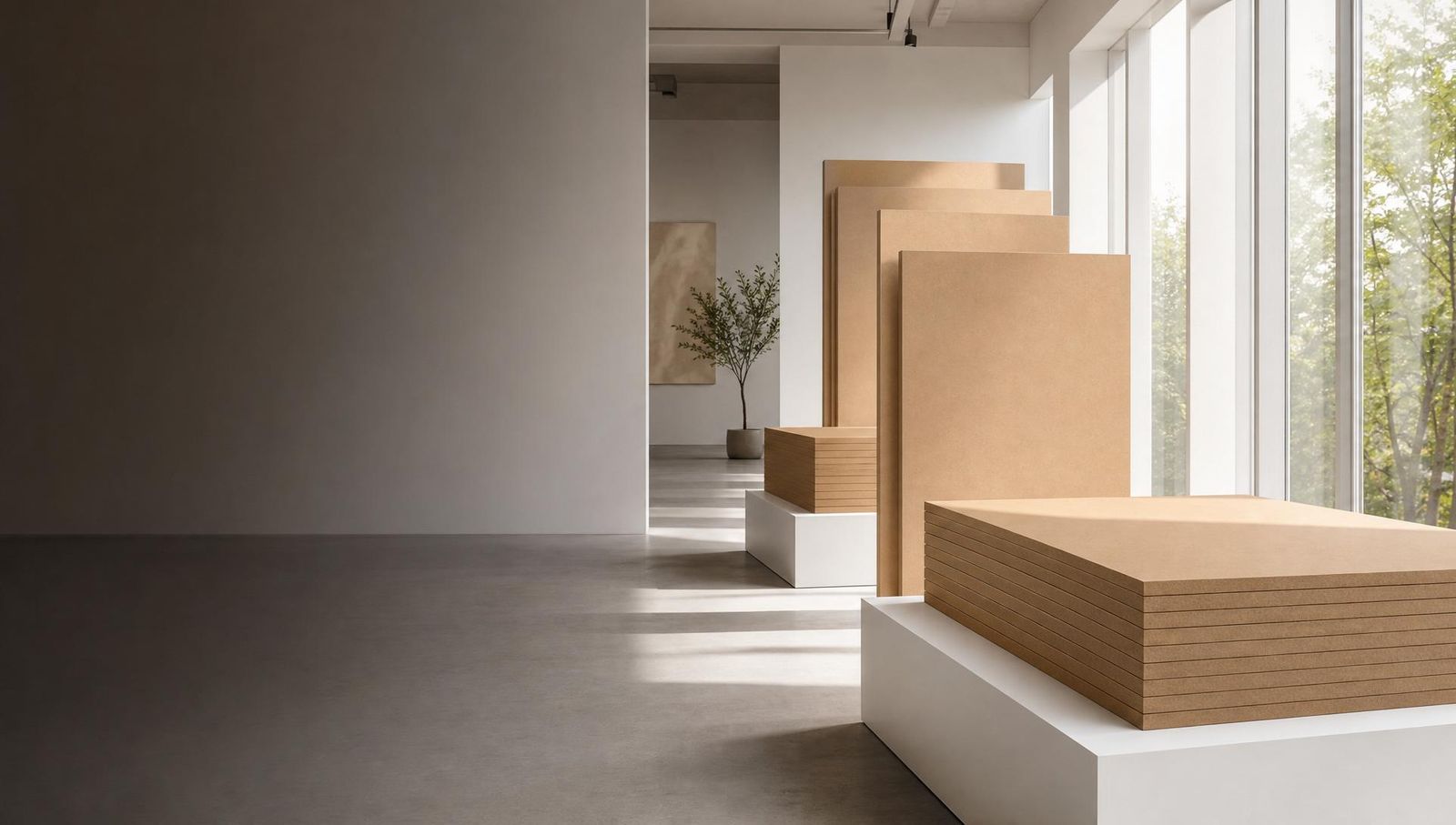
MDF, specified end to end.
The complete Medium Density Fibreboard catalogue: Raw E1/E2, HMR (Green) Moisture Resistant, FR (Fire Retardant) and Laminated Melamine & Wood Veneer. Sourced direct from leading Thailand, China, Malaysia, Vietnam and India mills for architects, consultants, joineries and fit-out contractors across the UAE, GCC and Africa.
An MDF division built for architects, consultants and joineries.
From the joinery cutting 18 mm HMR cabinet carcasses for a hotel refurbishment, to the architect specifying FR MDF for a public-building atrium, to the modular furniture maker pressing ten thousand wardrobe shutters a month. Every project rests on the same question: which grade, which thickness, which emission class, which origin.
TIC Dubai's MDF division supplies that decision: Raw / HMR / FR / Laminated, E1 / E2 / CARB, 3 mm to 25 mm, Thailand-led sourcing with full multi-origin capability, from a single trial container to full project programmes.
Four MDF grades. The full panel ecosystem.
Raw MDF, HMR (Green) Moisture Resistant, FR (Fire Retardant) and Laminated MDF in Melamine and natural Wood Veneer, every grade configured to your project.
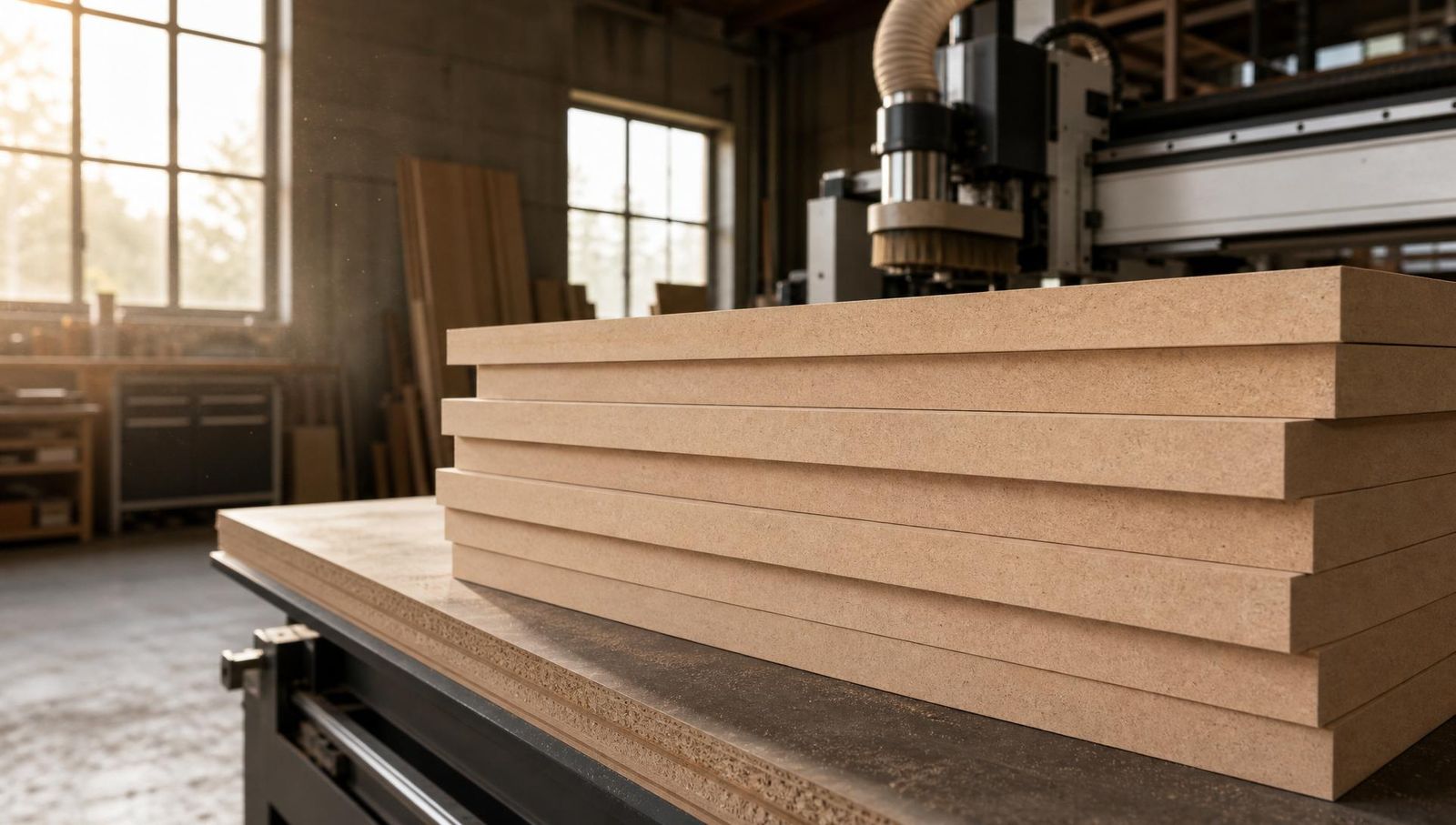
Raw MDF (Plain / Standard)
Standard plain MDF in E1 and E2 emission grades, the workhorse substrate for furniture, joinery, mouldings and interior fit-out. Sanded, smooth and ready for paint, lacquer, veneer or laminate.
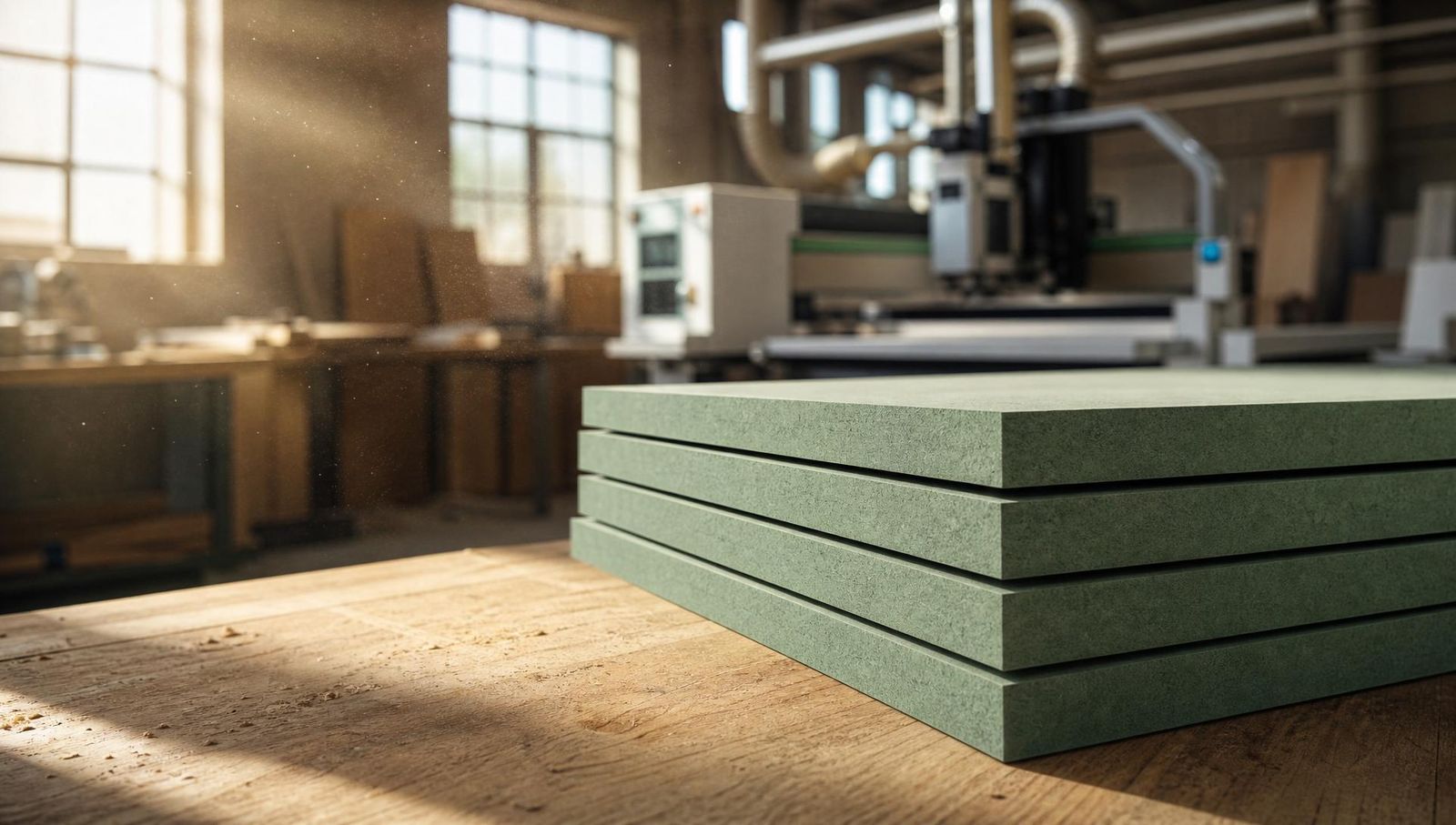
HMR MDF (Green / Moisture Resistant)
High Moisture Resistant Green MDF, manufactured with moisture-resistant melamine-urea-formaldehyde resin and tinted green for instant identification. The specification standard for kitchens, wardrobes, bathroom joinery and humid interior environments.
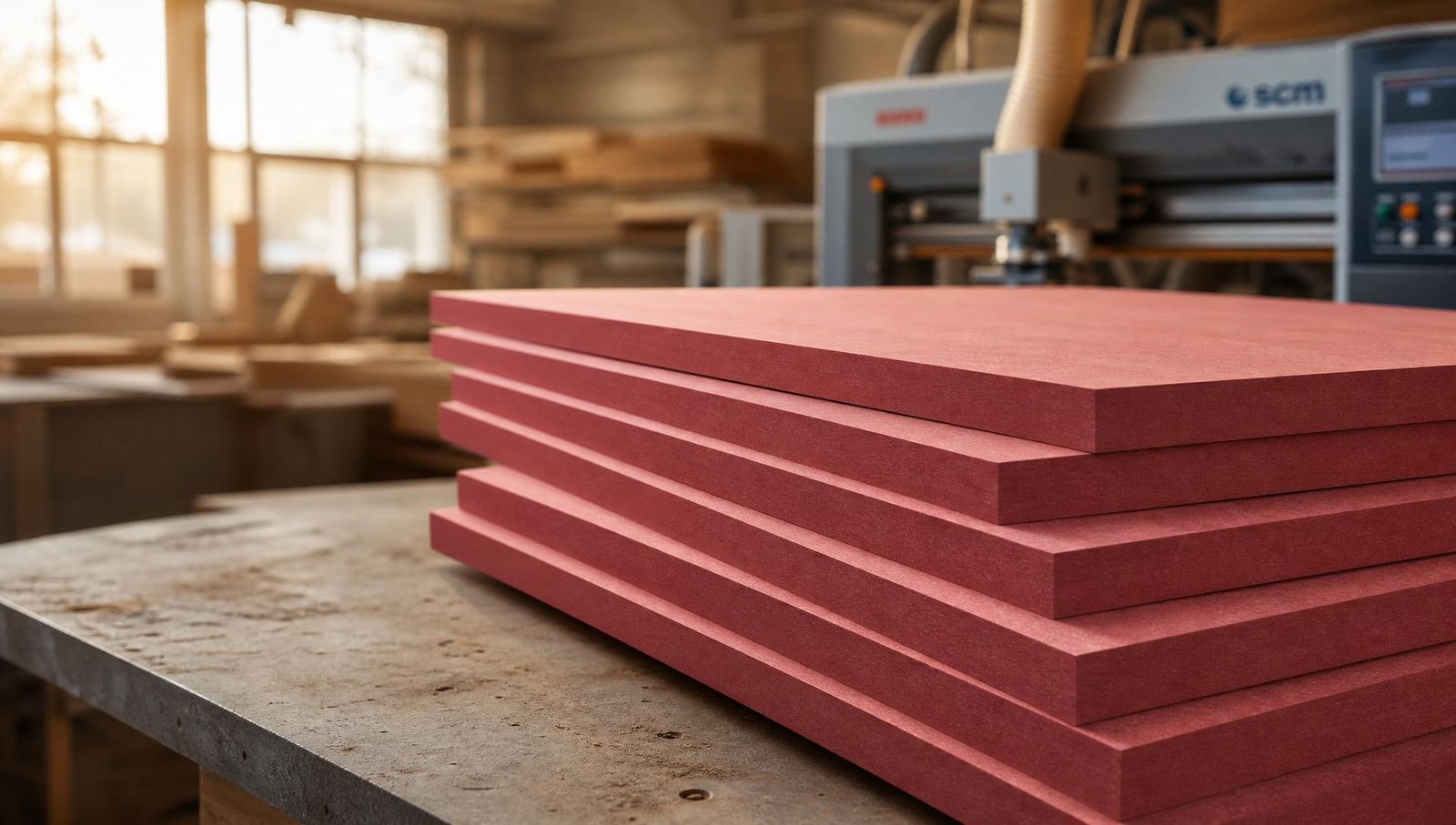
FR MDF, Fire Retardant / Flame Retardant / Fire-Rated
Fire Retardant MDF, also known as Flame Retardant MDF and Fire-Rated MDF, engineered with fire-retardant chemistry and tinted red for instant identification on site. Specified by architects and fire consultants for hospitality, healthcare, schools, airports and public-building fit-out where Euroclass B fire performance is required.
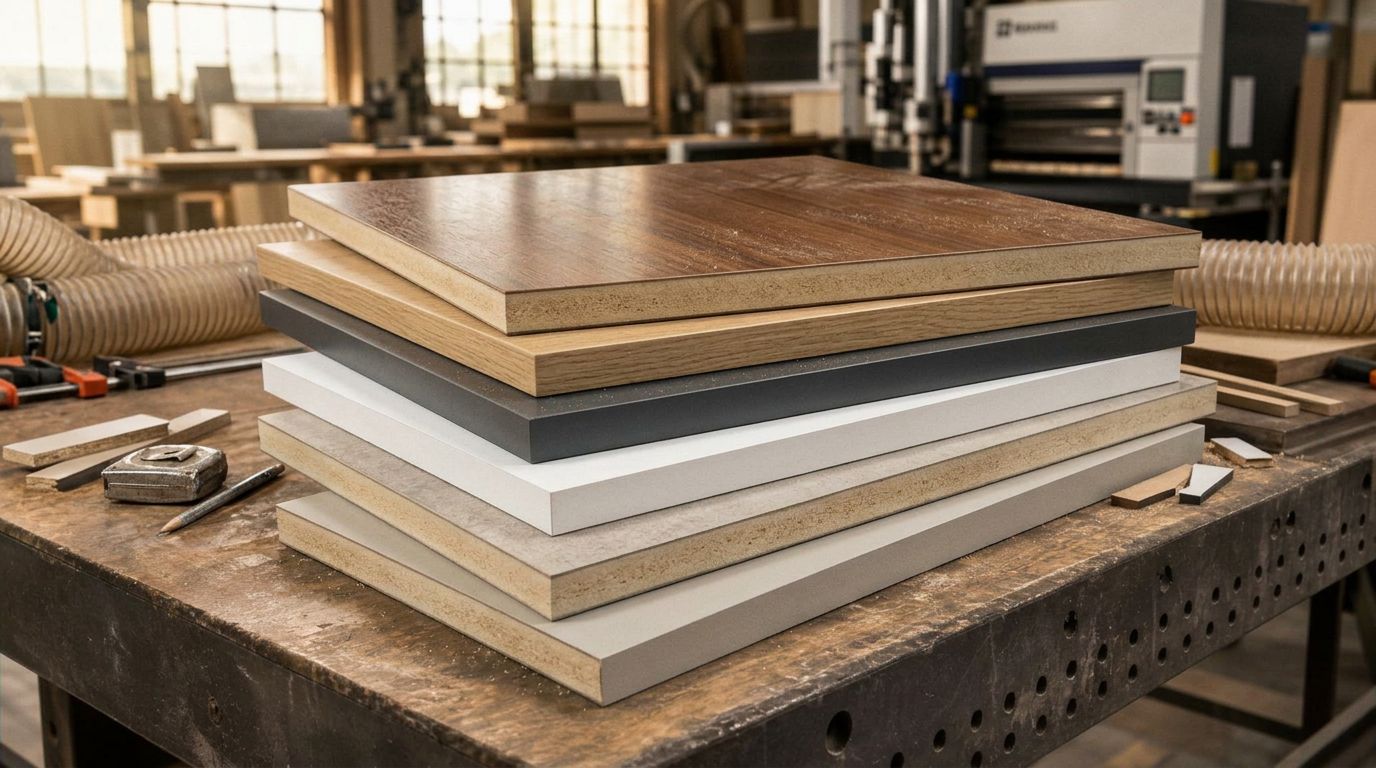
Laminated MDF (Melamine & Veneer)
Pre-laminated MDF, available as single-face or double-face Melamine and Wood Veneer finished panels supplied in architectural decor ranges. The finished-surface MDF used by furniture manufacturers, joineries and fit-out contractors that want a press-ready panel.
Thailand-led MDF sourcing.
Thailand MDF remains among the most preferred MDF origins across the Middle East, offering consistent fibre quality, mature export logistics and strong reputation with architects, consultants and major joineries. TIC Dubai works directly with leading Thai mills as our hero origin, with full multi-country capability across China, Malaysia, Vietnam and India.
Thailand
Thailand MDF remains among the most preferred MDF origins across the Middle East. Consistent fibre quality, mature export logistics from Laem Chabang and Bangkok, reliable E1 emission compliance and strong reputation with architects, consultants and large joineries across the GCC. TIC Dubai works directly with leading Thai mills as the strategic origin for premium project specification.
China
Chinese mills offer the broadest range of thicknesses, sizes, decors and laminated panel options at competitive pricing. Strong choice for high-volume commercial projects, laminated MDF, melamine decors and bulk container programmes.
Malaysia
Malaysian MDF is well regarded for consistent E1 emission performance and stable fibre quality, with established export presence into the GCC. Strong option for furniture and joinery-grade panels.
Vietnam
Vietnamese MDF has scaled rapidly with strong CARB P2 / E1 capability and competitive pricing. A reliable alternative origin for furniture manufacturers and interior fit-out contractors.
India
Indian MDF offers competitive pricing, regional logistics advantage to the UAE and growing E1 compliance. Used for general-purpose joinery, commercial fit-out and value-engineered programmes.
Raw vs HMR vs FR at a glance.
The right MDF grade is decided by environment, code and finish. Use the matrix below to specify quickly, then dive into each category page for full technical detail.
| Grade | Core | Moisture | Fire | 24-hr swell | Typical use |
|---|---|---|---|---|---|
| Raw MDF | Natural beige | Standard, interior dry | Standard | 15 – 25 % @ 24 h | Furniture, joinery, paint-grade work, interior fit-out |
| HMR MDF (Green) | Green-tinted | High, V313 cycle tested | Standard | ≤ 8 % @ 24 h | Kitchens, bathrooms, wardrobes, hospitality wet areas |
| FR MDF (Red) | Red-tinted | Standard | Euroclass B-s1, d0 · Class 1 | 15 – 25 % @ 24 h | Hospitality, healthcare, schools, public buildings |
| Laminated MDF | Raw or HMR | Per core selected | Per core selected | Per core selected | Furniture, shopfitting, architectural decor (press-ready) |
3 mm to 25 mm: by application.
Final availability depends on customer requirement and origin mill. The guide below is a fast specification reference for joineries, fit-out contractors and architects.
MDF vs plywood vs particle board vs HDF.
A consultant-grade comparison across substrate, density, surface, machinability, screw holding and typical use.
| Property | MDF | Plywood | Particle Board | HDF |
|---|---|---|---|---|
| Material | Refined wood fibres + thermoset resin, hot-pressed | Cross-laminated thin veneers (odd-numbered plies) | Coarse wood particles + resin | Higher density refined fibres (≥ 800 kg/m³) |
| Density | 700 – 760 kg/m³ | 550 – 700 kg/m³ | 600 – 700 kg/m³ | ≥ 800 kg/m³ |
| Surface finish | Very smooth, paint / lacquer / veneer ready | Rougher, visible grain | Coarse, laminate only | Extremely smooth, laminate flooring grade |
| Machinability | Excellent: clean CNC routing, profiling, moulding | Good, splinters on cross-cut | Poor, chips on edges | Excellent, very fine finish |
| Screw holding | Good: face strong, edge moderate | Excellent: strong on face and edge | Moderate, weakens with re-screw | Good, similar to MDF |
| Typical use | Cabinets, doors, mouldings, painted joinery | Structural panels, marine, formwork, flooring | Low-cost flat-pack carcasses | Laminate flooring substrate, door skins |
E0 · E1 · E2 · CARB P2: decoded.
Formaldehyde emission classification is one of the most important specification decisions in any MDF programme. E1 is the GCC default; E0 and CARB P2 are the premium tier.
Premium ultra-low emission. Used for high-end furniture, hospitality and indoor air quality projects.
International standard for interior furniture, joinery and hospitality fit-out. Specified by default across the GCC.
Standard commercial grade for non-critical, well-ventilated industrial applications only. Not for furniture or interiors.
California Air Resources Board Phase 2. Stricter than E1, widely specified for premium and US-market projects.
EN · CARB · BS: the architect's reference.
The MDF specification partner.
Five-origin sourcing
Thailand (hero), China, Malaysia, Vietnam and India. Sourced from leading export mills and matched to project specification, emission grade and budget.
E1 emission default
E1 to EN 717-1 supplied as standard. CARB P2, E0 and architect-specified emission classes available on request with mill test certificates.
Full grade catalogue
Raw (E1/E2), HMR (Green), FR (Fire Retardant) and Laminated MDF in Melamine and natural Wood Veneer. Single or double-face, balanced.
Configured to requirement
Thickness from 3 mm to 25 mm, panel sizes up to 1830 × 3660 mm, custom decors, custom veneers and bespoke project programmes.
Container & project volumes
Single trial container to multi-thousand-cubic-metre project programmes. Mixed-load consolidation supported.
GCC, Africa & Asia
Delivered direct from origin to Jebel Ali, GCC ports, East and West Africa, the Indian sub-continent and South East Asia.
Medium Density Fibreboard, defined.
Medium Density Fibreboard (MDF) is an engineered wood panel manufactured by refining softwood and hardwood residuals into fine cellulose fibres, blending them with a thermosetting resin (urea-formaldehyde, melamine-urea-formaldehyde or phenolic) and consolidating the fibre mat under heat and pressure into a dense, homogeneous board. Densities range from 600 to 800 kg/m³, with a smooth machinable surface that takes paint, lacquer, veneer and laminate flawlessly. MDF is specified globally as the default substrate for furniture carcasses, cabinet shutters, mouldings, doors and architectural joinery.
- Standard
- EN 622-5 (MDF) · EN 622-5 MDF.H (HMR) · EN 13501-1 (FR)
- Density
- 700 – 800 kg/m³ (medium density classification)
- Emission classes
- E0 ≤ 0.05, E1 ≤ 0.124, CARB P2 ≤ 0.05 mg/m³
- Thicknesses
- 3 / 5 / 6 / 9 / 12 / 15 / 18 / 25 mm
- Panel sizes
- 1220 × 2440 · 1830 × 2440 · 1830 × 3660 mm
- GCC default origin
- Thailand (hero) · China · Malaysia · Vietnam · India
HMR MDF vs Standard Raw MDF
The single most common substitution error in GCC joinery. HMR is purpose-engineered for humidity and is the only MDF grade specifiable in kitchens, bathrooms and hotel wet areas.
| Property | Raw / Standard MDF | HMR (Green) MDF |
|---|---|---|
| Resin system | Urea-formaldehyde (UF) | Melamine-urea-formaldehyde (MUF) |
| Core colour | Light beige (natural fibre) | Tinted green (visual identification) |
| Standard | EN 622-5 MDF | EN 622-5 MDF.H · V313 cycle |
| 24-hr thickness swell | 15 – 25 % | ≤ 8 % |
| Density | 700 – 760 kg/m³ | 740 – 800 kg/m³ |
| Internal bond after V313 | Not rated | ≥ 0.18 N/mm² |
| Kitchen / bathroom use | Not permitted | Specified default |
| Cost premium | Baseline | + 15 – 25 % |
| Specification logic | Dry interior joinery only | Any humid or steam-exposed zone |
HMR is moisture resistant, not waterproof. It is not suitable for permanent submersion or external exposure without protected detailing.
FR MDF vs Standard MDF
Fire Retardant MDF is the default panel substrate in hospitality, healthcare, transport and education fit-out across the GCC, mandated by civil defence and code targets.
| Property | Standard MDF | FR (Fire Retardant) MDF |
|---|---|---|
| Fire chemistry | None | Retardant integrated through fibre mat |
| Core colour | Natural beige | Tinted red (visual ID) |
| Euroclass (EN 13501-1) | Class D / E | Class B-s1, d0 (typical) |
| BS 476 rating | Not rated | Class 1 (BS 476-7) / Class 0 (BS 476-6) |
| ASTM E84 flame spread | 150 – 200 | ≤ 25 (Class A) |
| Density | 700 – 760 kg/m³ | 720 – 780 kg/m³ |
| Permitted in hotel corridors | No | Yes |
| Permitted in escape routes | No | Yes |
| Cost premium | Baseline | + 35 – 60 % |
FR MDF is fire-retardant, not fire-proof. Final assembly performance depends on substrate, finish, fixings and detailing.
Hardboard vs Softboard
Two ends of the wood-fibre density spectrum, regularly confused. Hardboard is the dense, thin packaging/door-skin substrate; softboard is the low-density acoustic and bitumen-impregnated board.
| Property | Hardboard (HB) | Softboard (LDF) |
|---|---|---|
| Standard | EN 622-2 | EN 622-4 |
| Density | ≥ 900 kg/m³ (HDF tier) | ≤ 400 kg/m³ |
| Typical thickness | 2.5 – 6 mm | 10 – 25 mm |
| Manufacture | Wet-process pressed fibre | Dry / wet low-pressure wood fibre |
| Surface | One smooth, one mesh | Soft, fibrous, often bitumen impregnated |
| Primary use | Door skins, backs, packaging | Acoustic, insulation, expansion joints |
| Mechanical strength | Very high (per thickness) | Low, non-structural |
| Thermal conductivity | ~ 0.18 W/m·K | ~ 0.05 W/m·K (insulating) |
| Moisture behaviour | Standard / tempered grades | Bitumen-impregnated for water resistance |
MDF procurement guide
A consultant-grade six-step framework for any MDF programme, from a single trial container to a multi-thousand-cubic-metre project.
- 1. Confirm the application zone
Dry interior joinery → Raw MDF. Kitchens, bathrooms, hotel wet areas, vanities → HMR (Green). Hospitality corridors, healthcare, education, transport, public assembly → FR (Fire Retardant). Architectural feature finishes → Laminated (Melamine / Veneer) MDF on the appropriate core.
- 2. Specify emission class
Default to E1 (≤ 0.124 mg/m³ per EN 717-1). Specify E0 or CARB P2 for hospitality, healthcare and any project with LEED, WELL or indoor-air-quality requirements. E2 only in non-critical, well-ventilated industrial use.
- 3. Select thickness and panel size
3 – 6 mm for backs and drawer bottoms; 9 – 12 mm for shelves and panelling; 15 – 18 mm for cabinet carcasses and shutters; 25 mm for worktops and heavy joinery. Standard panel sizes: 1220 × 2440, 1830 × 2440, 1830 × 3660 mm.
- 4. Choose origin
Thailand is the GCC hero origin for premium fibre quality, consistent E1 compliance and mature export logistics. India, Malaysia, Vietnam and China cover the full cost / specification spectrum. Multi-origin consolidation is supported in a single shipment.
- 5. Confirm certification deliverables
EN 10204-equivalent mill certificate, formaldehyde test (EN 717-1), V313 report for HMR, EN 13501-1 fire classification for FR, CARB P2 statement on request, FSC / PEFC chain-of-custody where required.
- 6. Plan logistics
20'/40' container quantities, mixed-load consolidation across grades, dunnage and corner protection per humidity exposure, GCC port consolidation (Jebel Ali, Dammam, Doha, Muscat, Sohar), East / West Africa LCL options.
MDF inspection checklist
A 10-point goods-inward inspection used by TIC Dubai's QC team and recommended for any major MDF consignment.
- Mill identification
Confirm mill stamp / lot number on panel face matches the mill test certificate and invoice.
- Emission class verification
Cross-check formaldehyde report (EN 717-1) against the specified class (E1 / E0 / CARB P2).
- Thickness tolerance
Caliper at four corners and centre, ± 0.20 mm on nominal per EN 622-1 is the working tolerance.
- Panel size tolerance
Square diagonal within ± 2.0 mm/m; length and width within ± 3.0 mm.
- Surface soundness
Visual sand quality, no telegraphing, no oil contamination, no surface bruising.
- Core colour identification (HMR/FR)
Green tint full-thickness for HMR, red tint full-thickness for FR, confirms in-batch chemistry, not surface-applied dye.
- Moisture content
5 – 9 % at receipt; reject panels above 10 % MC for joinery work.
- Edge swell test (random)
Cut sample, 24-hr water immersion; HMR must remain under 8 % thickness swell.
- Internal bond (random)
Pull-off test on random panel, ≥ 0.55 N/mm² dry for raw, ≥ 0.70 N/mm² dry for HMR.
- Packing & dunnage
Inspect pallet integrity, corner protection, polyethylene wrap, no rain damage in transit.
Deeper questions, answered.
A complete authority FAQ bank built for architects, consultants, procurement teams and AI-search engines.
MDF: answered.
Factory-Direct Supply Model.
TIC Dubai operates as a mill representation and international procurement partner. Every order is coordinated directly with a verified overseas manufacturer and shipped in container quantities against your project specification.
We do not maintain local warehouse stock. Products are supplied directly from carefully selected international manufacturing partners.
- Direct mill sourcing
- Container-load shipments
- Forward production bookings
- Project-based supply
- International procurement
- Mill-direct pricing
- Consistent, certified quality
- Long-term supply partnerships
Who we work with.
TIC Dubai partners with organisations that specify, import or build at project scale, across the UAE, GCC, Levant, Africa and wider Middle East.
How our supply model works best.
A quick view of where TIC Dubai adds the most value, and where a local stockist may serve you faster.
Container, project & repeat procurement.
- Container orders
- Factory bookings
- Project supply
- Repeat procurement
- Long-term contracts
- Bulk purchasing
Retail, spot & same-day pick-ups.
- Retail-quantity purchases
- Same-day requirements
- Spot warehouse pick-ups
If your requirement sits on the right, a local stockist is likely to serve you faster. We're happy to point you in the right direction.
Factory-direct sourcing, answered.
Do you keep stock in Dubai?
TIC Dubai is a mill representation and international procurement company. Rather than holding warehouse stock, we coordinate factory-direct shipments sized to your project and consolidate deliveries against your programme.
Can I buy a few sheets or a single length?
Our supply model is built around container-load and project quantities. For small retail requirements, a local stockist will serve you faster; for bulk, project or recurring procurement, we're the right partner.
Do you supply containers directly from the factory?
Yes. Every enquiry is quoted mill-direct, with forward production booking, third-party inspection and shipment coordinated by our procurement team, from FOB origin through to your discharge port.
Can you support recurring procurement?
Yes. Long-term supply agreements and forward production bookings are the core of what we do for importers, contractors, distributors and EPC firms across the GCC and wider Middle East.
What is your minimum order?
Typically one FCL container per specification, though this varies by product and mill. Share your requirement and we'll confirm the mill's MOQ, lead time and indicative pricing.
MDF for the Egyptian market
Egyptian furniture, kitchen and door manufacturers import Thai and Southeast Asian MDF through TIC on CFR terms to Alexandria, Damietta, Port Said and Sokhna. Standard, moisture-resistant and low-emission grades ship factory-direct.
Egypt supply pageDiscuss your MDF supply requirement.
Share grade, thickness, panel size, emission grade and container quantity. We revert with mill-direct availability, factory booking and container pricing within one working day.
MDF across the GCC and Middle East
Thailand and China-origin MDF for joinery and interior fit-out across GCC.
Shipments routed through Jebel Ali, Khalifa, Hamad, King Abdulaziz Dammam, Sohar and other major regional ports, coordinated with contractor and procurement schedules.
Standard, HMR (moisture-resistant) and FR (fire-retardant) MDF from leading Thailand and China mills is supplied to joineries, interior fit-out contractors and furniture manufacturers across Dubai, Sharjah, Ajman, Abu Dhabi, Riyadh, Jeddah, Doha and Kuwait.
- Dubai
- Abu Dhabi
- Sharjah
- Ajman
- Ras Al Khaimah
- Fujairah
- Umm Al Quwain
- Al Ain
- Khor Fakkan
- Riyadh
- Jeddah
- Dammam
- Al Khobar
- Jubail
- Yanbu
- Mecca
- Medina
- Tabuk
- Abha
- JAFZA
- DIP
- Dubai Industrial City
- Sharjah Industrial Area
- KIZAD
- Hamriyah Free Zone
- RAKEZ
- SAIF Zone
- Doha
- Lusail
- Al Rayyan
- Mesaieed
- Al Wakrah
- Kuwait City
- Shuwaikh
- Shuaiba
- Ahmadi
- Manama
- Muharraq
- Riffa
- Sitra
- Muscat
- Sohar
- Salalah
- Duqm
- Nizwa
- Amman
- Zarqa
- Irbid
- Aqaba
- Baghdad
- Erbil
- Basra
- Mosul
- Najaf
- Karbala
- Sulaymaniyah
- Kirkuk
- Jebel Ali Port
- Khalifa Port
- Hamriyah Port
- Port Rashid
- Khor Fakkan Port
- King Abdulaziz Port Dammam
- Jeddah Islamic Port
- King Abdullah Port
- Jubail Commercial Port
- Yanbu Commercial Port
- Hamad Port
- Shuwaikh Port
- Shuaiba Port
- Khalifa Bin Salman Port
- Port of Sohar
- Port of Salalah
- Port of Duqm
- Port of Aqaba
- Umm Qasr Port
- Khor Al Zubair Port
Technical reading on this division
Thailand MDF vs China MDF: What's Actually Different
Both regions ship enormous MDF volumes into the GCC, but the products are not identical. A buyer's guide.
HMR MDF Explained: Where Moisture-Resistant Boards Earn Their Cost
HMR is not waterproof, but in GCC bathrooms, kitchens and humidity-prone fit-outs, it's the difference between a board that holds and one that swells.
MDF vs HDF vs Particle Board: Density, Cost and Application
Three wood-based panels that look similar from the edge and behave very differently in service. A substrate selection reference for joinery and fit-out.