
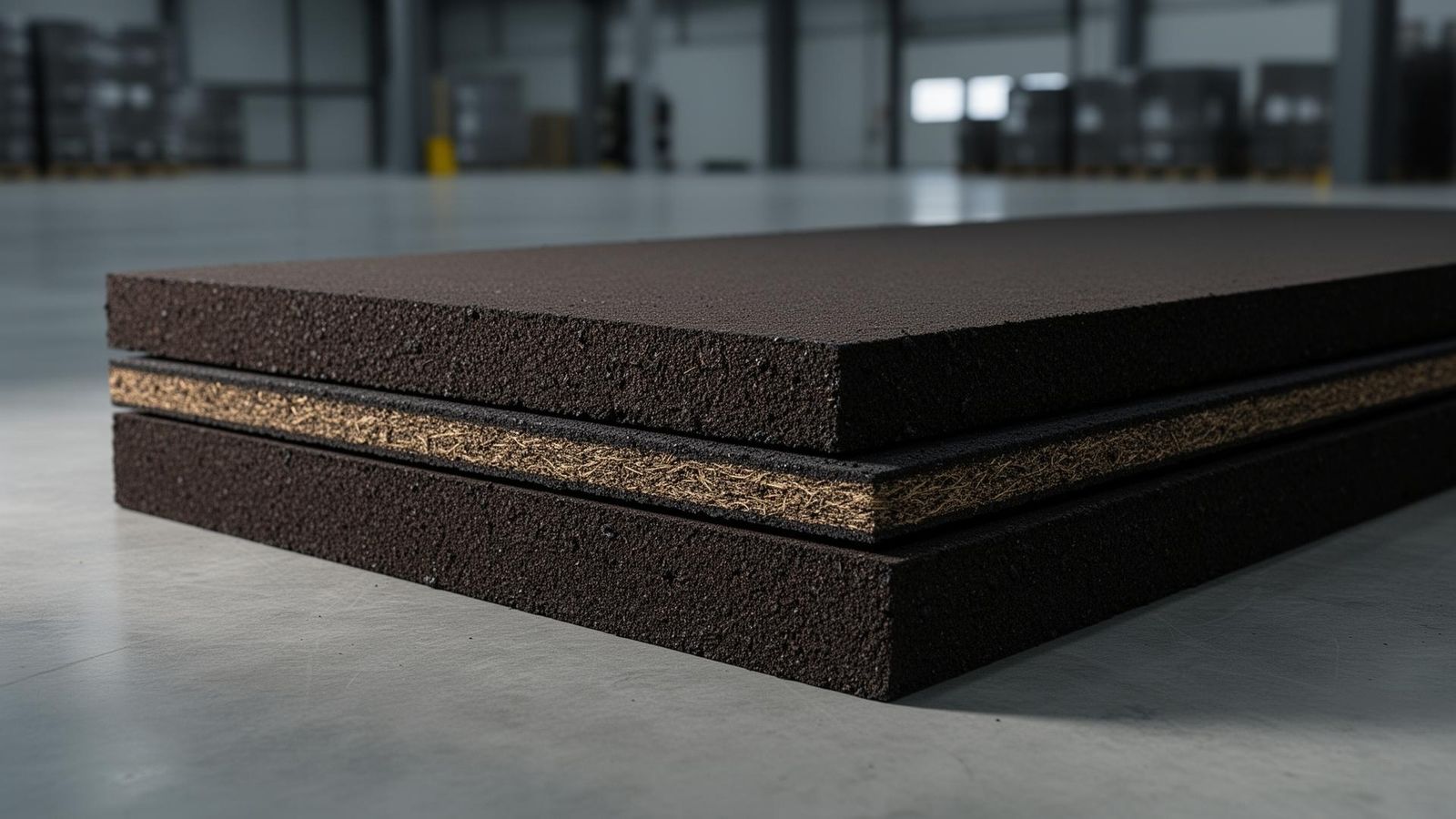
Bitumen Softboard: Expansion Joint Filler Board.
Bitumen impregnated fibreboard expansion joint filler for highways, airports, bridges, industrial floors, concrete pavements and precast structures across the UAE and GCC. ASTM D1751 / D1752 / BS 1142 compliant.
The cost-effective workhorse of concrete expansion joints.
Bitumen softboard, also known as expansion joint filler board, bitumen impregnated fibreboard, joint filler board, bitumen fibre board and bituminous expansion joint board, is a flexible fibreboard core fully impregnated with bitumen. It is the regional standard expansion joint filler for concrete construction, installed before the pour to absorb thermal and structural movement, control cracking and waterproof the joint.
Across the GCC, where extreme thermal cycling between day and night drives significant slab movement, properly specified bitumen softboard is the difference between a clean joint that performs for decades and a slab field that cracks randomly within years.
Why concrete needs expansion joints.
Concrete Expansion
Concrete expands and contracts with temperature and moisture. Without joints, slabs crack uncontrollably. Expansion joint filler accommodates this movement.
Load Transfer
Joints allow adjacent slabs to move independently while maintaining structural integrity under wheel loads, thermal cycling and shrinkage.
Waterproofing
Bitumen impregnation seals the joint against water ingress, protecting reinforcement and sub-base from corrosion and erosion.
Crack Control
Properly spaced expansion joints concentrate movement at planned locations, preventing random cracking across the slab field.
Where bitumen softboard ships.
Engineering-grade compliance.
Density
Typically 280–320 kg/m³, bitumen-impregnated fibrous core.
Bitumen Content
Minimum 35% bitumen impregnation by weight for full waterproofing.
Water Absorption
< 15% by volume after 24-hour immersion (ASTM D545).
Compression Recovery
≥ 70% recovery after 50% compression (ASTM D545).
Extrusion
Minimal extrusion under compression, maintaining joint geometry.
Standards
ASTM D1751 / ASTM D1752 / BS 1142 compliant on request.
From 10 mm to 25 mm.
10 mm
Light-duty internal expansion joints, partition base joints.
12 mm
Standard concrete pavement and industrial floor joints.
15 mm
Heavy-duty industrial floors, precast wall joints.
18 mm
Bridge approach slabs and infrastructure expansion joints.
20 mm
Highway expansion joints, airport runway joints.
25 mm
Wide expansion joints in long concrete pavements and bridges.
- 1220 × 2440 mm (standard sheet)
- 1000 × 2000 mm
- 900 × 1800 mm
- Custom cut-to-size strips for joint widths 50 mm – 600 mm
How bitumen softboard compares with other joint fillers.
| Property | Bitumen Softboard | Cork Filler | Rubber Filler | Foam (PE/PU) Filler |
|---|---|---|---|---|
| Cost Efficiency | High (low unit cost) | Low (premium price) | Medium | High |
| Compressibility | Good (≥ 50%) | Excellent | Excellent | Excellent |
| Compression Recovery | Good (≥ 70%) | Very Good (≥ 85%) | Excellent (≥ 90%) | Fair–Good |
| Water Resistance | Excellent (impregnated) | Good | Excellent | Excellent |
| Long-term Durability | Decades in service | Decades | Decades | Variable, can degrade |
| Installation Complexity | Simple, site-cuttable | Simple | Moderate | Very simple |
| Maintenance | Top sealant refresh only | Top sealant refresh only | Top sealant refresh only | Frequent inspection |
| Suitability by Application | Roads, runways, slabs, infra | Premium architectural, façades | Heavy dynamic / impact loads | Light internal partition joints |
| Engineer Preference (GCC) | Default for infrastructure | Specified for high-end finishes | Specified for dynamic load | Rarely specified for structural |
| Lifecycle (years) | 30–50+ | 30–50+ | 30–50 | 10–20 |
| Sustainability | Recycled fibre core | Renewable cork | Recycled rubber options | Petrochemical |
| Best Fit | Roads, runways, bridges, slabs | Architectural / heritage | Heavy dynamic load joints | Light internal joints |
How consultants and engineers specify joint filler.
Specification Language
Consultants typically specify 'bitumen impregnated fibreboard expansion joint filler complying with ASTM D1751 (or D1752 Type I), thickness as per drawings, supplied with manufacturer's test certificate.' Drawings call out joint width, depth and sealant type separately.
Key Selection Criteria
Joint width, anticipated movement (thermal + shrinkage + creep), exposure (water, fuel, chemicals), traffic category (pedestrian to heavy aircraft), and required compliance standard (ASTM, BS, EN, local authority).
Movement Calculation
Engineers calculate joint movement using slab length × ΔT × coefficient of thermal expansion of concrete (~10×10⁻⁶/°C) plus drying shrinkage. Filler must accommodate the calculated movement at ≤ 50% compression.
Compression & Recovery
Specifications typically require minimum 50% compressibility and minimum 70% recovery per ASTM D545. Bitumen softboard satisfies both with margin for repeated cycling.
Sealant Compatibility
Top 15–25 mm of the joint is reserved for a field-applied sealant (PU, PS or silicone). The filler must remain bitumen-stable so it does not bleed into the sealant interface.
Documentation Required
Mill test certificate referencing ASTM D1751/D1752, batch number, date, thickness, density, bitumen content, water absorption and compression recovery, issued with each shipment.
From storage to sealant: getting the joint right.
Storage on Site
Store flat, off the ground, under cover and away from direct UV and rainfall. Bitumen softens above 60 °C, so avoid stacking under metal sheeting in direct sun. Keep in original packaging until installation.
Joint Preparation
Clean the joint of all dust, laitance, oil and debris. Substrate must be sound and dry. Confirm joint width matches the specified filler thickness within ±2 mm.
Positioning Before Pour
Place the board vertically and flush to formwork. Hold in alignment with steel pins, dowels or temporary timber battens. Top edge must sit 15–25 mm below the finished concrete surface to allow for sealant.
Compression Considerations
Never pre-compress the board during installation. Concrete should not extrude over the top edge. If formwork shifts during pour, replace damaged boards before the concrete sets.
Sealant Integration
After concrete cures, install a closed-cell backer rod above the filler to control sealant depth, then apply the specified PU/PS/silicone sealant. Maintain a 2:1 width-to-depth sealant ratio.
Site Handling
Carry boards on the long edge to prevent flexural damage. Cut with a fine-tooth saw or sharp utility knife on a flat surface. Wear gloves; bitumen can stain skin and clothing.
Common Mistakes
Avoid: (1) installing in waterlogged joints, (2) using the wrong thickness, (3) skipping the backer rod, (4) finishing concrete over the board, (5) leaving the joint un-sealed beyond 7 days.
Field issues, causes, prevention and fixes.
Board Damaged During Pour
Cause: poor handling or formwork pressure. Impact: gap in joint, future cracking. Prevention: handle on edge, secure formwork. Solution: replace damaged section before pour.
Thickness Mismatch
Cause: wrong board thickness vs. joint width. Impact: filler floats or over-compresses. Prevention: verify thickness against drawings. Solution: replace with correct thickness; never stack thinner boards.
Excessive Compression
Cause: undersized joint or premature movement. Impact: bitumen extrusion, loss of recovery. Prevention: design joint to ≤ 50% compression. Solution: cut out and replace; review joint design.
Water Ingress at Joint
Cause: failed sealant or missing backer rod. Impact: corrosion of embedded steel, sub-base erosion. Prevention: full sealant + backer rod system. Solution: rout out failed sealant, replace backer rod and re-seal.
Sealant Separation
Cause: sealant applied without bond breaker. Impact: three-sided adhesion, sealant tears. Prevention: always install backer rod. Solution: remove sealant, install rod, re-seal.
Joint Movement Beyond Design
Cause: under-spaced joints or omitted control joints. Impact: random cracking adjacent to expansion joint. Prevention: design per ACI 224 spacing. Solution: introduce additional sawn control joints.
Incorrect On-Site Storage
Cause: outdoor storage under direct sun. Impact: bitumen bleed, board deformation. Prevention: covered, shaded, off-ground storage. Solution: reject deformed boards before installation.
Board Deformation Before Pour
Cause: prolonged exposure or impact damage. Impact: irregular joint geometry. Prevention: install within days of delivery. Solution: replace deformed sections.
Where bitumen softboard performs across critical infrastructure.
Highways & Roads
Long concrete pavements expand and contract significantly across GCC summer/winter cycles. Bitumen softboard joints every 6–12 m absorb movement, prevent blow-ups and protect the sub-base from water ingress.
Airport Runways
Runway slabs experience high thermal loading and aircraft impact. ASTM D1751-compliant 20–25 mm bitumen softboard is the default expansion joint filler for runways, taxiways and aprons across regional airports.
Bridges & Flyovers
Bridge approach slabs, abutments and deck joints require movement accommodation for thermal expansion, traffic loading and abutment settlement. Bitumen softboard performs alongside specialised bridge expansion devices.
Ports & Container Yards
Heavy container handling demands robust joints. Bitumen softboard absorbs movement under static and dynamic loads at Jebel Ali, Khalifa, Hamad, Sohar and Dammam port pavements.
Industrial Facilities
Factory floors, plant rooms and process areas need joints that resist water, fuel and mild chemical exposure. Bitumen softboard combined with chemical-resistant sealant is the regional default.
Warehouses & Logistics
Large-area warehouse slabs with forklift traffic require expansion joints to control thermal and shrinkage movement. Bitumen softboard delivers low cost over long joint runs.
Water Treatment Plants
Reservoir walls, tank slabs and channel structures use bitumen softboard at construction joints. For potable contact, switch to certified food-grade variants.
Rail Infrastructure
Concrete plinths, station platforms and depot slabs use bitumen softboard joints to manage thermal movement across long structural runs in metro and rail projects.
Practical thickness guidance by application.
10 mm
Use for: light internal expansion joints, partition base joints, joints in short slab runs (< 6 m). Movement capacity ≈ 5 mm. Not for traffic or external pavements.
12 mm
Use for: standard concrete pavement joints, industrial floor slabs, internal warehouse floors. Movement capacity ≈ 6 mm. The default for light-to-medium traffic floors.
18 mm
Use for: heavy-duty industrial floors, precast wall joints, medium-span external pavements. Movement capacity ≈ 9 mm. Common for heavy plant areas.
20 mm
Use for: highway expansion joints, airport runway joints, bridge approach slabs. Movement capacity ≈ 10 mm. The default for heavy infrastructure.
25 mm
Use for: wide expansion joints in long concrete pavements, bridges, dams and reservoirs. Movement capacity ≈ 12.5 mm. Specify where long runs or high ΔT are expected.
ASTM D1751, D1752, BS 1142 and ASTM D545 explained.
ASTM D1751
Specification for Preformed Expansion Joint Filler for Concrete Paving and Structural Construction (Non-extruding and Resilient Bituminous Types). Defines compression, recovery, water absorption, density and extrusion limits. The most widely specified standard for bitumen softboard in the GCC.
ASTM D1752
Specification for Preformed Sponge Rubber, Cork and Recycled PVC Expansion Joint Fillers. Type I sponge rubber, Type II cork, Type III self-expanding cork. Referenced when cork or rubber is preferred; D1751 covers bituminous boards.
BS 1142
British Standard for fibre building boards. Used as a complementary reference for the fibre core properties before bitumen impregnation, particularly on projects following UK consultant specifications.
ASTM D545
Test Methods for Preformed Expansion Joint Fillers. Defines the laboratory test procedures (compression, recovery, water absorption, extrusion) referenced inside D1751 and D1752 compliance statements.
How Consultants Use Them
Specifications typically read: 'Expansion joint filler shall be bitumen impregnated fibreboard to ASTM D1751, supplied with manufacturer's test certificate.' One line locks down material, performance and documentation.
How Contractors Interpret Them
Contractors order against the consultant's standard, ensure mill test certificates are issued per shipment and verify thickness, density and bitumen content match the certificate before installation.
Expansion joint terminology, defined.
Expansion Joint
A planned discontinuity in a concrete structure that allows it to expand and contract freely with temperature and moisture changes without inducing cracking.
Movement Joint
General term for any joint (expansion, contraction or isolation) designed to accommodate dimensional change in a concrete element.
Joint Filler
The compressible material installed in a movement joint to fill the gap, support the sealant above it and absorb structural movement. Bitumen softboard is the most widely used filler.
Sealant
Field-applied flexible material (PU, PS or silicone) installed above the filler to weatherproof the top of the joint and accommodate surface movement.
Compression Recovery
The percentage of original thickness a joint filler recovers after being compressed and released, per ASTM D545. ASTM D1751 requires ≥ 70%.
Bitumen Impregnated Fibreboard
Technical name for bitumen softboard: a fibre core fully saturated with bitumen for waterproofing, flexibility and durability in concrete joints.
Concrete Pavement
A reinforced or plain concrete surface course for roads, runways, container yards and industrial slabs, the primary host for bitumen softboard expansion joints.
Thermal Expansion
Dimensional growth of concrete with rising temperature. In GCC conditions, summer slab temperatures of 60–70 °C drive significant expansion that must be absorbed at joints.
Thermal Contraction
Dimensional shrinkage with falling temperature. Combined with drying shrinkage, this defines total joint movement that the filler must accommodate.
Infrastructure Joint
Generic term for expansion, contraction, isolation and construction joints in highways, runways, bridges and ports. Bitumen softboard is the regional default filler.
Backer Rod
A closed-cell foam rod installed above the joint filler and below the sealant. Controls sealant depth and prevents three-sided adhesion.
Three-Sided Adhesion
Failure mode where sealant bonds to all three faces of a joint, causing tearing under movement. Prevented by installing a backer rod.
A recycled-fibre joint filler with decades-long service life.
Modern bitumen softboard is manufactured with a recycled paper and wood fibre core, diverting waste fibre from landfill into long-life infrastructure. Combined with a service life that typically matches the host concrete structure, the cradle-to-grave footprint is favourable relative to most virgin synthetic alternatives, supporting Estidama, LEED and similar sustainability assessments in the GCC.
Construction Materials across the GCC and Middle East
Bitumen softboard, cement boards, the Eco-Friendly Joint Filler Board and insulation across GCC infrastructure markets.
Shipments routed through Jebel Ali, Khalifa, Hamad, King Abdulaziz Dammam, Sohar and other major regional ports, coordinated with contractor and procurement schedules.
TIC Dubai supplies bitumen impregnated softboard expansion joint filler, fibre cement boards, the Eco-Friendly Joint Filler Board (sustainable wood-fibre expansion joint filler) and thermal & acoustic insulation boards to infrastructure contractors, civil contractors, precast manufacturers, consultants, developers and government project teams across Dubai, Abu Dhabi, Sharjah, Ras Al Khaimah, Fujairah, Riyadh, Jeddah, Dammam, Doha, Kuwait City, Manama, Muscat, Sohar and Salalah, with shipments routed through Jebel Ali, Khalifa, Hamad, Dammam and Sohar ports.
- Dubai
- Abu Dhabi
- Sharjah
- Ajman
- Ras Al Khaimah
- Fujairah
- Umm Al Quwain
- Al Ain
- Khor Fakkan
- Riyadh
- Jeddah
- Dammam
- Al Khobar
- Jubail
- Yanbu
- Mecca
- Medina
- Tabuk
- Abha
- JAFZA
- DIP
- Dubai Industrial City
- Sharjah Industrial Area
- KIZAD
- Hamriyah Free Zone
- RAKEZ
- SAIF Zone
- Doha
- Lusail
- Al Rayyan
- Mesaieed
- Al Wakrah
- Kuwait City
- Shuwaikh
- Shuaiba
- Ahmadi
- Manama
- Muharraq
- Riffa
- Sitra
- Muscat
- Sohar
- Salalah
- Duqm
- Nizwa
- Amman
- Zarqa
- Irbid
- Aqaba
- Baghdad
- Erbil
- Basra
- Mosul
- Najaf
- Karbala
- Sulaymaniyah
- Kirkuk
- Jebel Ali Port
- Khalifa Port
- Hamriyah Port
- Port Rashid
- Khor Fakkan Port
- King Abdulaziz Port Dammam
- Jeddah Islamic Port
- King Abdullah Port
- Jubail Commercial Port
- Yanbu Commercial Port
- Hamad Port
- Shuwaikh Port
- Shuaiba Port
- Khalifa Bin Salman Port
- Port of Sohar
- Port of Salalah
- Port of Duqm
- Port of Aqaba
- Umm Qasr Port
- Khor Al Zubair Port
Bitumen softboard: technical reading.
Standards, thickness selection and failure-mode guidance for consultants and contractors specifying expansion joint filler boards.
What Is Expansion Joint Filler Board? Function and Materials
A technical reference on the most-misunderstood line item in concrete construction: the joint filler that lets structures move.
ASTM D1751 vs ASTM D1752: Joint Filler Standards Compared
Two ASTM standards, often confused, sometimes cross-specified. A clear reference on which one covers what.
Bitumen Softboard vs Cork Board: Joint Filler Comparison
Both are preformed compressible joint fillers. Each one wins in a different application. A direct comparison.
Expansion Joint Thickness Selection Guide for GCC Infrastructure
Joint movement is calculable, not guessable. A reference for setting filler thickness across GCC infrastructure conditions.
Common Expansion Joint Failures and How to Prevent Them
Most joint failures are predictable from the specification stage. A practical guide to the failures that consume GCC infrastructure maintenance budgets.
Bitumen softboard: frequently asked.
What is bitumen softboard?
Bitumen softboard, also called bitumen impregnated fibreboard or expansion joint filler board, is a fibreboard core fully impregnated with bitumen. It is installed in concrete expansion joints to absorb thermal and structural movement, prevent random cracking and waterproof the joint.
Where is bitumen softboard used?
It is the standard expansion joint filler for highways, airport runways, bridges, industrial floors, concrete pavements, precast structures, water tanks, marine works, retaining walls and warehouse slabs across the UAE and GCC.
What thicknesses are available?
We supply 10, 12, 15, 18, 20 and 25 mm thick bitumen softboard in 1220 × 2440 mm and 1000 × 2000 mm sheets, plus cut-to-size strips for joint widths from 50 mm to 600 mm.
Does TIC Dubai supply ASTM D1751 compliant material?
Yes. Our bitumen softboard is supplied with mill test certificates referencing ASTM D1751, ASTM D1752 or BS 1142 as required by the consultant or authority. Compliance documentation is sent with each shipment.
What is the difference between bitumen softboard and bitumen impregnated fibreboard?
They are the same product. The market uses several names interchangeably: bitumen softboard, bitumen impregnated fibreboard, expansion joint filler board, joint filler board, bitumen fibre board, bituminous expansion joint.
How does bitumen softboard compare with cork or rubber filler?
Bitumen softboard is the cost-effective workhorse for large-area infrastructure joints. Cork is premium and used for architectural joints. Rubber is preferred for heavy dynamic loads. Foam (PE/PU) is light-duty only. For roads, runways and slabs, bitumen softboard is the regional standard.
Is bitumen softboard eco-friendly?
Modern bitumen softboard uses a recycled fibre core (waste paper / wood fibre), making it a low-embodied-carbon expansion joint filler relative to virgin synthetic alternatives. Sustainability documentation is available on request.
What compressibility and recovery should I expect?
ASTM D1751-compliant bitumen softboard typically compresses by ≥ 50% under load and recovers ≥ 70% after release. This allows it to absorb seasonal expansion and contraction repeatedly without extrusion.
How is bitumen softboard installed?
The board is placed vertically in the expansion joint before concrete pour, held in position with steel pins or temporary supports. Once concrete cures, the top edge is sealed with a polyurethane or polysulphide sealant. Detailed installation guides are available on request.
Can bitumen softboard be cut on site?
Yes. It cuts easily with a fine-tooth saw or hand knife. We also pre-cut to project-specific widths and lengths to reduce site waste and labour.
What is the typical lifespan of a bitumen softboard joint?
Properly installed bitumen softboard joints last for decades, typically the full service life of the concrete structure, provided the top sealant is maintained on a normal inspection cycle.
Is bitumen softboard suitable for potable water tanks?
Standard bitumen softboard is not specified for potable water contact. For drinking water reservoirs, request our food-grade and water-contact-compliant joint filler variants.
Do you supply bitumen softboard in Saudi Arabia and Qatar?
Yes. We supply across the UAE, Saudi Arabia (Riyadh, Jeddah, Dammam, Jubail), Qatar (Doha, Lusail), Kuwait, Bahrain, Oman (Muscat, Sohar, Salalah, Duqm), Jordan and Iraq through Jebel Ali, Khalifa, Hamad, Dammam and Sohar ports.
What is the minimum order quantity?
MOQ depends on thickness and destination. Project quantities and full container loads are both supported. Share your project schedule and we revert with the optimal sourcing plan.
Can TIC Dubai supply other expansion joint products?
Yes. Beyond the bitumen softboard filler, we coordinate joint sealants (PU, PS, silicone), backer rods, water stops and joint accessories from the same supply chain for a complete joint assembly.
What is an expansion joint and why is it required?
An expansion joint is a planned discontinuity in concrete that allows the slab to expand and contract with temperature and moisture without cracking. Without it, restrained concrete cracks randomly under thermal and shrinkage stress, especially in GCC climates where summer slab temperatures reach 60–70 °C.
What is compression recovery and why does it matter?
Compression recovery is the percentage of original thickness a filler returns to after being compressed. ASTM D1751 requires at least 70%. High recovery is what allows the same joint to absorb seasonal expansion and contraction repeatedly over decades.
What is ASTM D1751?
ASTM D1751 is the American specification for preformed bituminous expansion joint fillers, non-extruding and resilient. It sets minimum thresholds for compression, recovery, water absorption, density and bitumen content. It is the most widely specified standard for bitumen softboard in the GCC.
What is the difference between ASTM D1751 and ASTM D1752?
D1751 covers bituminous fibreboard fillers. D1752 covers sponge rubber, cork and self-expanding cork fillers. Consultants reference D1752 when cork or rubber is preferred; D1751 is the standard for bitumen softboard.
How do engineers calculate joint movement?
Movement ≈ slab length × ΔT × coefficient of thermal expansion of concrete (~10×10⁻⁶/°C) plus drying shrinkage. The filler thickness must accommodate this movement at no more than 50% compression.
What thickness should I use for a highway expansion joint?
20 mm bitumen softboard is the regional default for highway and runway expansion joints. 25 mm is specified where slab runs are long or ΔT is extreme. For low-traffic internal floors, 12 mm is sufficient.
What happens if the wrong thickness is installed?
If the filler is too thin, it floats and concrete bridges across the joint, causing random cracking. If too thick, it is over-compressed, extrudes bitumen, and loses its recovery capacity, leading to early failure.
Why is a backer rod needed above the filler?
A backer rod controls sealant depth and prevents three-sided adhesion. Without it, sealant bonds to the bitumen surface and tears under movement. The backer rod is a non-negotiable part of a correctly detailed joint.
What causes expansion joint failure?
The most common causes are: wrong filler thickness, missing backer rod, failed top sealant, water ingress, joints spaced too far apart, and damage during the concrete pour. Most failures originate at installation, not from the material itself.
What sealant should be used above bitumen softboard?
Polyurethane (PU) is the regional default for trafficked joints. Polysulphide (PS) is used in chemical-resistant applications. Silicone is used in non-trafficked façade and architectural joints. All require a backer rod between the filler and the sealant.
Is bitumen softboard suitable for marine and port pavements?
Yes. Bitumen softboard is widely used at Jebel Ali, Khalifa, Hamad, Dammam and Sohar port pavements. Its water resistance and recovery suit heavy container loading. A chemical-resistant sealant should be specified above it.
Can bitumen softboard handle fuel and chemical exposure?
Standard bitumen softboard resists water and mild chemicals but is not designed for continuous hydrocarbon contact. For fuel forecourts and chemical plants, specify a chemical-resistant joint system with PU or PS sealant above the filler.
How is bitumen softboard installed in vertical joints?
For vertical wall joints (precast, retaining walls, tanks), the board is fixed to the first pour face with compatible adhesive or mechanical fasteners before the adjacent element is cast. The joint is sealed on each exposed face after curing.
How is bitumen softboard cut on site?
Use a fine-tooth saw, sharp utility knife or jigsaw on a flat surface. Avoid bending the board to break it, this produces ragged edges that compromise the seal. For straight cuts, score and snap is acceptable on thinner boards.
What is the maximum joint spacing for concrete pavements?
ACI 224 and PCA guidance recommend expansion joint spacing of 6–12 m for plain concrete pavements, depending on slab thickness, climate and aggregate. In the GCC, 6–9 m is common for external pavements due to high thermal range.
Does bitumen softboard support LEED or Estidama?
Yes. Modern bitumen softboard uses a recycled fibre core, contributing to recycled-content credits. Combined with a service life that matches the host structure, the lifecycle impact is favourable. Documentation is available for submission.
Can bitumen softboard be used in precast structures?
Yes. It is commonly cast against the first precast element, then the adjacent element is poured or placed against it. Wall-to-wall, wall-to-slab and slab-to-slab precast joints all use bitumen softboard with appropriate sealant detailing.
What is the storage shelf life of bitumen softboard?
Stored flat, off the ground, under cover and out of direct sun, bitumen softboard has a shelf life of 12–18 months without performance loss. In high-heat outdoor storage, bitumen can bleed within weeks.
Can bitumen softboard be re-used after removal?
No. Once compressed in service, the filler does not recover sufficiently to be reinstalled. Damaged or removed boards should be replaced with new material.
Is bitumen softboard fire-resistant?
Bitumen is combustible; bitumen softboard is not classified as a fire-resistant material. For fire-rated joints, specify a dedicated intumescent fire-rated joint system. Bitumen softboard remains acceptable for the structural joint behind a fire-rated finish.
What is the difference between an expansion joint and a control joint?
An expansion joint accommodates dimensional growth (expansion + contraction) with a soft filler in a wide gap. A control joint is a sawn or formed groove that induces a planned crack to control shrinkage cracking. Bitumen softboard is used in expansion joints, not control joints.
What lead times should I expect for project quantities?
Standard thicknesses are stocked in Dubai for prompt despatch. Project quantities (full containers, cut-to-size or non-standard thicknesses) typically ship within 4–6 weeks from order confirmation, including testing and certification.
Complete the joint and envelope assembly.
Construction Materials
Full TIC Dubai construction division: joint fillers, boards, insulation.
Cement Boards
Fibre cement boards for cladding, partitions and façade substrates.
Eco-Friendly Joint Filler Board
Sustainable wood-fibre expansion joint filler, a bitumen-free alternative for concrete movement joints.
Insulation Boards
Thermal and acoustic insulation boards for envelopes and partitions.
Hardboard
High-density fibreboard for joinery, packaging and panel applications.
Softboard
Low-density fibreboard for acoustic and base-layer applications.
Get a bitumen softboard quotation.
Tell us thickness, sheet size or cut-to-size width, project volume and destination. We revert with mill options, lead times and indicative pricing within one working day.