
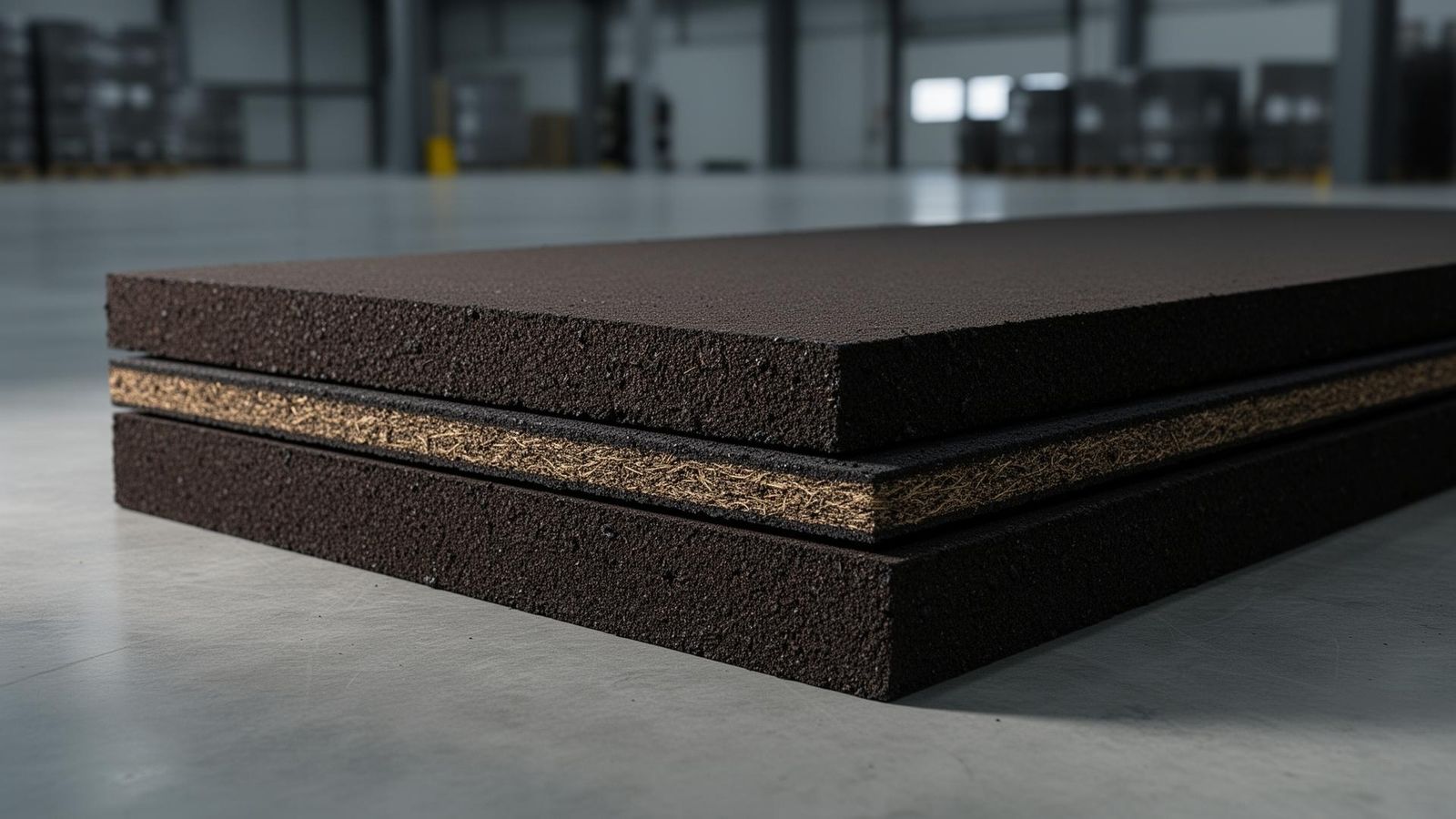
The function of a filler board
A concrete expansion joint is a deliberate gap separating two adjacent slabs or structural members, allowing them to expand and contract independently with temperature and moisture changes. Without the joint, thermal stress would crack the concrete uncontrolled. A filler board occupies this gap during the pour, preventing the second slab from bonding to the first, and remains in place permanently to absorb the cyclic compression-extension movement.
The filler board must be: (a) compressible (typically to 50% of original thickness under specified load), (b) recoverable (regaining 70-90% of original thickness when load is removed), (c) durable in the service environment (water, alkali, UV, mechanical wear), and (d) compatible with the joint sealant applied above it.
Material classes in current use
Bitumen impregnated softboard (cellulose fibres bonded and impregnated with bitumen, conforms to ASTM D1751): the GCC default for roads, bridges, airports, ports, industrial floors and infrastructure. Most cost-effective; durable in concrete. Cork-bound filler (granulated cork in bitumen or resin binder, ASTM D1752 Type III): higher recovery, used where extension cycles dominate over compression cycles. Self-expanding cork (compressed cork that grows back to original thickness, ASTM D1752 Type II): used in vertical joints, walls, and water-retaining structures. Closed-cell polyethylene foam (ASTM D1056): light-duty applications, indoor floors, decorative slabs. Sponge rubber (ASTM D1752 Type I): high-cycle joints requiring rapid recovery, less common in GCC.
For structural infrastructure across UAE, KSA, Qatar, Kuwait, Oman, Jordan and Iraq, bitumen softboard to ASTM D1751 covers >80% of joints.
Where filler boards are specified
Roads and highways: 20-25mm bitumen softboard at every transverse joint, typically every 4-6m. Bridges and flyovers: 25-40mm filler at deck joints, often combined with proprietary joint systems. Airport runways and taxiways: 20-25mm bitumen softboard, with specific certification for fuel and de-icer resistance. Ports and yards: 20-40mm bitumen softboard at slab joints around heavy paving. Industrial floors and warehouses: 15-25mm bitumen softboard at expansion and isolation joints. Multi-storey building slabs: 15-20mm at construction-day joints and movement joints. Water-retaining structures: cork or hybrid filler with hydrophilic sealant.
Standards and certification
ASTM D1751 - Standard Specification for Preformed Expansion Joint Filler for Concrete Paving and Structural Construction (Non-extruding and Resilient Bituminous Types). This is the dominant specification. ASTM D1752 - Standard Specification for Preformed Sponge Rubber, Cork, and Recycled PVC Expansion Joint Fillers for Concrete Paving and Structural Construction. BS 1142 - Fibre building boards (older British standard, still cited in some legacy specs). AASHTO M213 - Preformed Expansion Joint Fillers for Concrete (US transport equivalent of D1751).
TIC Dubai supplies bitumen softboard certified to ASTM D1751 with mill test certificates, accepted on Aramco, ADNOC, ASHGHAL, Public Works Authority Qatar, and Ministry of Public Works Kuwait projects.