
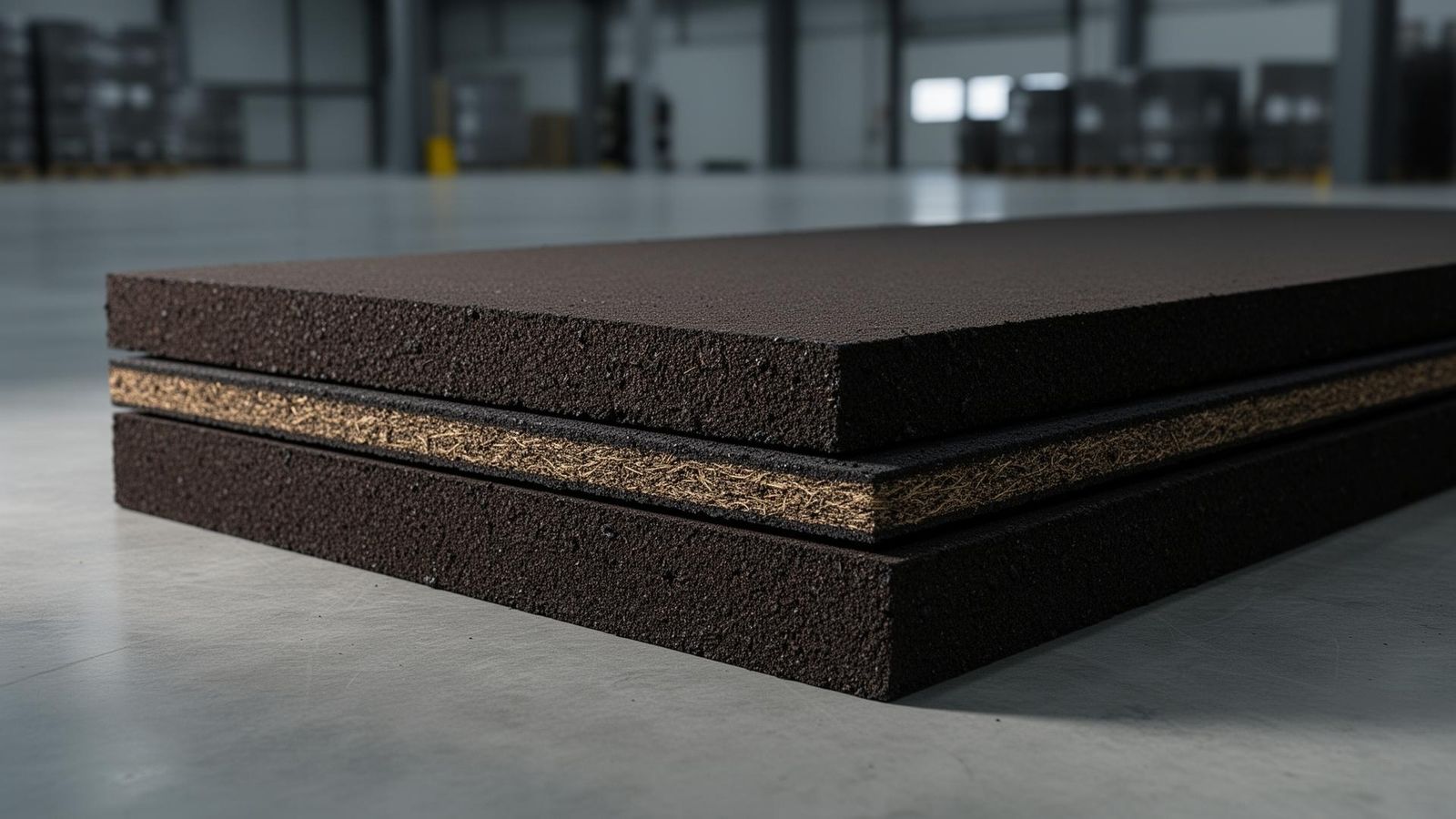
Failure 1: Filler too thin for actual movement
Symptom: concrete spalling on both sides of the joint, often visible within 1-2 summers. Cause: filler compressed beyond its recovery range, transmitting compressive load directly to the concrete edges. Prevention: calculate movement from slab length, temperature range and shrinkage; specify filler at minimum 1.5x calculated movement.
Failure 2: Sealant applied directly without filler
Symptom: sealant cracking and pulling away from joint walls within 12-24 months. Cause: no compressible filler beneath the sealant means the sealant alone absorbs all movement, exceeding its strain capacity. Prevention: always install filler board to within 10-25mm of the surface, with sealant in the upper reservoir over a bond-breaker.
Failure 3: Filler not bonded or restrained during pour
Symptom: voids or irregular joint shape after formwork removal. Cause: filler floated or shifted during concrete placement. Prevention: tack-fix the filler to the formwork or to a sleeper bar; for vertical joints, use temporary battens.
Failure 4: Wrong material class for the application
Symptom (cork in paving): premature crushing under vehicle load. Symptom (bitumen in submerged joint): extrusion of bitumen, joint widening, sealant detachment. Prevention: match material to application per ASTM D1751 (paving) vs D1752 (water/extension).
Failure 5: Joint debris contamination
Symptom: filler crushed unevenly, point loading transferred to concrete edges, spalling. Cause: site debris (steel fragments, hardened mortar lumps, gravel) trapped in the joint during construction. Prevention: clean joint immediately before filler installation; protect joint from foot traffic until sealant is applied.
Failure 6: Sealant incompatible with filler
Symptom: sealant softening, blistering or staining. Cause: bitumen migrating into polysulfide or silicone sealant. Prevention: use a bond breaker tape over bitumen softboard, or specify sealant explicitly compatible with bitumen (most polyurethane and polysulfide products handle this).
Failure 7: Wrong thickness in surface-mounted reservoirs
Symptom: sealant either over-stressed (too thin) or sagging (too thick) during temperature cycles. Cause: incorrect Sealant Width-to-Depth Ratio (typically 2:1). Prevention: design joint reservoir geometry per sealant manufacturer; bitumen softboard sits below the sealant reservoir, depth set by backer rod or filler trim.
Maintenance check schedule for GCC infrastructure
Roads: annual visual inspection, sealant replacement every 5-7 years, filler replacement only on damage. Airports: 6-monthly inspection, sealant replacement every 4-6 years, FAA P-605 / ICAO joint sealant standards apply. Industrial floors: annual sealant inspection, replace on damage. Bridges: biannual full joint inspection per RTA/MOMRA standards.