Fibre Cement Boards: Facades, Partitions, Ceilings & Wet Areas.
Non-combustible, moisture-resistant and durable fibre cement boards for facade systems, internal partitions, suspended ceilings, wet areas and fire-rated assemblies across the UAE and GCC.
The engineered alternative to gypsum and wood-based panels.
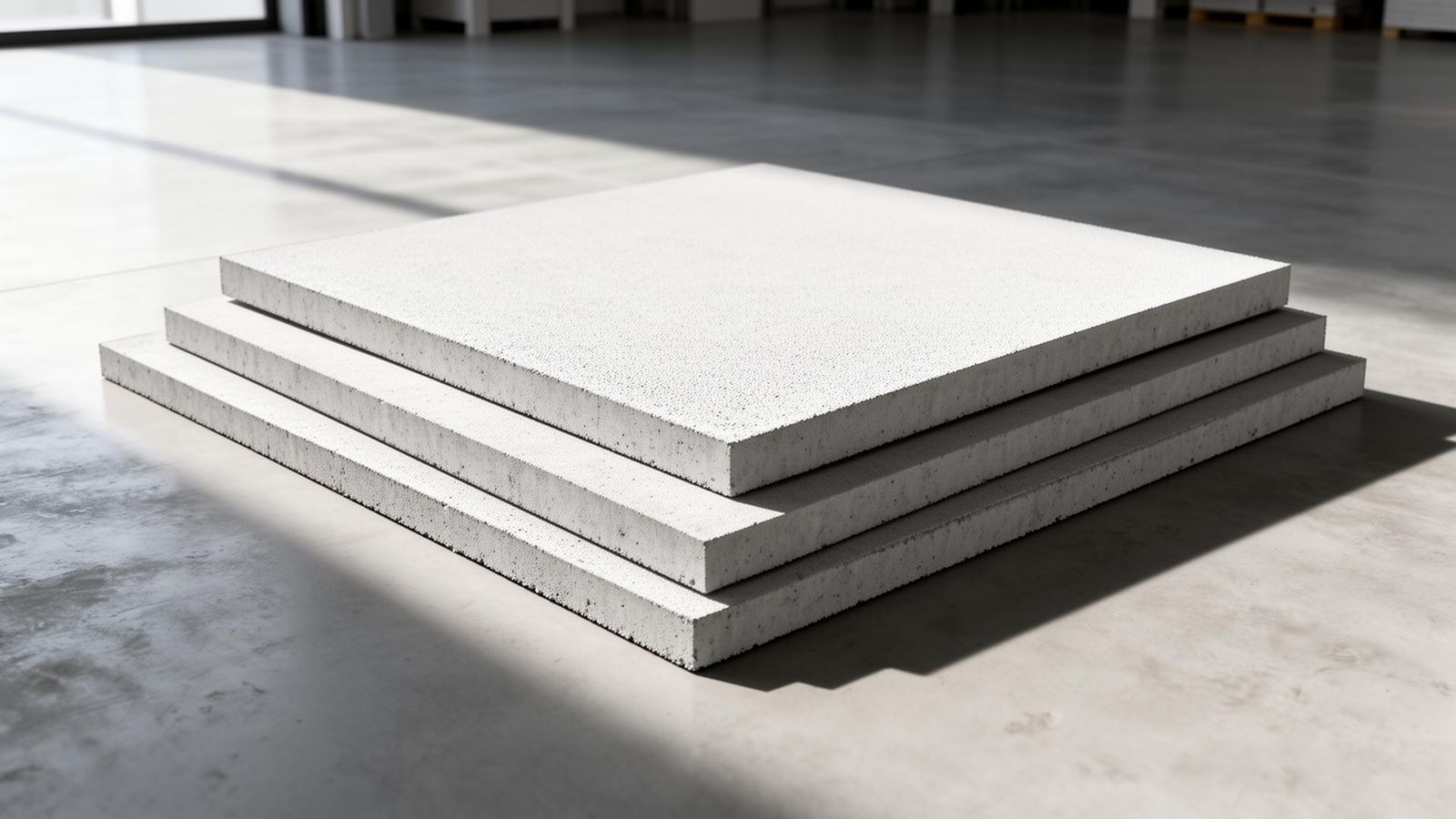
Fibre cement boards are engineered panels of Portland cement, silica and cellulose fibres, autoclaved into dimensionally stable, non-combustible, moisture-resistant sheets. They have replaced gypsum in wet areas, replaced timber sheathing in fire-rated walls, and become the default rain-screen layer in modern ventilated facades.
Built for fire, moisture and impact.
Fire Resistance
Non-combustible (A1 / Class 0), used in fire-rated wall and ceiling assemblies up to 4 hours.
Moisture Resistance
Unaffected by water, suitable for permanent wet-area, external and high-humidity installations.
Impact Strength
High flexural and impact strength, resistant to knocks and minor damage in heavy-traffic areas.
Dimensional Stability
Minimal expansion and contraction across temperature and humidity cycles.
Termite & Fungal Resistance
Cementitious matrix is inherently resistant to insects, fungal attack and rot.
Durability
Decades-long service life in external, internal and wet-area applications.
Where cement boards ship.
From 6 mm to 18 mm.
6 mm
Lightweight ceiling boards and decorative panels.
8 mm
Internal partition skins and tile backer boards.
9 mm
Standard wet-area walls and ceiling assemblies.
12 mm
Structural sheathing, fire-rated walls and external cladding.
15 mm
Heavy-duty floor underlay and high-impact partition systems.
18 mm
Structural flooring and high-performance facade backing.
Construction Materials across the GCC and Middle East
Bitumen softboard, cement boards, the Eco-Friendly Joint Filler Board and insulation across GCC infrastructure markets.
Shipments routed through Jebel Ali, Khalifa, Hamad, King Abdulaziz Dammam, Sohar and other major regional ports, coordinated with contractor and procurement schedules.
TIC Dubai supplies bitumen impregnated softboard expansion joint filler, fibre cement boards, the Eco-Friendly Joint Filler Board (sustainable wood-fibre expansion joint filler) and thermal & acoustic insulation boards to infrastructure contractors, civil contractors, precast manufacturers, consultants, developers and government project teams across Dubai, Abu Dhabi, Sharjah, Ras Al Khaimah, Fujairah, Riyadh, Jeddah, Dammam, Doha, Kuwait City, Manama, Muscat, Sohar and Salalah, with shipments routed through Jebel Ali, Khalifa, Hamad, Dammam and Sohar ports.
- Dubai
- Abu Dhabi
- Sharjah
- Ajman
- Ras Al Khaimah
- Fujairah
- Umm Al Quwain
- Al Ain
- Khor Fakkan
- Riyadh
- Jeddah
- Dammam
- Al Khobar
- Jubail
- Yanbu
- Mecca
- Medina
- Tabuk
- Abha
- JAFZA
- DIP
- Dubai Industrial City
- Sharjah Industrial Area
- KIZAD
- Hamriyah Free Zone
- RAKEZ
- SAIF Zone
- Doha
- Lusail
- Al Rayyan
- Mesaieed
- Al Wakrah
- Kuwait City
- Shuwaikh
- Shuaiba
- Ahmadi
- Manama
- Muharraq
- Riffa
- Sitra
- Muscat
- Sohar
- Salalah
- Duqm
- Nizwa
- Amman
- Zarqa
- Irbid
- Aqaba
- Baghdad
- Erbil
- Basra
- Mosul
- Najaf
- Karbala
- Sulaymaniyah
- Kirkuk
- Jebel Ali Port
- Khalifa Port
- Hamriyah Port
- Port Rashid
- Khor Fakkan Port
- King Abdulaziz Port Dammam
- Jeddah Islamic Port
- King Abdullah Port
- Jubail Commercial Port
- Yanbu Commercial Port
- Hamad Port
- Shuwaikh Port
- Shuaiba Port
- Khalifa Bin Salman Port
- Port of Sohar
- Port of Salalah
- Port of Duqm
- Port of Aqaba
- Umm Qasr Port
- Khor Al Zubair Port
Cement boards: technical reading.
Comparisons, wet-area and fire-rated assembly references for facade, partition and ceiling specifiers.
What Is Cement Board? Composition, Standards and GCC Applications
The board that replaced gypsum in wet areas and replaced asbestos in everything else. A technical reference on cement board for GCC construction.
Cement Board vs Gypsum Board: Where Each One Belongs
Two boards used for the same wall but built for opposite environments. A reference for matching board to application.
Cement Board vs Calcium Silicate Board: Specification Reference
Two cementitious-looking boards with different chemistries and different best uses. A technical reference.
Wet Area Wall Systems Explained: Cement Board Behind Tile
Cement board is one layer in a layered system. A reference for how wet-area walls are correctly built in GCC hospitality and residential projects.
Fire Rated Wall Systems Explained: Cement Board Partitions
A fire-rated wall is a tested assembly, not a single product. A reference for how cement board systems achieve 60-240 minute ratings.
Cement boards: frequently asked.
What are fibre cement boards?
Fibre cement boards are engineered panels manufactured from Portland cement, silica, cellulose fibres and selected additives, autoclaved into dimensionally stable boards. They combine the durability of cement with the workability of wood-based panels.
Where are cement boards used in construction?
Cement boards are specified for exterior facades, ventilated cladding, internal partitions, suspended ceilings, wet-area walls, tile backers, fire-rated assemblies, soffits, shaft walls, modular construction and external sheathing.
Are cement boards fire resistant?
Yes. Fibre cement boards are non-combustible (typically A1 / Class 0 to BS 476 and EN 13501-1) and are used in fire-rated wall and ceiling assemblies achieving up to 4 hours of fire resistance depending on system build-up.
Are cement boards moisture resistant?
Yes. Cement boards are unaffected by water, they do not swell, rot or deteriorate in permanently wet, humid or external conditions, making them the default substrate for bathrooms, kitchens, swimming-pool areas and facades.
What thicknesses are available?
We supply 6, 8, 9, 12, 15 and 18 mm fibre cement boards in standard 1220 × 2440 mm sheets and project-specific cut sizes.
Can cement boards be used in facade systems?
Yes. Cement boards are widely used as the rain-screen layer in ventilated facade systems, as substrate for stone, render and tile facades, and as a fire-resistant external sheathing in steel-frame construction.
How are cement boards installed?
Cement boards are mechanically fastened with cement-board screws to timber or light-gauge steel sub-frames. Joints are taped and treated with cementitious or alkali-resistant systems depending on the finish specification.
Are cement boards termite resistant?
Yes. The cementitious composition is inherently resistant to termites, insects, fungal attack and rot, a significant advantage over wood-based boards in GCC and tropical climates.
Can cement boards be tiled directly?
Yes. Cement boards are the preferred tile backer for wet areas and external applications, with no need for additional waterproofing membranes in many systems.
Do you supply cement boards across the GCC?
Yes. TIC Dubai supplies cement boards across Dubai, Abu Dhabi, Sharjah and the wider UAE, plus Saudi Arabia, Qatar, Kuwait, Bahrain, Oman, Jordan and Iraq, routed through major regional ports.
Get a cement board quotation.
Tell us thickness, application, sheet size and project volume. We revert with mill options, lead times and indicative pricing within one working day.