Definition
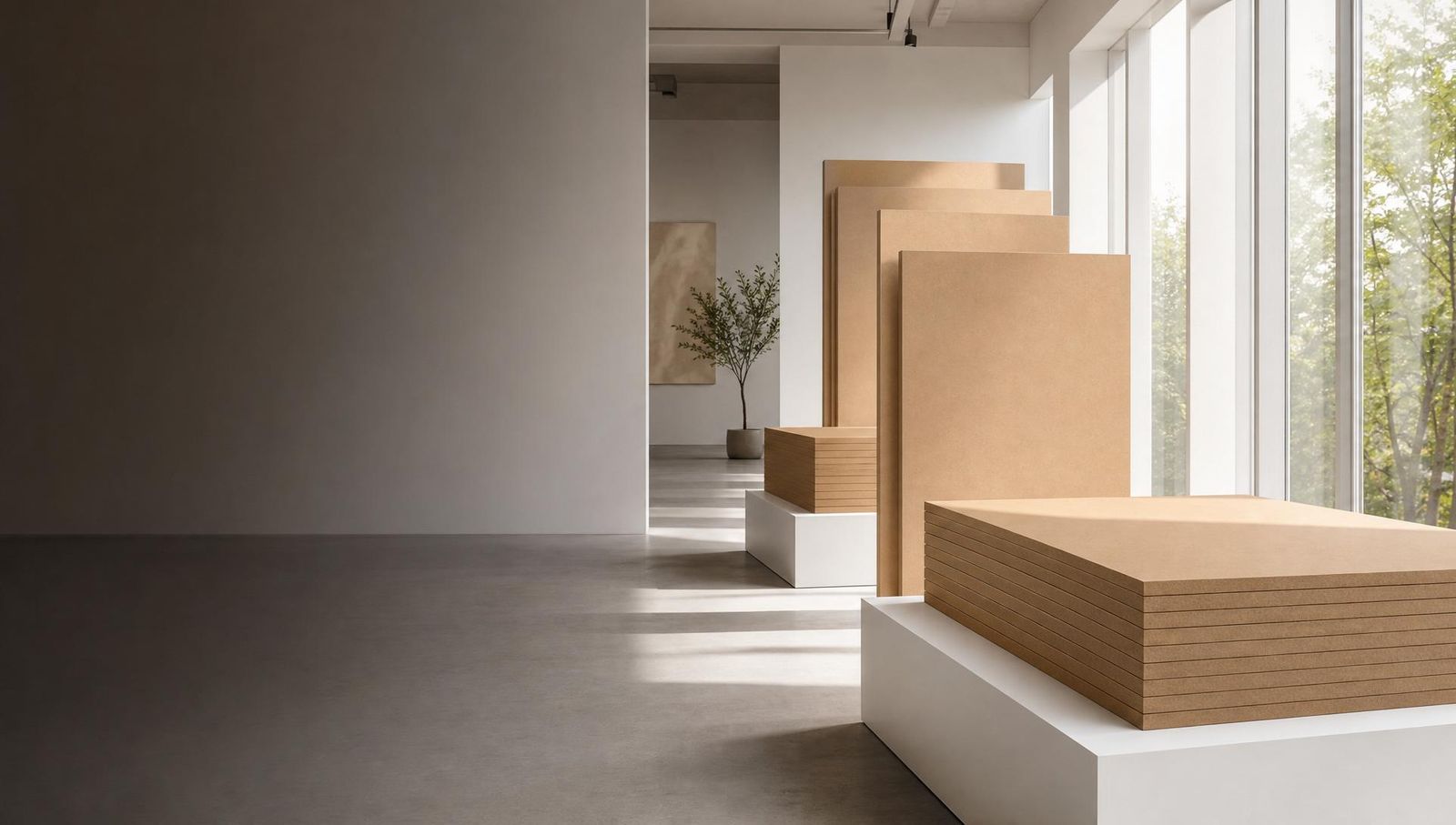
MDF (Medium Density Fibreboard), HDF (High Density Fibreboard) and Particle Board (Chipboard) are three wood-based panel products manufactured by reducing wood to fragments, mixing those fragments with synthetic resin, and pressing under heat into uniform sheets. The decisive variables are the size of the wood fragments and the resulting density:
Particle Board: large wood particles and chips, density typically 600-700 kg/m³. MDF: refined wood fibres, density 650-800 kg/m³. HDF: very fine wood fibres, density 800-1000+ kg/m³.
Finer fibres produce smoother surfaces and finer machined edges; higher density delivers higher screw-holding strength, harder surfaces and better dimensional stability.
Comparison table
Property | Particle Board | MDF | HDF Density | 600-700 kg/m³ | 650-800 kg/m³ | 800-1000+ kg/m³ Surface | Coarse, visible chip texture | Smooth, paint-ready | Very smooth, lamination-ready Machined edge quality | Rough | Clean | Very clean Screw holding (face) | Moderate | Good | Excellent Screw holding (edge) | Poor | Moderate | Good Moisture resistance (standard) | Low | Low | Moderate Moisture resistance (HMR / V313) | Good | Good | Very good Fire resistance (FR variant) | Available | Available (FR MDF) | Available Cost index | 1.0 | 1.3-1.6 | 1.6-2.2 Standard | EN 312 | EN 622-5 | EN 622-5 (HDF)
Where each panel wins
Particle Board: budget cabinet carcass, low-cost shelving, furniture core where laminate or veneer face hides the substrate. Most flat-pack furniture worldwide is particle board with melamine surface.
Standard MDF: paint-grade joinery, mouldings, wall panels, doors that will be painted or veneered. The default substrate for built-in joinery in GCC fit-out where the surface will be finished.
HMR MDF (Moisture Resistant, green-tinted): kitchen and bathroom carcasses, vanity units, wet-area joinery, anywhere humidity is sustained but the panel is not submerged.
FR MDF (Fire Retardant, red-tinted): hotel corridors, hospital partitions, airport joinery, public building fit-out where fire-rated wall and ceiling substrate is required.
HDF: laminate flooring core (almost universal), high-quality door skins, premium furniture surfaces, perforated acoustic panels, hardboard substitution.
Formaldehyde emission
All three panels are bonded with urea-formaldehyde or melamine-urea-formaldehyde resin and emit residual formaldehyde over their service life. Emission classes:
E2, high emission, increasingly banned in indoor service. E1, standard low-emission, the current GCC default. E0, low emission (≤0.5 mg/L formaldehyde extraction), increasingly specified on premium fit-out. CARB Phase 2, California regulation, even tighter than E0, often required on US-spec projects. F**** (F-four-star), Japanese JIS rating equivalent to CARB P2 or better.
For hospitals, schools, hotels and residential interiors in the UAE, KSA and Qatar, E1 is the minimum and CARB P2 / F**** is increasingly the modern specification.
Standards
EN 622-5, Medium-density fibreboards (MDF, HDF and ultra-HDF). EN 312, Particle boards. EN 13986, Wood-based panels for construction use, with CE marking requirements. ANSI A208.1, Particle Board (US). ANSI A208.2, Medium Density Fibreboard for Interior Applications (US). JIS A 5908, Particle Board (Japan). JIS A 5905, Fibreboards (Japan).
GCC sourcing
MDF for the GCC market is supplied predominantly from Thailand, China, Malaysia, Indonesia and Vietnam. Thailand and Malaysia are the quality benchmarks for premium E1 / E0 / CARB P2 MDF; Chinese mills cover the volume mid-market; Vietnamese mills are increasingly competitive. Particle Board ships from the same origins plus India and Turkey. HDF is dominated by Vietnam and Malaysia. TIC Dubai supplies MDF, HMR MDF, FR MDF, HDF and chipboard mill-direct in 2440x1220mm and 2440x1830mm formats from 6mm to 25mm thickness.