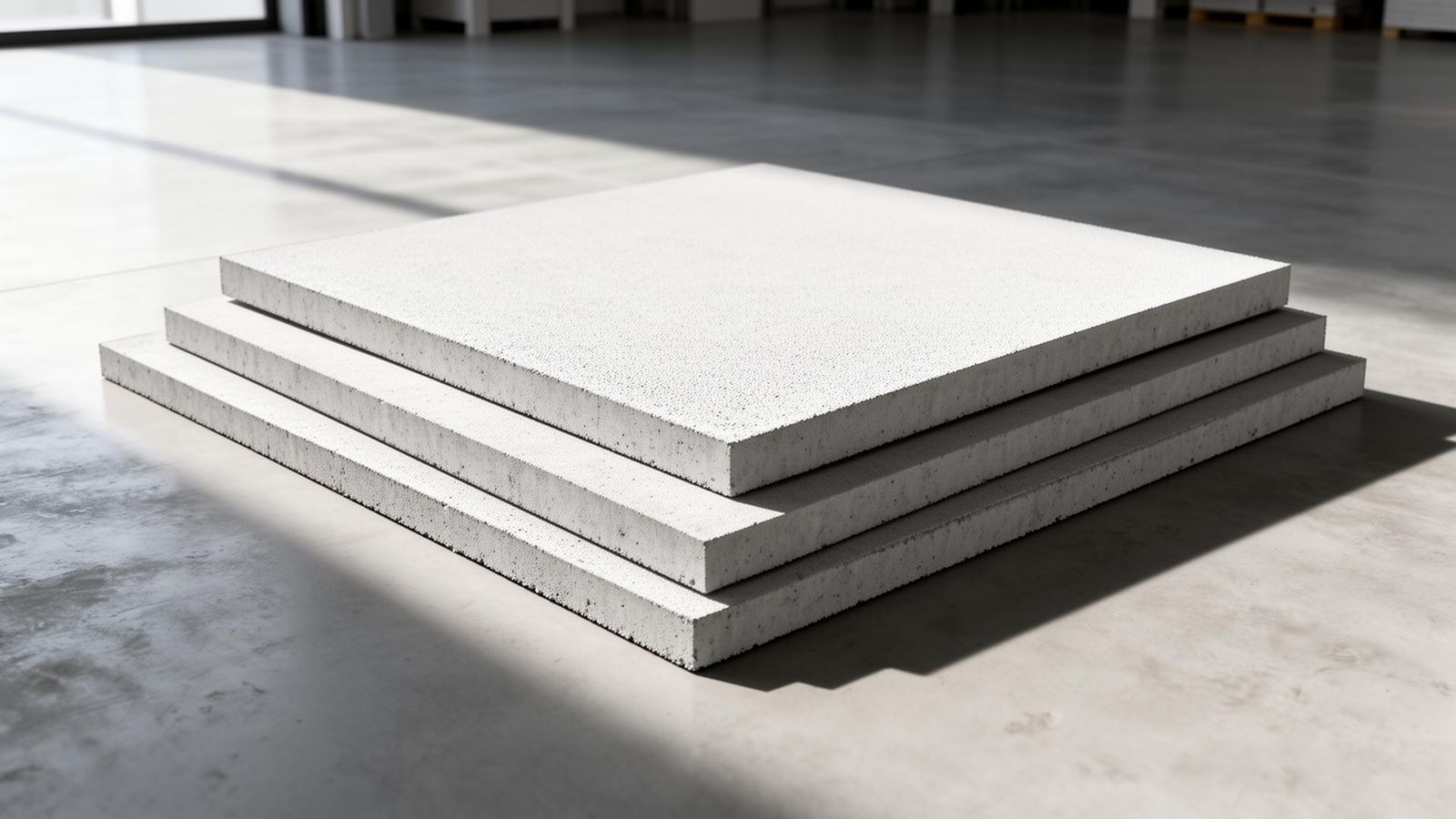
Cement board
Portland cement + cellulose/PVA fibre + silica + water. Density 950-1850 kg/m³. Water-resistant (passes immersion tests with negligible strength loss), fungus-resistant, dimensionally stable under humidity, impact-resistant, fire-rated. Heavier and harder to cut than gypsum.
Gypsum board (drywall, plasterboard)
Calcium sulfate dihydrate (gypsum) core + paper or glass-mat facing. Density 600-900 kg/m³. Excellent fire resistance (chemically bound water in the gypsum releases as steam, slowing fire spread), good acoustic performance, lightweight, easy to cut and finish. Standard gypsum is moisture-resistant but not water-resistant; specialty moisture-resistant grades (MR/green-board, glass-mat backed) extend the use envelope but are still not equivalent to cement board in wet zones.
Side-by-side comparison
Water resistance: Cement board high; standard gypsum low; MR gypsum medium. Fire performance: Cement board A1/A2 non-combustible; gypsum A1/A2 with calibrated assemblies. Weight per m²: Cement board 8-25 kg/m² (depending on thickness); gypsum 7-15 kg/m². Cost per m²: Gypsum 1.0x baseline; MR gypsum 1.3x; cement board 2.0-3.5x. Workability: Gypsum easiest; cement board requires planning for cutting. Acoustic performance: Comparable when used in equivalent partition systems. Impact resistance: Cement board significantly higher.
Where gypsum wins
Dry interior partitions, ceilings, soffits in residential, hotel guestrooms (excluding bathrooms), office cellular walls, retail back-of-house, fire-rated assemblies designed around gypsum systems, acoustic walls in cinemas and conference rooms.
The GCC interior fit-out industry runs predominantly on gypsum board because the cost, weight and finish quality are unmatched in dry zones.
Where cement board wins
Bathrooms, kitchens, swimming pool surrounds, laundry rooms, balconies and external walls, exterior cladding rainscreens, fire-rated partitions in high-risk zones (kitchens, plant rooms, electrical), tile backer in any wet application, hospital and laboratory walls subject to deep cleaning.
Specifying gypsum behind tile in a Dubai hotel bathroom is a guaranteed maintenance failure; specifying cement board behind paint in a hotel corridor is unnecessary cost.
Hybrid wall assemblies
Most GCC projects use both within the same wall: cement board on the wet face (tiled side of a bathroom wall) and gypsum on the dry face (corridor side). Studs and insulation behave identically; only the board changes. This is the standard interior dry-wet partition.