Definition and composition
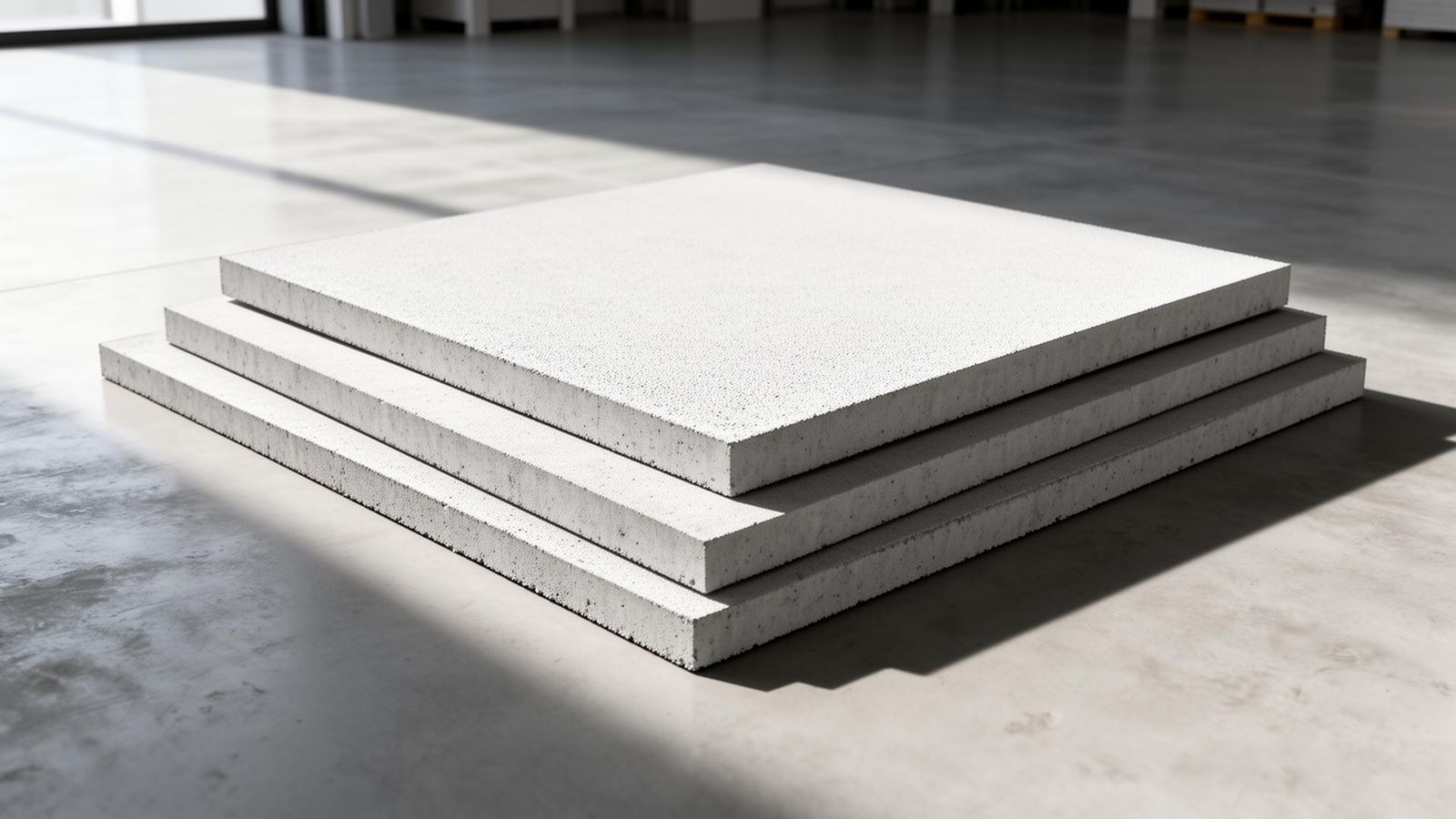
A cement board is a rigid sheet manufactured from Portland cement, fine silica (or another silaceous aggregate), reinforcing fibres (cellulose, PVA, or in legacy products asbestos - now banned in GCC), and water, formed by the Hatschek process or similar wet-laid method, then air-cured or autoclaved. The result is a sheet with the dimensional stability and fire resistance of cement combined with the workability of a board product.
Density ranges: low-density boards 950-1200 kg/m³ (interior wall lining), medium-density 1200-1500 kg/m³ (general construction), high-density 1500-1850 kg/m³ (exterior cladding, fire-rated, structural). Thickness: 4-25mm depending on application. Standard sheet size 1220x2440mm.
Reference standards
EN 12467 - Fibre-cement flat sheets. Product specification and test methods. The dominant standard in GCC specifications. Categorises boards into Categories A and B (exterior/interior exposure) and classes 1-5 by minimum bending strength. ISO 8336 - International equivalent to EN 12467. ASTM C1186 - Specification for non-asbestos fibre-cement flat sheet. Used in projects with American-origin consultancies. ASTM C1325 - Standard specification for non-asbestos fibre-mat reinforced cementitious backer units (used as tile backer in wet areas). BS 690 - Older British standard, still cited in legacy GCC specifications.
For UAE, KSA, Qatar, Kuwait and Oman projects, EN 12467 Category A Class 3 or 4 covers most exterior cladding requirements; Category B is acceptable for interior wet-area lining.
Application categories
Wet area wall lining (bathrooms, kitchens, laundries): 6-12mm cement board behind tile. Exterior cladding (rainscreen facade): 8-16mm high-density board. Fire-rated partitions and ceilings: 9-15mm board to EN 12467 Class A1 / non-combustible to BS 476. Floor underlay (tile substrate): 6-12mm cement backer. Structural sheathing: 9-15mm structural cement board. Eaves, soffits and fascia: 6-9mm board, prefinished or to be painted.
Across NEOM, The Line, Red Sea, Dubai South, Saadiyat Cultural District, Lusail, Sabah Al-Salem and Cairo New Capital projects, cement boards are specified in all of the above applications.
Why cement board replaced gypsum and asbestos
vs Gypsum board: cement board is water-resistant (does not soften when wetted), fungus-resistant, dimensionally stable under humidity changes, and impact-resistant. Gypsum remains the standard for dry interior walls because of cost and workability, but cement board is mandatory in wet zones.
vs Asbestos cement (legacy): non-asbestos formulations using cellulose, PVA or wood fibre were developed from the 1980s onwards. UAE and KSA prohibit asbestos in new construction. All cement boards supplied today are asbestos-free.
Installation principles
Fastening: stainless or galvanised screws (countersunk, predrilled in dense boards), centres 200-300mm. Joints: 3-5mm gap with elastomeric sealant in wet zones, alkali-resistant tape and skim in dry zones. Edges: factory edge for visible joints, cut edge sealed in exterior application. Cutting: score-and-snap for thin boards, diamond blade for thicker exterior boards (with extraction to control silica dust).