
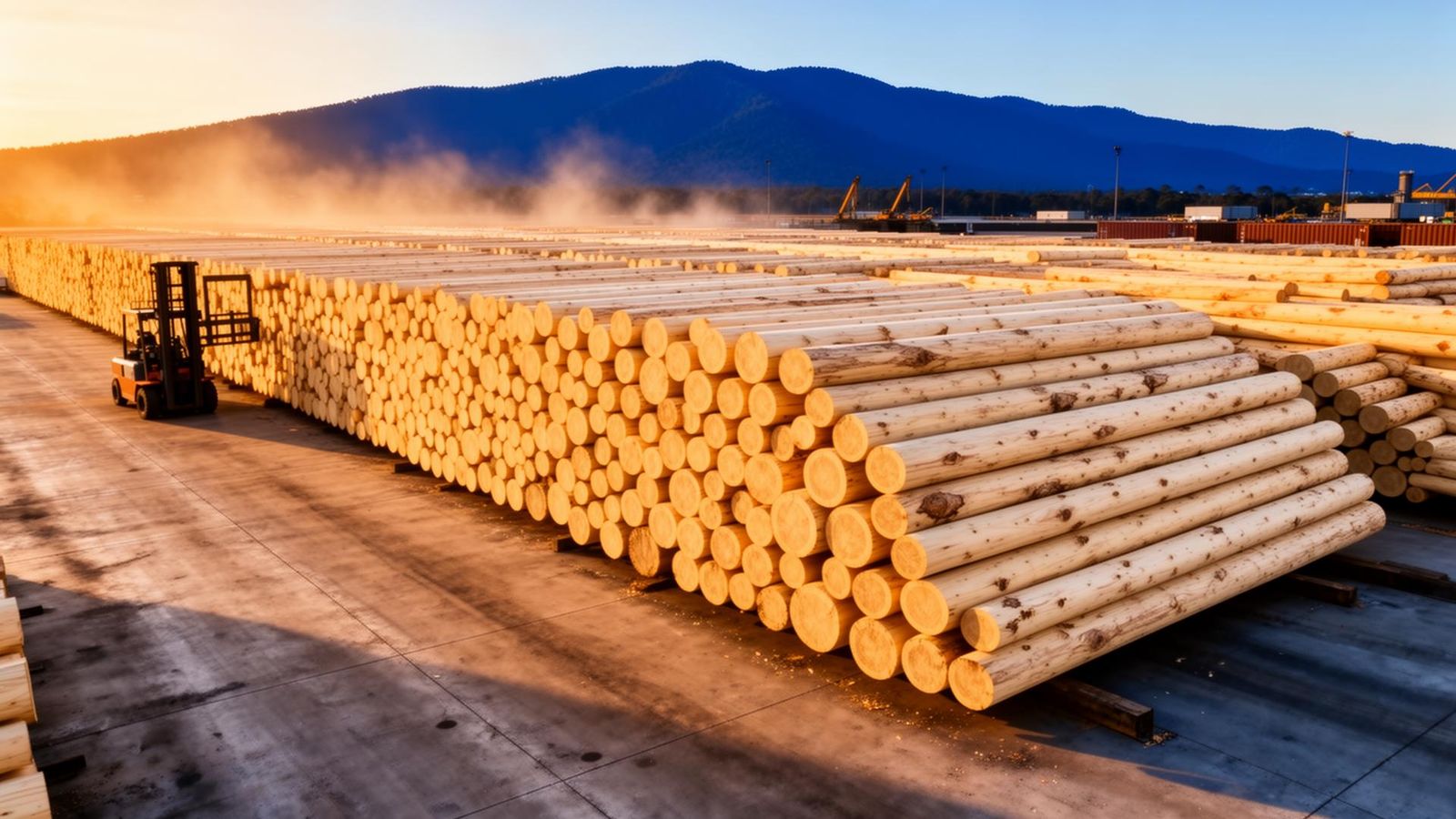
Definition: round softwood logs from plantation pine forests
A pine log is a debarked, cross-cut section of a pine tree trunk (genus Pinus) supplied in its round, unsquared form for downstream sawmilling, peeling, chipping and engineered wood production. Plantation-grown radiata pine (Pinus radiata) from New Zealand, Chile, Brazil and Uruguay is the dominant traded volume; Scots pine (Pinus sylvestris) from Northern Europe, Russia and the Baltics is the dominant traded volume in the EMEA softwood market.
Unlike hardwood square logs which are squared at origin, pine logs travel as cylindrical roundwood and are broken down by the destination sawmill. The economics work because pine grows fast, ships in bulk volumes, and converts cleanly through high-throughput modern sawmills.
Species that dominate the trade
Radiata pine (Pinus radiata): the global plantation softwood. Originally Californian, now grown on millions of hectares in New Zealand, Chile, Australia, Argentina, Spain and South Africa. Fast-growing (25-30 year rotation), pale honey-coloured, low natural density, accepts pressure treatment exceptionally well. The default sawlog and peeler species worldwide.
Scots pine (Pinus sylvestris): the European workhorse from Russia, the Baltics, Finland, Sweden, Poland and Germany. Slower-growing, denser, more naturally durable, reddish heartwood, the preferred species for high-spec joinery and pressure-treated outdoor timber.
Maritime pine (Pinus pinaster), loblolly pine (Pinus taeda), Caribbean pine (Pinus caribaea) and longleaf pine (Pinus palustris) round out the commercial softwood log trade.
Where pine logs end up after the saw
Sawmilling: primary breakdown into cants, then resawing into dimensional lumber (2×4, 2×6, 4×4, scantlings) for construction, framing and pallet manufacturing. Peeling: rotary peeling of larger-diameter clears into 1.5-3.0 mm veneer sheets for plywood and LVL (laminated veneer lumber) manufacturing. Chipping: lower-grade logs and offcuts chipped for MDF, particleboard, OSB and pulp & paper mills. Pressure treatment: pine accepts CCA, ACQ, MCA and copper-azole treatment exceptionally well, becoming outdoor decking, fencing, utility poles and landscape timber.
Why GCC importers buy pine logs over sawn lumber
Three commercial drivers. Conversion yield: a destination sawmill can match its product mix exactly to local demand, where sawn lumber arrives in fixed sizes. Cost: roundwood lands at a meaningful discount to equivalent sawn lumber on a volume basis. Flexibility: a single log can be re-graded after first cut, capturing higher-grade clears that would have been sold as sawn No.2 in the export market.
GCC sawmills in Jebel Ali Free Zone, Hamriyah, Khorfakkan, Sohar and Dammam buy pine logs by the bulk vessel to feed industrial sawmilling, pallet plants and engineered wood operations serving the regional construction and packaging markets.