Definition: a fine-grained European hardwood
Beech wood is a temperate-climate hardwood from the Fagus genus in the Fagaceae family, the same family as oak. The two commercially dominant species are European beech (Fagus sylvatica), grown across Central and Eastern Europe, and American beech (Fagus grandifolia), grown across the eastern United States and Canada. A third species, Oriental beech (Fagus orientalis), supplies the Turkish and Caucasian markets.
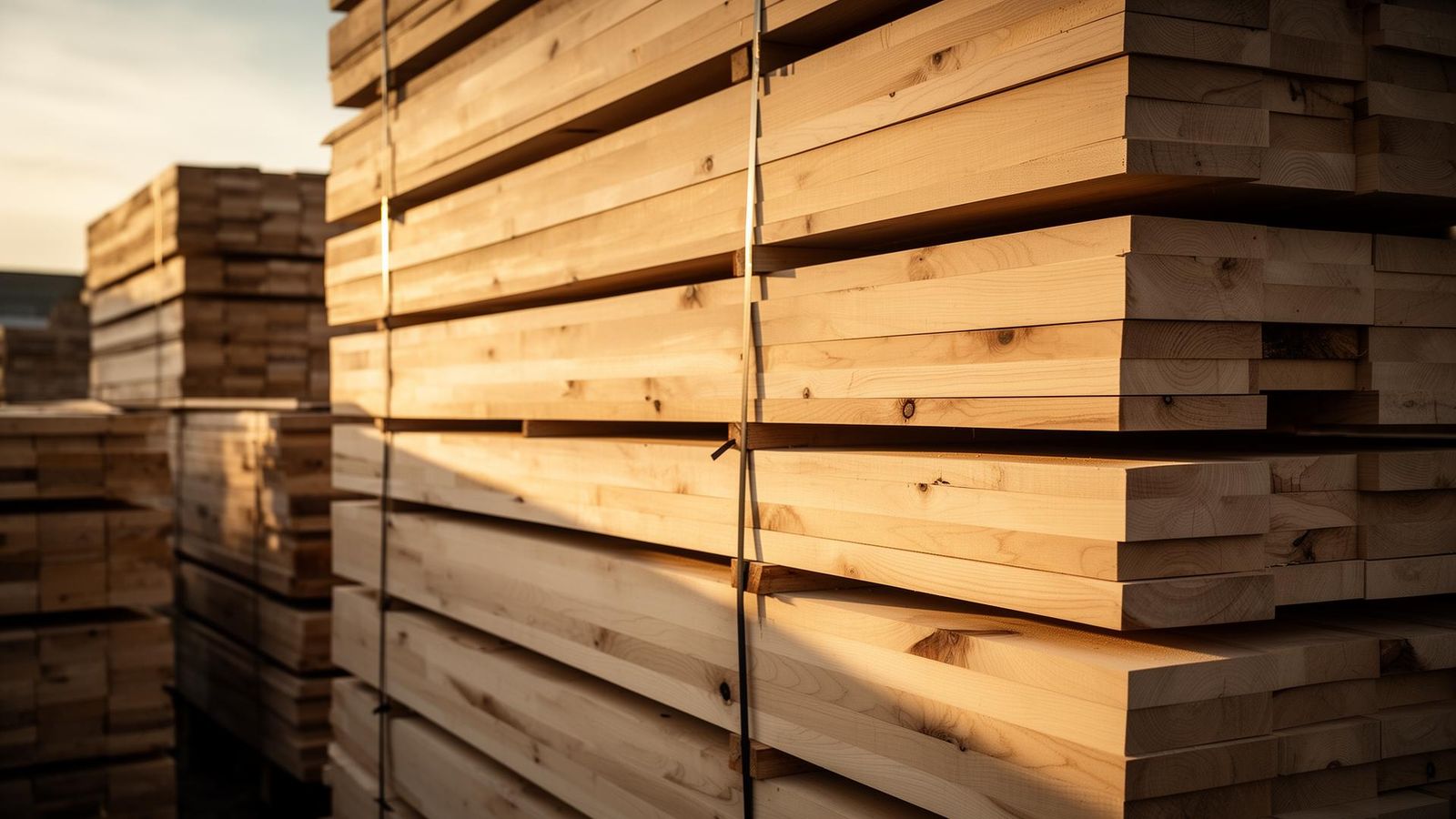
The wood is pale cream to light pink in its natural state, with very fine straight grain, characteristic ray flecks on the quartersawn face, and tiny pin-knots. Density 680–750 kg/m³, Janka hardness ~5,800 N, modulus of rupture ~103 MPa, mechanically comparable to European oak and ash.
Why it is the European furniture industry's default hardwood
Three structural advantages combine in beech: an exceptionally fine, straight, uniform cell structure that machines to a glass-smooth finish off the blade; a low ray-fleck interference that lets it steam-bend to tight radii without splitting; and a homogeneous, taint-free, non-toxic chemistry that makes it safe for direct food contact and children's furniture.
These properties drive its dominance in European furniture, bentwood chair frames, plywood multiplex (Buchensperrholz), flooring, stair treads, toys, kitchenware, tool handles and pattern-making.
Steamed vs unsteamed: the two finishes
The European furniture trade overwhelmingly specifies steamed beech: green logs or boards are loaded into a steam chamber at 95–100°C for 36–72 hours before kiln drying. The heat denatures phenolic compounds, producing the characteristic warm pinkish-red colour throughout the board and relieving internal drying stress. Steamed beech is the European furniture industry default; unsteamed beech (pale cream to light yellow) is preferred in the US and UK markets for paint-grade joinery.
What beech wood is not suitable for
Untreated beech is not durable outdoors, EN 350 class 5 (not durable). It is an interior-only timber unless thermally modified (Thermo-Beech) or pressure-treated. Direct ground contact, exterior cladding and decking applications require either oak, larch, accoya or thermo-beech, not standard kiln-dried beech.