
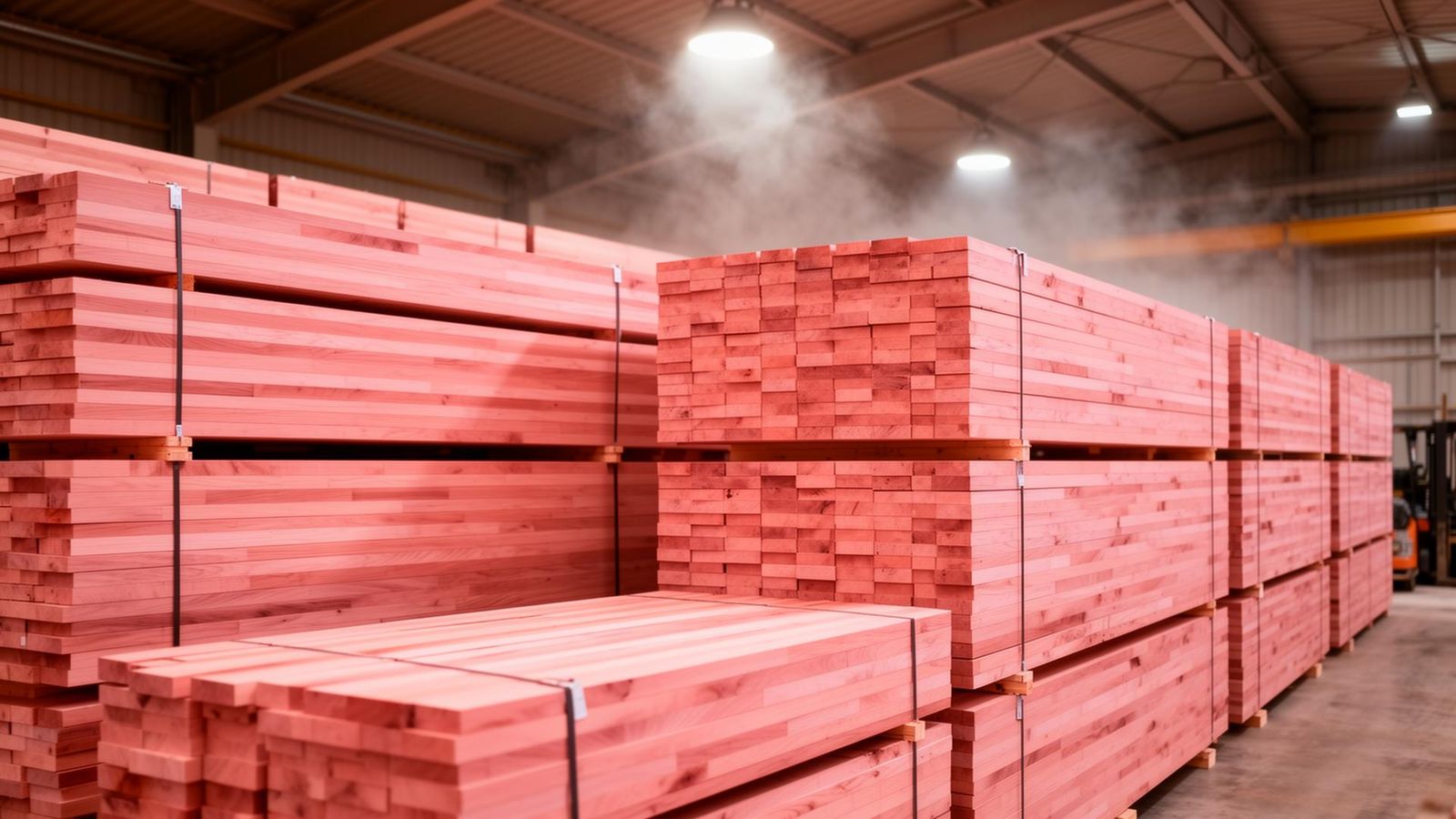
The steam chamber process
Green beech logs or freshly sawn boards are loaded into a sealed steel steaming chamber. Live steam at 95–100°C is injected; the cycle runs 36–72 hours depending on thickness. The heat denatures phenolic compounds throughout the wood structure, producing a homogeneous warm pinkish-red colour from face to face, and relieves internal drying stress that would otherwise cause checking and warp in the kiln.
After steaming, boards are air-stickered, equalised and kiln-dried to 8–12% moisture content. The result is a stable, evenly coloured board that accepts stains and finishes uniformly across heartwood and sapwood, the European furniture industry standard.
The colour and finishing argument
Unsteamed beech has a clear visual mismatch between cream sapwood and slightly darker honey heartwood. Under clear and natural finishes, this mismatch is obvious and rejected by European furniture brands. Steaming homogenises the colour, allowing the entire board to behave as a single visual unit. For paint-grade joinery, unsteamed beech is acceptable; for clear-finished furniture, steamed is almost always specified.
Dimensional and mechanical effects
Steaming relieves growth and drying stress, reducing internal tension that would cause warping, twisting and checking in the kiln. Janka hardness drops marginally (~3–5%) from the unsteamed baseline of ~5,800 N. Machining behaviour, glue-up performance and steam-bending performance are all preserved. A modest premium of 5–10% per m³ vs unsteamed is the typical cost differential.
When to specify unsteamed
Paint-grade joinery where the visible colour doesn't matter, US-market furniture where the unsteamed pale colour is preferred, certain musical instrument components, and industrial uses (handles, blanks, jigs) where colour is irrelevant. Unsteamed beech is also slightly cheaper.