
Definition: the international phytosanitary standard for wood packaging
ISPM-15 (International Standard for Phytosanitary Measures No. 15) is the global regulation issued by the IPPC (International Plant Protection Convention) under the FAO. It governs solid wood packaging material (SWPM) crossing international borders, pallets, crates, dunnage, blocking, bracing, cable drums and skids, to prevent the spread of wood-boring pests and pathogens such as the pine wood nematode and Asian longhorn beetle.
Any wooden pallet, crate, or piece of dunnage leaving the country of manufacture must be ISPM-15 treated AND marked with the official IPPC stamp. Non-compliant wood is rejected, fumigated, returned to origin or destroyed at the importer's cost.
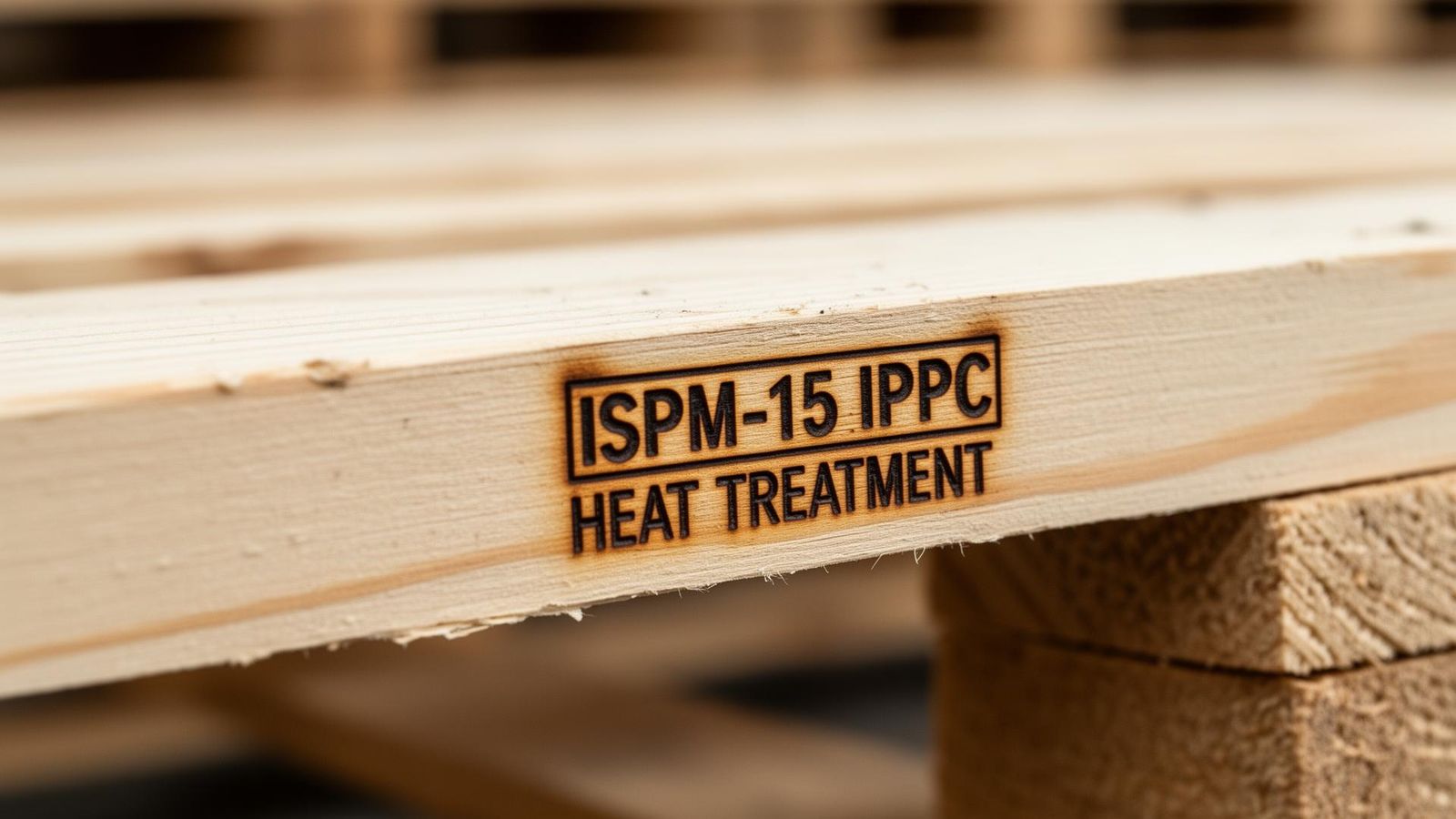
Reading the IPPC stamp
Every compliant piece carries the same four-part mark:
1. The IPPC wheat-ear symbol. 2. The two-letter ISO country code of the producer (e.g. AE for UAE, IN for India, CN for China). 3. The unique registration number of the producing facility, assigned by the national plant protection authority. 4. The treatment code: HT (heat treatment), MB (methyl bromide), DH (dielectric heating), or KD-HT where kiln drying meets HT spec. DB optionally added when debarked.
The mark must be applied on at least two opposite sides, legibly, in non-toxic ink or burned-in branding, and never on the loose component, always on the assembled or final unit.
Treatment methods accepted under ISPM-15
Heat Treatment (HT): wood heated until the entire core reaches a minimum of 56 °C for at least 30 minutes. The dominant treatment globally, accepted everywhere, low residue, no chemical liability.
Methyl Bromide (MB): chemical fumigation in a sealed chamber. Being phased out worldwide due to ozone-depletion concerns; the EU banned MB-treated SWPM imports years ago. Avoid for new programmes.
Dielectric Heating (DH): microwave/radio-frequency heating, valid since 2013, used for high-throughput production where conventional kilns are slow.
Kiln-dried-to-HT-spec (KD-HT): kiln drying that incidentally satisfies the HT temperature/time spec, common in pine sawmills.
TIC Dubai supplies HT-treated pallet components exclusively for new programmes, it is the cleanest, most widely accepted route.
Why ISPM-15 matters commercially
Customs at every major GCC port (Jebel Ali, Hamad, Dammam, Sohar, Shuwaikh) inspect SWPM and reject non-compliant shipments. For exporters, a rejected pallet means re-treatment fees, demurrage, missed sailings and customer claims. For pallet manufacturers, ISPM-15 capability is the price of entry into the export-packaging market.
Round logs and processed wood products (plywood, MDF, particleboard, OSB, finished furniture) are exempt from ISPM-15, the standard targets solid wood packaging only.