
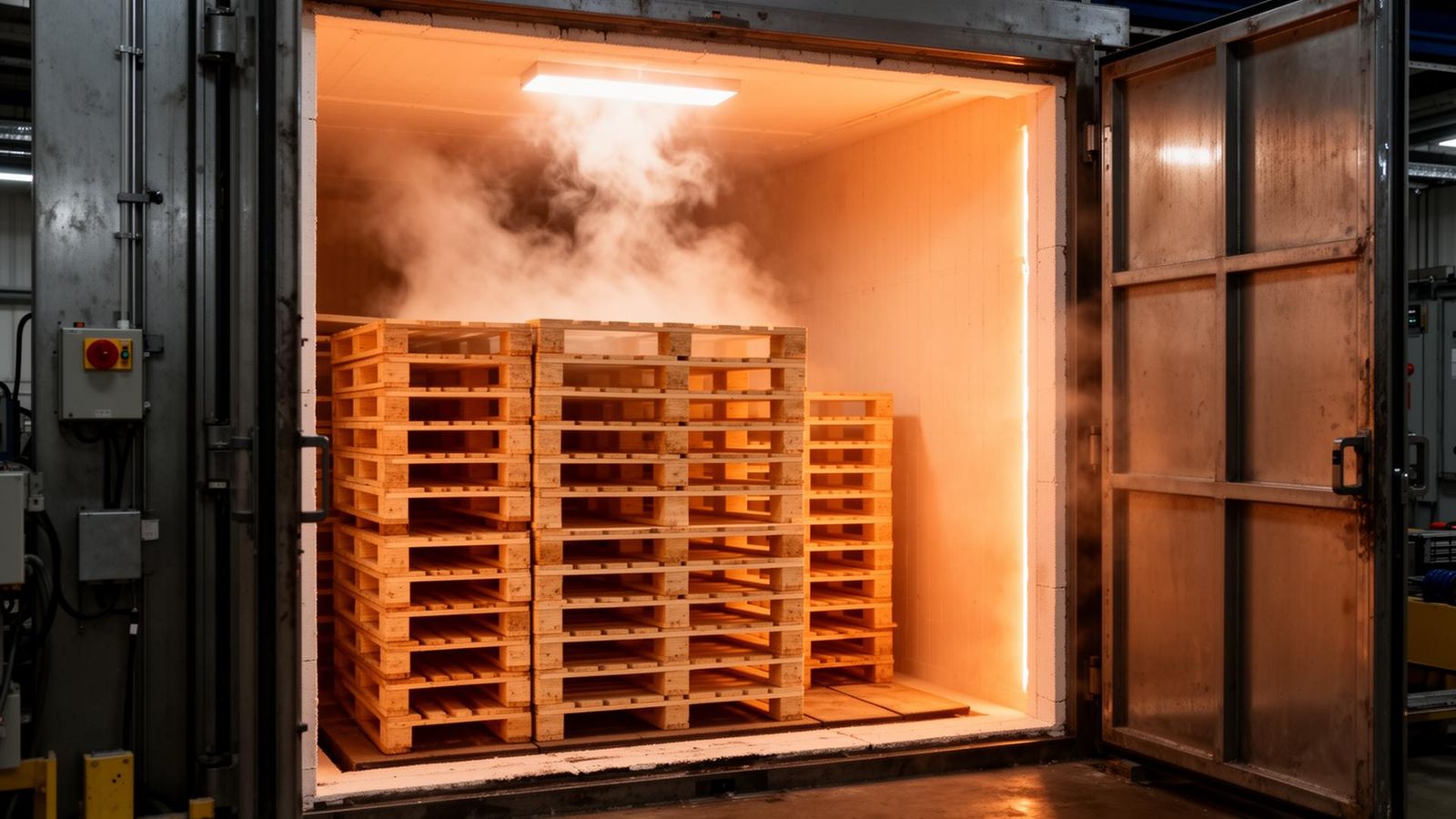
How each treatment works
Heat Treatment (HT): pallets are loaded into a sealed chamber, heated by steam, gas or biomass burner until the wood core reaches ≥ 56 °C for ≥ 30 minutes (for hardwoods, some pests require 60 °C / 60 min). Probes inside reference loads log the cycle for certification. Cycle time: 4-12 hours including ramp-up and cool-down.
Methyl Bromide (MB): pallets are sealed in a gas-tight chamber and fumigated with methyl bromide at prescribed dose, temperature and concentration-time (CT) product for 16-24 hours. Effective, fast at high temperatures, but the gas is ozone-depleting and human-toxic.
Environmental and regulatory profile
MB is regulated under the Montreal Protocol as a Class I ozone-depleting substance. Most major importing blocs, EU, Switzerland, Norway, Australia, New Zealand, refuse MB-treated pallets at port. The US, China, India, the UAE and Saudi Arabia accept either treatment, but procurement teams increasingly mandate HT for ESG reporting.
HT carries no chemical residue, no ODS liability, no special handling rules. The treatment leaves the wood completely chemical-free.
Cost and throughput
HT is cheaper per pallet at scale: a modern HT chamber treats 200-400 pallets per cycle on biomass fuel from sawmill offcuts. MB carries higher operating cost (the chemical, the licensed operator, the venting cycle and the gas-monitoring overhead).
For high-throughput pallet plants, HT integrated with kiln drying (KD-HT) is the most efficient configuration, moisture content is set and ISPM-15 compliance achieved in a single thermal cycle.
Which to specify
New programmes: specify HT only. It is universally accepted, environmentally clean, lower-cost and lower-liability.
Existing MB inventory destined for non-EU markets: usable until depleted; do not order new MB stock. TIC Dubai supplies HT exclusively across all pallet wood programmes for the GCC and exports beyond.