
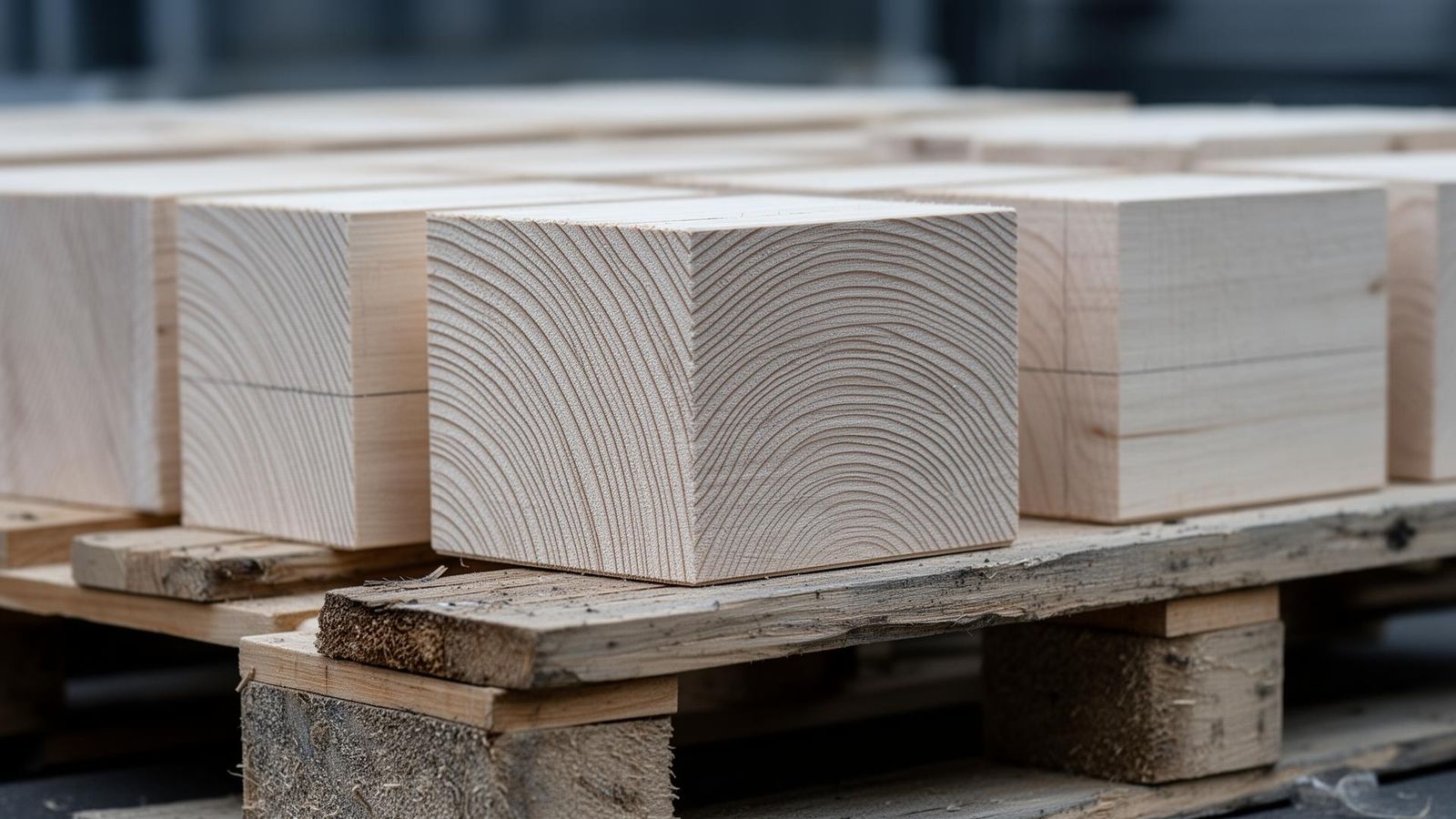
Solid wood pallet blocks
Cut from clear softwood (pine, whitewood, spruce) or hardwood depending on rating. Single piece, no joints, full timber section. Highest strength-to-weight ratio, dimensionally stable, the EPAL specification default. Limited by the availability of large clean sections, drives a higher per-block cost on premium grades.
Finger-jointed (FJ) pallet blocks
Made from short, clean offcuts end-joined with structural adhesive into longer sections. The finger-joint pattern is visible on the end grain. Mechanical performance approaches solid wood (the joint is rarely the failure point), with significant material recovery gains, making FJ blocks 15-30% cheaper than equivalent solid blocks.
Approved for EPAL Euro pallet manufacture since 2010. The dominant block in modern European and Asian pallet plants.
Composite (LVL-style) pallet blocks
Made from veneer or chip layers bonded under heat and pressure into a uniform composite. Predictable density, no knots, minimal moisture movement, exceptional consistency. Slightly heavier than solid wood at equal section, with strength engineered into the lay-up.
Used for high-stack-load pallet pools (automotive, electronics, food) and engineered wood block applications where dimensional stability is critical.
Specifying blocks on the RFQ
Specify: block type (solid / FJ / composite), dimensions (78×78×95, 78×78×100, 78×78×145 are EPAL standards), species (pine, whitewood, spruce, mixed softwood), grade (clear, sound knots only, industrial), moisture content (≤ 22% for HT-stamped output) and quantity. Pallet block plants in Türkiye, Italy, Romania and Brazil are the global production centres; TIC Dubai sources to GCC delivery.