
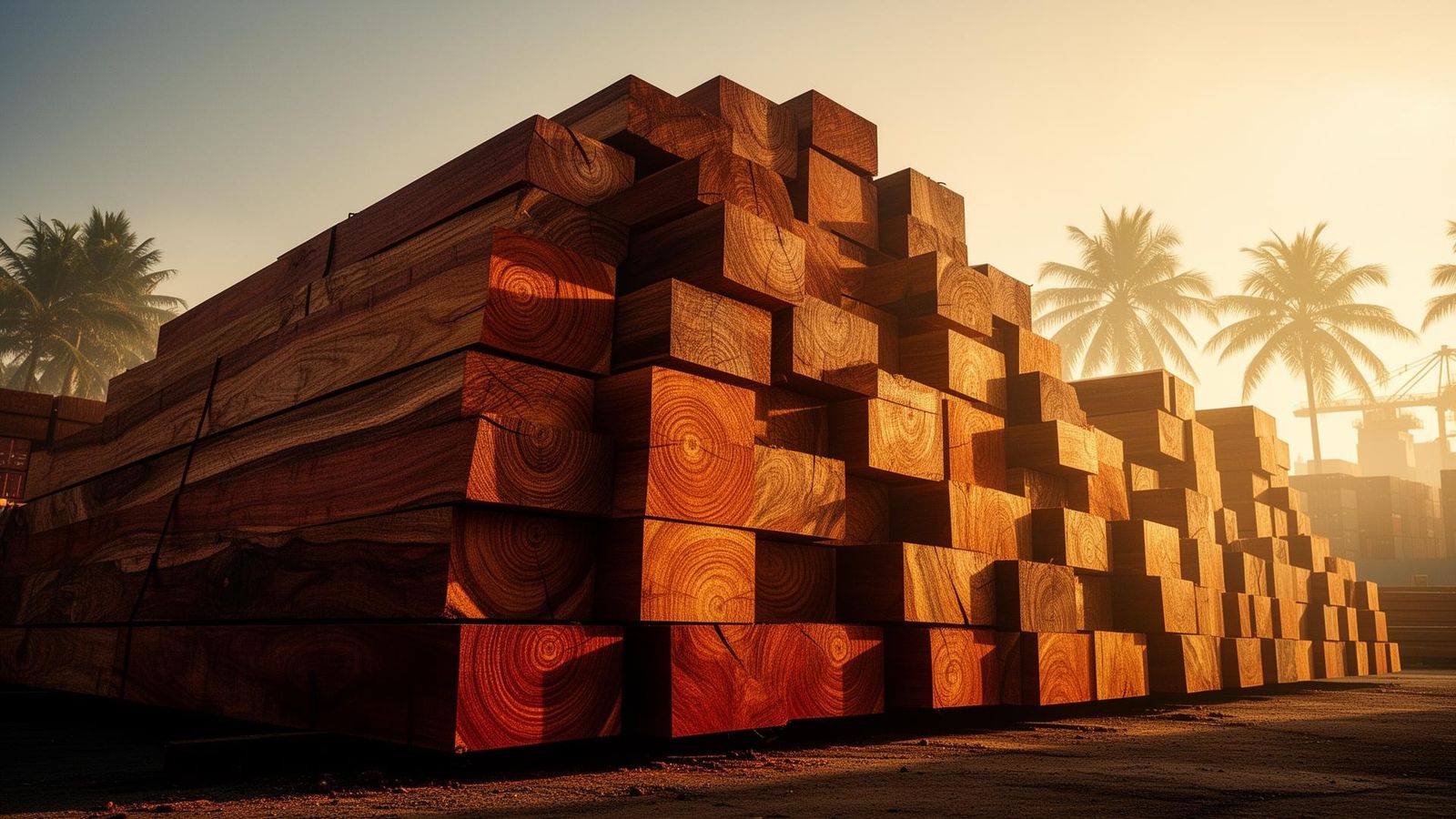
Definition: hardwood timber squared on four faces
A hardwood square log is a section of trunk timber from a broadleaf species (iroko, sapele, dabema, khaya, teak, oak, beech) squared on four faces by twin band-saw or chainsaw at the origin sawmill. The result is a parallel-sided beam free of bark, sap and wane, presented in standard cross-sections from 100×100 mm to 300×300 mm and lengths from 1.8 m to 6.0 m.
The form is the upstream feedstock for the joinery, furniture, door and flooring industries, a higher-yield, easier-to-handle alternative to round logs that removes a primary breakdown step at destination.
How they're produced at origin
Felled hardwood logs are cross-cut to length, then passed through a twin band-saw that takes the round trunk and removes opposing slab faces in two passes. The log is rotated 90° and the operation repeated, leaving a four-sided squared timber. Better sawmills then dress the squared faces to ±5 mm tolerance and end-seal the cut faces within 24 hours to prevent end-checking during kiln or air drying.
Tropical mills in Cameroon, Gabon, Congo, Côte d'Ivoire, Ghana, Myanmar and Indonesia produce the bulk of African and Asian square logs. European mills in France, Germany, Croatia and Romania produce squared oak, beech and ash for premium joinery markets.
Why GCC buyers specify squared over round
Three commercial reasons: yield, packing and process. Yield: squared timber removes 20-30% of round-log waste at origin where labour is cheaper, lifting downstream usable volume per cubic metre. Packing: squares stack into 20' and 40' containers at near-perfect density, where round logs leave significant void. Process: GCC joineries and component plants do not run primary band-saws, squared stock arrives ready for re-saw, machining and joinery production.
For high-density species (iroko, sapele, dabema, azobe) the weight-to-volume ratio means containers ship to weight limits before volume limits; squared stock maximises chargeable mass.
Standard species, sections and lengths
Most-traded species: iroko, sapele, dabema, khaya, wawa, teak, European oak, European beech, European ash. Premium and specialty: padouk, okan, azobe, kossipo, bubinga (CITES II, permit required), Burmese teak.
Cross-sections: 100×100, 150×150, 200×200, 250×250, 300×300 mm. Larger custom sections (350+ mm) subject to log diameter at origin. Lengths: 1.8 m to 6.0 m, with 3.0 m and 4.0 m most-used in GCC joinery. Tolerance: ±5 mm per face on cross-section, +50/-0 mm on length.
Where they end up in GCC industry
Joinery shops: re-sawn and machined into door blanks, frames, mouldings and architectural millwork. Furniture plants: dressed into table legs, structural carcasses and visible joinery. Flooring mills: re-sawn into strip and plank flooring stock. Component plants: cut to size for window sections, cabinetry rails and stair parts. Sawmills: secondary breakdown into boards for re-export across the Levant, Iraq and the Indian subcontinent.