
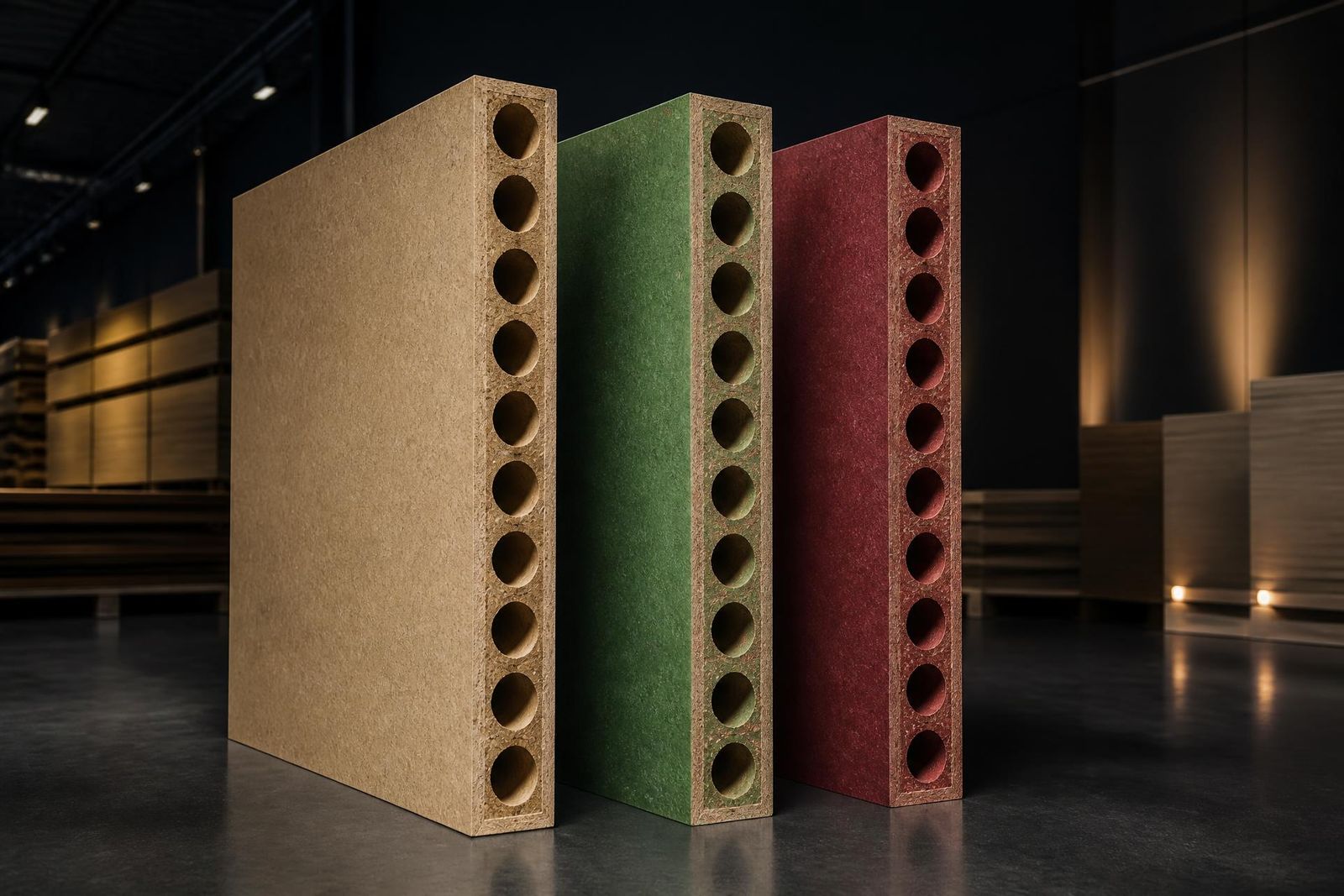
Tubular Core Chipboard (Door Core)
Engineered lightweight core board with continuous hollow tubular cavities running through the panel. The default core substrate for flush doors, hotel doors, apartment doors, wardrobe shutters and interior joinery, high strength-to-weight, excellent screw-holding and superior sound performance compared to honeycomb cores.
What tubular core chipboard is.
Tubular Core Chipboard, also known as Hollow Core Chipboard, Door Core Chipboard, Tubular Particle Board or Hollow Core Particleboard, is an engineered lightweight core panel manufactured with continuous parallel hollow tubular cavities extruded through the board. It is the global standard core for flush doors and interior door manufacturing, used by door producers across hospitality, residential and commercial projects to deliver a lightweight, dimensionally stable, sound-attenuating door at a fraction of the weight of a solid core.
Tubular Core Chipboard is an extruded particleboard panel produced from wood particles, urea-formaldehyde or melamine-urea-formaldehyde resin and wax, pressed through a continuous extrusion die that forms the characteristic tubular hollow cores running parallel to the long axis. The result is a rigid, lightweight core panel with high strength-to-weight ratio, excellent dimensional stability, strong screw and dowel holding in the solid edge zones, and good acoustic insulation across the door face. It is supplied in Standard (natural), HMR (Green, moisture-resistant) and Fire-Rated (Red) grades to match interior, humid and life-safety door specifications.
Manufacturing: Resinated wood particles are continuously extruded through a heated die fitted with cylindrical steel rods, which form the parallel hollow cores. The extruded slab is cured under heat and pressure, then cut to door-blank size and sanded. Edge frames (stiles, rails and lock blocks) are added by the door manufacturer to convert the core into a finished flush door, which is then faced with HDF, MDF, plywood, veneer or laminate skin.
Tubular core chipboard is supplied as a core substrate. Fire rating, acoustic rating, security rating and weather rating are properties of the complete door assembly (core + facings + edges + hardware + seals), not of the core in isolation. Always share the door specification, target rating and certifying body, and we revert with the matching core grade and origin.
Tubular Core Chipboard variants.
Standard Tubular Core (Natural)
Standard interior-grade tubular core for dry conditions. The default core for residential interior doors, apartment doors, office doors, wardrobe shutters and furniture components. Natural beige body, E1 emission.
HMR Tubular Core (Green)
Moisture-resistant tubular core with MR resin system, identified by the characteristic green dye. Specified for kitchens, bathrooms, utility rooms, hospitality wet zones and humid interior environments where dimensional stability under humidity matters.
Fire-Rated Tubular Core (Red)
Fire-rated tubular core engineered with fire-retardant resin and additives, identified by the characteristic red dye. Used as the core substrate for fire-rated doors in hotels, hospitals, schools, high-rises and commercial buildings. Fire performance is certified at the complete door-assembly level, not the core alone.
Configured to your specification.
Share the parameters below. We revert with mill availability, lead time and pricing.
Density, strength, performance.
Where tubular core chipboard is specified.
- Flush doors and interior door manufacturing
- Hotel and hospitality guestroom doors
- Apartment, villa and residential interior doors
- Office, commercial and fit-out doors
- Fire-rated door cores (with certified assembly)
- Wardrobe shutters and built-in cabinetry
- Partition systems and interior joinery
- Furniture components requiring lightweight core
- Acoustic interior doors (with appropriate facing)
Tubular Core Chipboard
Standard vs HMR vs Fire-Rated
Side-by-side positioning across moisture, fire, application, door type and cost.
| Property | Standard (Natural) | HMR (Green) | Fire-Rated (Red) |
|---|---|---|---|
| Identification colour | Natural beige | Green dye | Red dye |
| Moisture resistance | Dry interior only | Good, humid interior rated | Standard interior, not for wet zones |
| Fire performance | Standard combustible | Standard combustible | Fire-retardant core (assembly-certified) |
| Typical door type | Residential / office interior | Kitchen / bathroom / hospitality | Fire doors, escape routes, compartmentation |
| Project sector | Residential, commercial fit-out | Hospitality, healthcare wet zones | Hotels, hospitals, schools, high-rise |
| Interior suitability | All dry interiors | All interiors incl. humid | All interiors, life-safety mandatory |
| Cost positioning | Most economical | Mid-tier | Premium (certification driven) |
Tubular Core vs Solid Particleboard Core
Why door manufacturers specify a tubular core over a solid particleboard infill.
| Property | Tubular Core Chipboard | Solid Particleboard Core |
|---|---|---|
| Weight | 40–60% lighter | Heavy |
| Strength-to-weight ratio | High (engineered tubular structure) | Lower per unit weight |
| Screw holding (edge zone) | Excellent with stile / lock block | Excellent throughout |
| Sound insulation | Good (air-cavity damping) | Higher mass = higher attenuation |
| Ease of machining | Easy, clean cuts on door lines | Heavier, slower on door lines |
| Door applications | Standard interior, hotel, apartment, FR (assembly) | Acoustic and security doors where mass matters |
| Site handling | Easier, reduced shipping weight | Demands more handling labour |
Tubular Core vs Honeycomb Door Core
How extruded tubular cores compare to paper / cardboard honeycomb cores.
| Property | Tubular Core Chipboard | Honeycomb (Paper) Core |
|---|---|---|
| Strength | Higher, solid wood-particle walls | Lower, paper cell walls |
| Rigidity | Higher in-plane and through-thickness | Lower, more prone to telegraphing |
| Weight | Light, with mass-loaded feel | Very light, hollow feel |
| Sound insulation | Better mass-spring-mass behaviour | Modest, low mass |
| Hardware holding | Excellent at edge frame | Requires lock-block inserts everywhere |
| Durability under impact | Higher, particle core resists deformation | Lower, paper crushes under impact |
| Typical projects | Hotels, hospitals, residential, commercial | Budget interior and back-of-house doors |
How to specify and procure tubular core chipboard.
- 01Specify the correct grade
Specify Standard for dry residential, commercial and office interiors; HMR (Green) for kitchens, bathrooms, hospitality wet zones and any permanent humid interior; Fire-Rated (Red) for hotels, hospitals, schools, high-rises and any door subject to fire compartmentation. Always confirm the project's fire-rating target (e.g. 30 / 60 / 90 minutes) so the matching core and certified assembly can be specified together.
- 02Select thickness to door spec
28–35 mm is typical for interior residential and commercial flush doors; 38–44 mm is standard for hotel, hospital and fire-rated doors; 50–58 mm is used for heavy commercial, acoustic and security doors. Always size the core thickness to the finished door thickness minus the combined facing thickness.
- 03Confirm edge frame and lock block
Tubular core panels require a perimeter edge frame (stiles and rails) plus a lock block (and typically a closer block) installed by the door manufacturer. Confirm hardware locations early so the lock and closer blocks land where they are required.
- 04Storage on site
Store flat, fully supported, on level bearers in a dry, ventilated, weather-protected area. Protect from direct sun, ground moisture, standing water and humidity swings. Allow the cores to acclimatise to the project's interior conditions for at least 48 hours before facing or final assembly.
- 05Machining and handling
Cut, drill and rebate using sharp carbide tooling on standard door-line equipment. Support both faces during through-cuts to prevent edge break-out. Handle on edge with two persons for door-blank sizes; never drag the face on the floor, protect surfaces with foam pads or stillage strapping.
- 06Moisture protection
Seal all cut edges, hardware mortices and hinge rebates before installation, especially on HMR cores in humid zones. Once faced and edge-banded, the assembled door becomes the moisture barrier; until then, treat the bare core as a moisture-sensitive substrate.
How to inspect tubular core chipboard on receipt.
Both faces should be uniformly sanded, calibrated and free of dust patches, sanding marks, glue spots, scorched zones and depressions. The surface should be ready to receive HDF, MDF, plywood, veneer or laminate facing without filling.
Inspect the long-edge cross-section: the tubular cores should be parallel, evenly spaced, of consistent diameter and continuous along the panel length. Crushed, oval or partially-collapsed cores indicate extrusion or pressing defects and should be rejected.
Check long-edge straightness with a straight-edge and panel diagonals with a tape measure. Panels should be square within mill tolerance (typically ± 1–2 mm on door-blank sizes) and free of visible bow, cup or twist.
Measure thickness at all four corners and at mid-edges with a calliper. Deviation should fall within mill tolerance (typically ± 0.3 mm). Variation greater than this will telegraph through the facing and the finished door surface.
Reject panels showing water stains, edge swelling, fibre raise on the face, mould bloom or musty odour. On HMR (Green) panels, the green dye should be uniform, pale, blotchy or absent dyeing can indicate substituted or non-MR resin.
Edges should be square, cleanly cut and free of break-out, splintering or chip-loss around the core openings. The wall thickness around each tubular core should be uniform and intact, exposed or broken walls weaken hardware fixing.
Verify width and length against the ordered door-blank schedule with a long tape. Confirm grade by colour (natural / green / red) and by mill stamp or pallet documentation; never accept undyed or pale panels as HMR or FR.
Why it's specified.
- Lightweight: typically 40–60% lighter than solid particleboard core doors
- High strength-to-weight ratio from extruded structural core
- Excellent screw and dowel holding at solid edge zones for hinges, locks and hardware
- Superior dimensional stability, minimal warp, twist or bow over door height
- Good sound insulation across the door face
- Smooth, uniform faces ready for HDF, MDF, plywood, veneer or laminate facing
- Machines cleanly on standard door-manufacturing lines
- Cost-effective alternative to solid core doors at production scale
- Reduced shipping weight and easier site handling
Where to specify carefully.
- Always requires a perimeter edge frame (stiles, rails, lock block), not used as a finished panel on its own
- Hardware fixing must land in the solid edge zone, not the hollow core area
- Fire performance is certified at the complete door assembly level, core grade alone does not guarantee a rating
- Standard (natural) grade is not suitable for permanent humid environments, specify HMR for wet zones
Certified to international specification.
Tubular Core Chipboard: answered.
Quote Tubular Core Chipboard.
Share grade, thickness, panel size, fire / emission rating and quantity. We revert with mill availability, lead time and pricing within one working day.