Definition
WBP (Weather and Boil Proof) is a classification for plywood adhesives that remain intact after prolonged exposure to water, boiling water and weather cycling. The term originates from BS 1203 and has been carried into procurement language across the Middle East, Africa and Asia. In modern European standards the equivalent classification is EN 314-2 Bond Class 3, the highest of three durability classes. A true WBP-bonded panel is one whose veneers do not delaminate after a defined boil-immerse-dry cycle and whose glue line retains a specified minimum shear strength after that exposure.
Resin chemistry: phenolic, melamine, urea
Three thermosetting resins dominate plywood manufacturing, and the difference between them is the difference between a marine-grade panel and a wet failure.
Phenol-Formaldehyde (PF) resin is the only chemistry that delivers true WBP performance. The cured resin is permanently cross-linked, hydrolysis-resistant and survives the EN 314-2 Class 3 boil cycle. PF is dark amber to brown, which is why the glue line on a genuine WBP panel reads as a thin dark stripe between veneers.
Melamine-Urea-Formaldehyde (MUF) resin is an intermediate chemistry. It improves on plain urea resin and meets EN 314-2 Class 2 (humid conditions, short water exposure), but it is NOT WBP. Many mills label MUF panels as "semi-WBP" or "WBP-equivalent", both terms are commercially convenient but technically inaccurate.
Urea-Formaldehyde (UF, also called MR, Moisture Resistant) is the cheapest chemistry. It cures clear, performs in dry interior service, and dissolves in prolonged water contact. UF/MR meets EN 314-2 Class 1 only and must never be specified for formwork, marine or exterior use.
How WBP plywood is manufactured
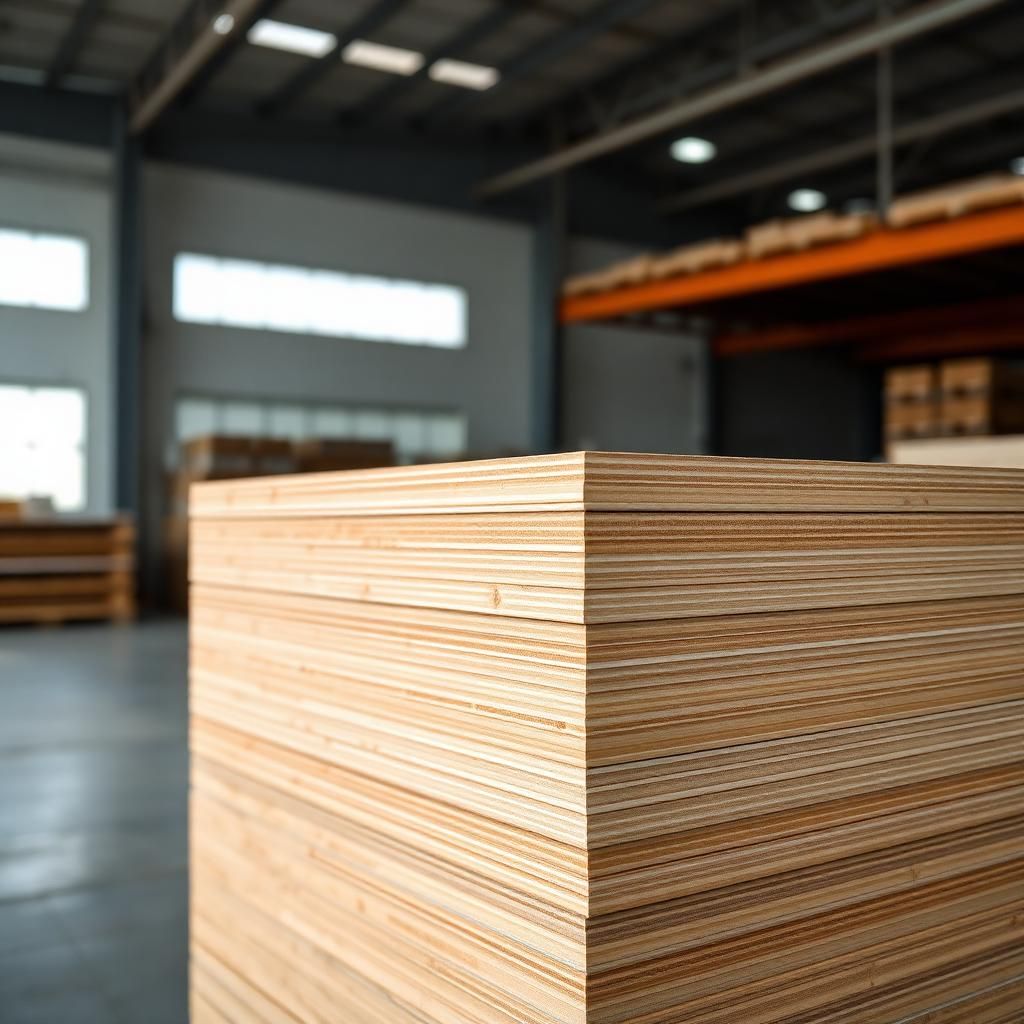
Veneers are peeled, dried to 6-10% moisture, graded and laid up in a balanced odd-numbered ply schedule (typically 7, 9, 11 or 13 plies for 12-21mm panels). Phenolic resin is roller-applied at a specified glue spread of 280-380 g/m² double-sided. The lay-up is cold-pressed to consolidate, then hot-pressed at 130-150°C and 8-15 kgf/cm² for a press time calculated from panel thickness (typically 1.0-1.4 minutes per millimetre). The cure is irreversible: once a PF glue line is set, it cannot be softened by water, solvents or short-duration heat. Film-faced plywood adds a phenolic-impregnated paper film on both faces during the final press cycle, fusing it to the substrate as a single thermoset system.
Standards: EN 314, BS 1203, JAS, BS EN 636
EN 314-1 defines the test method (specimen geometry, soaking and boiling regimes, shear strength measurement). EN 314-2 defines the three bond classes: Class 1 (dry conditions), Class 2 (humid conditions), Class 3 (exterior / WBP). EN 636 then groups panels by service environment: EN 636-1 (dry), EN 636-2 (humid), EN 636-3 (exterior). A panel marked EN 636-3 must carry an EN 314-2 Class 3 glue line.
BS 1203 (the historical British standard for plywood adhesives) defines four bond types: INT (interior), MR (moisture-resistant), BR (boil-resistant) and WBP (weather and boil proof). WBP is the top class. The standard is largely superseded by EN 314 in current European procurement but persists in legacy GCC specifications.
JAS (Japanese Agricultural Standard) defines Type 1 (special, equivalent to WBP), Type 2 (water-resistant) and Type 3 (interior). Korindo film faced plywood and Korinplex are produced and certified under JAS Type 1, which is functionally equivalent to EN 314-2 Class 3 / WBP.
WBP vs BWP: same word, different meaning
WBP (Weather and Boil Proof) is the European/British classification. BWP (Boiling Water Proof) is the Indian (BIS) classification used in IS 710 (marine plywood) and IS 4990 (concrete shuttering plywood). The chemistry is the same, phenolic resin, and a BWP-marked IS 710 panel will satisfy a WBP specification on a GCC project provided the IS test certificates accompany the consignment. The reverse also holds: a JAS Type 1 panel from Korindo meets BWP intent.
In practice, the term used on the purchase order should match the standard cited. "WBP to EN 314-2 Class 3" or "BWP to IS 710" are unambiguous; "WBP" alone, with no standard reference, is the single most common cause of resin disputes between contractors and traders.
WBP in film faced plywood
Film faced plywood is the highest-volume application of WBP glue in GCC construction. The substrate plies are PF-bonded, and the surface films are PF-impregnated paper fused on by the same thermoset chemistry. The result is a single chemical system that survives the moisture, alkalinity and mechanical abuse of repeated concrete pours. A "WBP" film faced panel built on MUF or UF glue will delaminate within 5-15 pours; a true PF-bonded panel routinely delivers 25-50 pours when stripped, cleaned and re-oiled correctly.
WBP in marine plywood
Marine plywood (IS 710, BS 1088, EN 13986 marine) is defined not only by its WBP/BWP glue line but also by veneer species, defect grade, void rate and dimensional tolerances. WBP glue is necessary but not sufficient. A panel can carry WBP-grade resin and still fail IS 710 if it has core voids, low-density face veneers, or out-of-tolerance density. Always request the species list, density figure and core void declaration alongside the WBP certification.
Common misconceptions
1. "WBP means waterproof." It does not. WBP describes the glue line, not the panel. Untreated WBP plywood will still absorb water through end-grain and face veneers and degrade biologically.
2. "All Chinese plywood is MR; all Indonesian plywood is WBP." False on both counts. Country of origin tells you nothing; the test certificate and resin supplier tell you everything.
3. "Brown glue line = WBP." A reliable visual indicator, but mills can tint UF resin brown. The boil test (3 hours boil, 8 hours soak, 16 hours dry, repeat) is the only definitive test.
4. "WBP and E0/E1 formaldehyde emission are the same conversation." They are independent. WBP describes durability; E0/E1/CARB-P2 describes emission. A panel can be E0 and MR (interior), or E1 and WBP (formwork).
How to verify WBP quality before shipment
1. Request the manufacturer's test certificate to EN 314-2 Class 3, IS 710, or JAS Type 1. The certificate should show shear strength values after the specified boil-soak-dry cycle, not a generic "WBP" claim.
2. Inspect the glue line on a freshly cut edge: a uniform dark amber-to-brown line with no white streaks is consistent with PF. White, milky or translucent glue lines indicate UF or MUF.
3. Run a field boil test on a 50x50mm sample: 3 hours in boiling water, 8 hours air dry. A PF-bonded sample will not delaminate. A UF-bonded sample will separate along one or more glue lines.
4. For shipments destined for GCC formwork projects, require a third-party (TUV, SGS, Bureau Veritas) pre-shipment inspection at the mill with a witnessed boil test on a randomly selected panel.
5. Verify the bond class statement on the panel edge stamp matches the purchase order language: EN 636-3 / EN 314-2 Class 3 / JAS Type 1 / IS 710 / IS 4990, these are the durable references.
GCC procurement context
On UAE, Saudi Arabia, Qatar and Oman infrastructure projects, consultants increasingly call out "WBP phenolic bonded plywood to EN 636-3 / EN 314-2 Class 3" in formwork specifications. On older masterspecs the term "WBP to BS 1203" still appears; both are acceptable provided the test certificate references the cited standard. Korindo Korinplex and Korindo Superform film faced plywood supplied through TIC Dubai are produced under JAS Type 1 / EN 314-2 Class 3, with mill test certificates traceable to the heat batch.