Why beech bends better than other species
Beech has long, straight, uniform cell structure with low ray-fleck interference and high cellulose flexibility under steam-induced plasticisation. The cell walls soften at 95–100°C, allowing the timber to bend to tight radii without splitting the outer face. White oak and ash are the closest cousins; beech remains the global benchmark.
The steam bending process
Steam at 95–100°C for 1 hour per 25 mm of timber thickness. Move the timber quickly from chamber to former, the working window is 60–90 seconds. Apply a compression strap on the outer face to hold it in compression (timber bends well in compression but poorly in tension) and force the bend onto the former. Clamp on the former for 24–72 hours to lock the new shape, then equalise to service moisture content.
Bend radius and limits
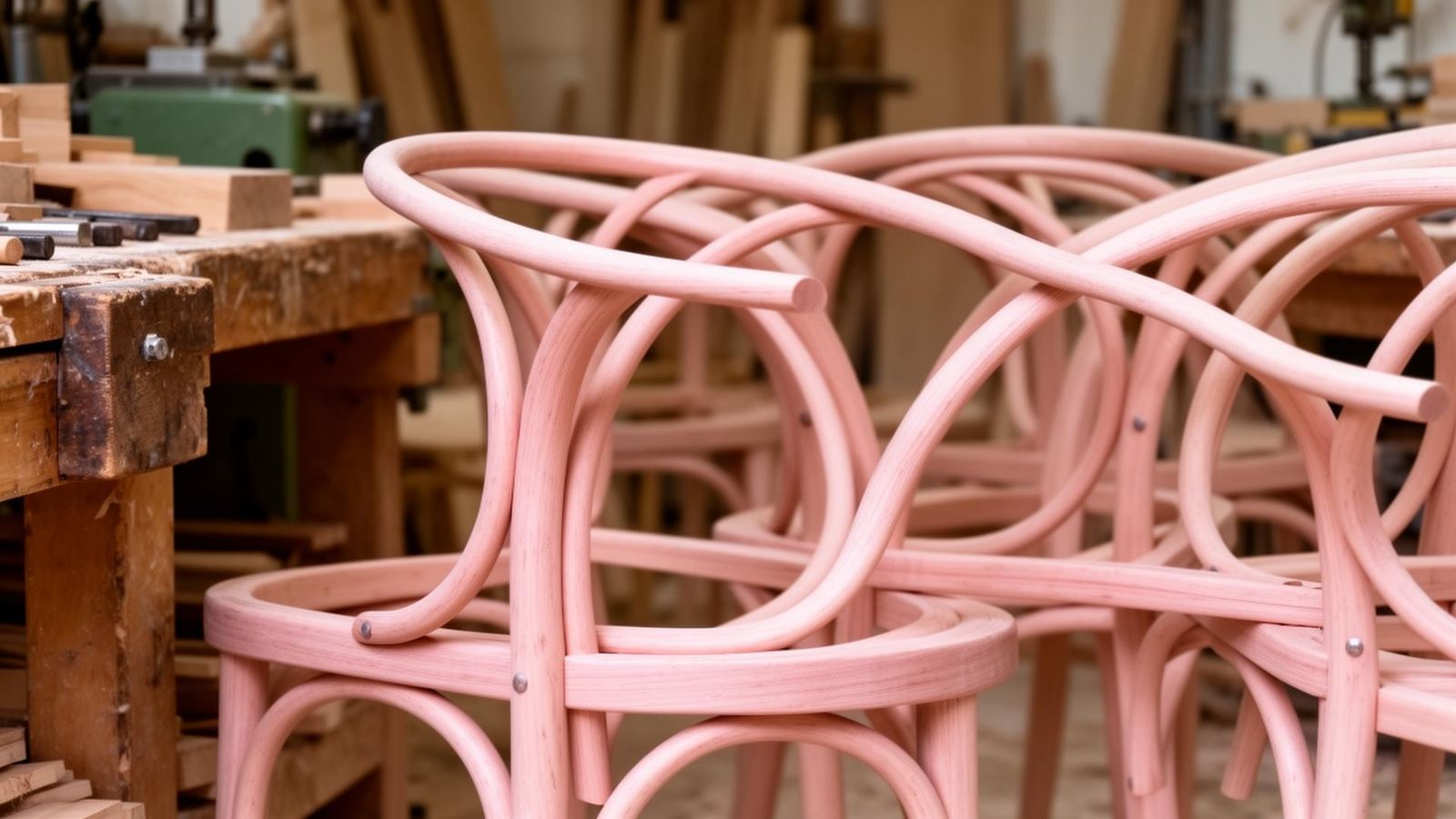
Under proper steaming with compression strap, beech bends to a radius of 5–8× the timber thickness for clear stock, and 10–12× the thickness for industrial-grade stock. The Thonet No. 14 chair achieves a continuous back-and-leg bend in a single piece of 26 mm steamed beech.
Contemporary applications
Thonet bentwood (since 1859), TON café chairs, Vitra furniture, Magis Air Chair, Eames LCM/DCM laminated bentwood, all built on the foundation of steam-bent beech. Modern bentwood production combines traditional steam bending with CNC profiling and laminated bent constructions for complex geometries.