Definition
6061 and 6063 are heat-treatable aluminium alloys in the 6xxx series (Al-Mg-Si). Both are extruded, both are heat-treated to T5 or T6 temper, and both anodise cleanly. The decisive difference is alloy content: 6061 carries about twice the magnesium and 60% more silicon, plus a deliberate copper and chromium addition, delivering significantly higher mechanical strength at the cost of extrudability and surface finish quality. 6063 is engineered the opposite way, lower alloy content for cleaner extrusion of complex thin-wall profiles with a flawless anodised finish.
Chemistry
Element | 6061 | 6063 Si | 0.40-0.80% | 0.20-0.60% Fe (max) | 0.70% | 0.35% Cu | 0.15-0.40% | 0.10% max Mn (max) | 0.15% | 0.10% Mg | 0.80-1.20% | 0.45-0.90% Cr | 0.04-0.35% | 0.10% max Zn (max) | 0.25% | 0.10% Ti (max) | 0.15% | 0.10%
Mechanical properties (T6 temper)
Property | 6061-T6 | 6063-T6 0.2% proof stress | 240 MPa | 170 MPa Tensile strength | 290 MPa | 215 MPa Elongation | ≥10% | ≥8% Hardness (HB) | ~95 | ~73 Fatigue strength | ~95 MPa | ~70 MPa Density | 2.70 g/cm³ | 2.70 g/cm³
Extrudability and finish
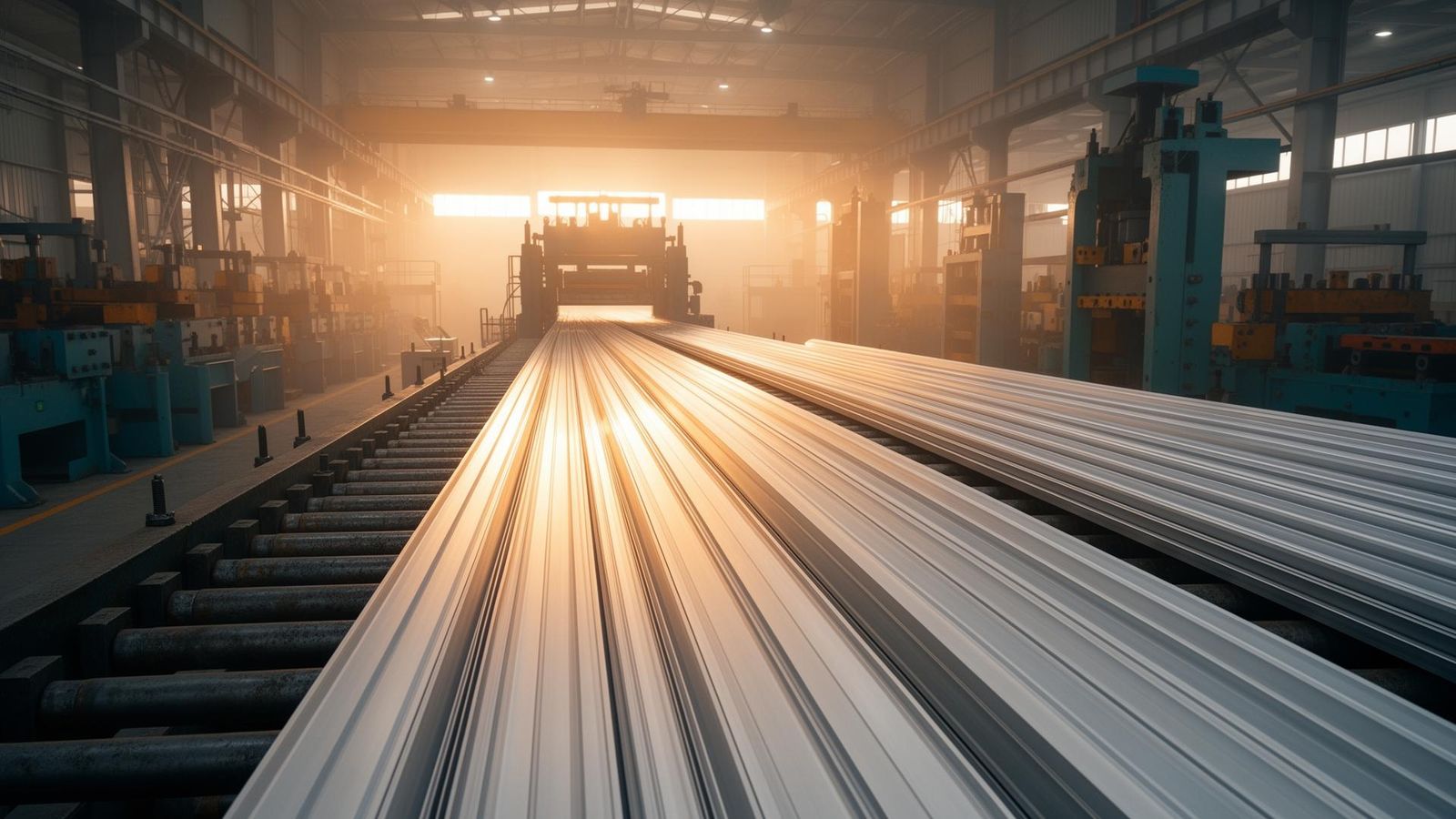
6063's lower alloy content makes it the easier alloy to extrude, higher press exit speeds, cleaner die life and more complex thin-wall sections are achievable. The reduced iron and copper content means anodising produces a uniform clear or coloured film without streaks, blotches or pitting. This is why 6063 is the global default for visible architectural extrusion: window frames, curtain walls, door frames, glazing systems, balustrades and trim.
6061 extrudes more slowly and to less-complex sections; its surface anodises less cleanly. It is rarely used in visible architectural service.
Applications
6061-T6: Structural members in transport (truck frames, bus chassis components, marine equipment). Machined parts: brackets, fittings, structural connectors, bicycle frames, aerospace components. Industrial heat exchangers, pressure vessels (low-pressure), pneumatic equipment. Marine deck fittings, masts, structural marine components.
6063-T5 / T6: Architectural window frames, curtain walls, sliding doors, glazing systems. Decorative balustrades, handrails, signage frames. LED housings, electronics enclosures. Furniture and fitness equipment frames. Irrigation pipes and tubing where pressure ratings are modest.
GCC architectural context
Across UAE, Saudi Arabia, Qatar and Oman, virtually every aluminium curtain wall and window system is extruded from 6063-T5 or 6063-T6. Major systems specifications (Schueco, Alumil, Sapa, RAKO, Reynaers) call 6063 by default. 6061 appears on the same projects only as structural components, louvre supports, bracketing, cladding sub-structure where strength matters more than finish.
Marine and offshore aluminium structures in the Arabian Gulf, boatbuilding, RO equipment supports, dockside structures, default to 5083 plate and 6061-T6 extrusions for structural sections.
Standards
EN 573 (chemistry), EN 755 (extruded rod, bar, tube, profiles), EN 12020 (extruded precision profiles for architectural use), ASTM B221 (extruded aluminium bars, rods, wire, profiles, tubes). On dual-spec projects, mills routinely issue MTCs referencing both standards.