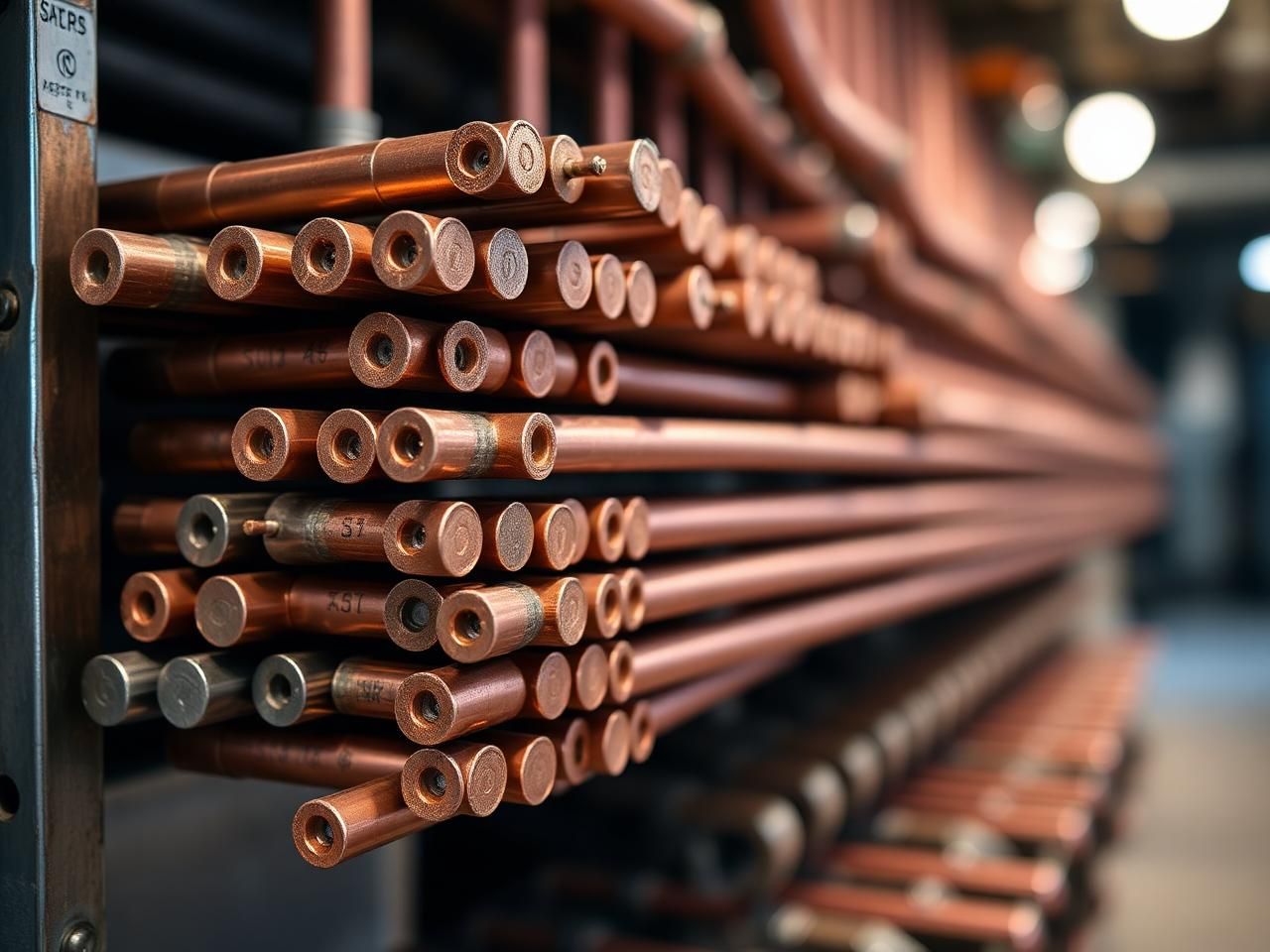
Copper busbars: bare, tin plated, custom.
Cu-ETP busbar for switchgear, transformers, data centres and renewable energy, supplied bare, tin plated or fully fabricated to drawing across the GCC.
Bare, tin plated, custom fabricated.
Copper Busbars
Standard bare copper busbar in ETP grade, the workhorse for panel, switchgear and transformer fabrication.
Tin Plated Copper Busbars
Electroplated tin finish for improved joint stability, corrosion resistance and contact resistance.
Bare Copper Busbars
Mill finish Cu-ETP busbar in standard widths and thicknesses for in-house fabrication.
Custom Copper Busbars
Punched, bent, drilled, taped, sleeved and tin-dipped to drawing, ready for switchgear and panel builders.
Thickness × width × length.
- Thickness: 3, 5, 6, 8, 10, 12, 15, 20 mm
- Width: 15, 20, 25, 30, 40, 50, 60, 80, 100, 120, 150, 200 mm
- Length: 4 m standard, 6 m on request
- Edge: square-cut (standard) or radiused
Capacity, joints, plating, insulation.
Current Capacity
Sized per IEC 61439-1 / IEC 60865; capacity depends on cross-section, orientation, ventilation and ambient temperature.
Joint Design
Bolted lap joints with M8/M10/M12 hardware; contact pressure and surface prep determine performance.
Tin Plating
5–10 µm electroplated tin reduces contact resistance and protects against tarnish in humid GCC conditions.
Insulation
Heat-shrink sleeving, dip-coating or moulded insulation available, colour-coded by phase.
Material specification at a glance.
| Property | Copper Busbar | Aluminium Busbar |
|---|---|---|
| Conductivity (IACS) | ~100% | ~61% |
| Cross-section for same A | Smaller | ~1.5× larger |
| Weight | Heavier | ~50% lighter |
| Joint reliability | Excellent | Needs bi-metallic / plated joints |
| Typical use | Switchgear, transformers, DC | Long bus runs, weight-critical |
Where copper busbars ship.
Copper busbars supply across the GCC, Levant & Iraq.
TIC Dubai supplies copper busbars to fabricators, OEMs, valve and fitting manufacturers, joineries and trade distributors across Dubai, Abu Dhabi, Sharjah, Ajman, Ras Al Khaimah, Fujairah and Umm Al Quwain in the UAE; Riyadh, Dammam, Al Khobar and Jeddah in Saudi Arabia; Doha in Qatar; Muscat, Sohar and Salalah in Oman; Kuwait City, Shuwaikh and Shuaiba in Kuwait; Manama in Bahrain; Amman and Aqaba in Jordan; and Erbil, Baghdad, Basra and Umm Qasr in Iraq.
Copper busbars FAQ
Should I specify copper or aluminium busbars for switchgear?
Copper offers ~100% IACS conductivity, smaller cross-section and stable bolted joints, the standard for switchgear, transformers and data-centre distribution. Aluminium is lighter and cheaper but requires ~1.5× cross-section and bi-metallic plated joints. For GCC switchgear OEMs, copper remains the default.
Why are copper busbars tin plated?
Tin plating reduces and stabilises contact resistance at bolted joints, prevents tarnish from sulphur and humidity, and improves long-term reliability in coastal GCC installations.
What is the current carrying capacity of a 50 × 10 mm copper busbar?
Indicatively ~880 A for a single bare bar vertically mounted in still air at 35°C ambient (per IEC 61439 sizing tables). Tin plating, multiple bars and forced ventilation increase capacity; bundled bars and enclosed panels reduce it.
Do you supply busbars fabricated to drawing?
Yes. Full punching, bending, drilling, deburring, tin plating, sleeving and packaging to drawing for switchgear and panel manufacturers across the GCC.
Get a copper busbar quotation.
Tell us thickness, width, length, plating and any fabrication detail; drawings welcome. We revert with mill and fabrication pricing within one working day.