
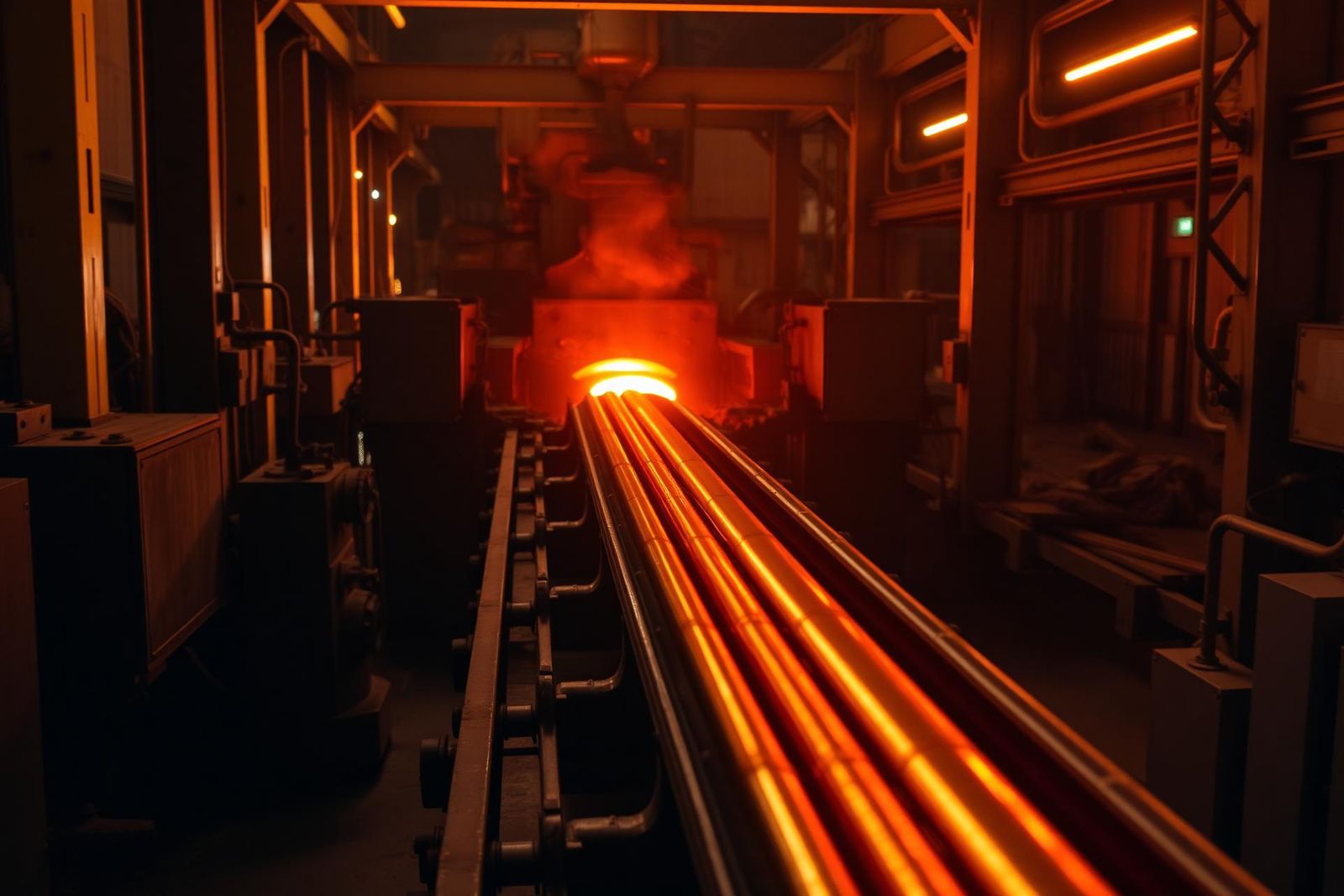
Continuous casting brass ingots: DZR, lead-free, water-grade.
EN 1982-compliant brass ingots for water armatures, sanitary fittings and industrial castings. UBA-listed and 4MS-compliant lead-free grades, supplied with full chemistry traceability.
Four ingot programmes.
Continuous Casting Ingots
Cast on continuous casting machines, delivering a uniform grain structure, predictable machinability, low slag.
Lead-Free Ingots
Pb < 0.1% brass ingots. UBA-listed and DM/4MS-compliant for drinking water.
DZR Ingots
Dezincification-resistant ingots (CW602N) for aggressive water and chloride-rich environments.
Water Fittings Ingots
Sanitary-grade ingots compliant with EN 1982, DIN 50930-6, UBA and 4MS protocols.
Why OEMs specify continuous casting.
Lower slag generation
Clean-melt continuous casting practice slashes slag and improves yield in downstream melting.
Material consistency
Uniform chemistry and grain structure across the full ingot, ensuring predictable casting and machining.
Machinability
Tight composition control delivers consistent chip behaviour for OEMs running automatic lathes.
Traceability
Heat-by-heat EN 10204 3.1 chemistry certificates supplied with every shipment.
Two casting routes.
| Property | Continuous Casting | Gravity Casting |
|---|---|---|
| Grain structure | Fine, uniform | Coarser, variable |
| Composition consistency | Excellent across length | Good but lot-dependent |
| Slag / inclusions | Very low | Moderate |
| Yield in remelt | Higher | Lower |
| Best for | High-volume OEM remelt | Smaller foundry batches |
EN, DIN, UBA, 4MS.
- EN 1982: Copper and copper alloys, ingots and castings
- DIN 50930-6: Corrosion of metals in contact with drinking water
- UBA Positive List (Germany): listed copper alloys for drinking water
- 4MS Common Composition List: Germany, France, Netherlands, UK
- Italian DM 25/2012: drinking water materials
- NSF/ANSI 61: drinking water system components (on request)
Where TIC ingots ship.
Continuous casting brass ingots supply across the GCC, Levant & Iraq.
TIC Dubai supplies continuous casting brass ingots to fabricators, OEMs, valve and fitting manufacturers, joineries and trade distributors across Dubai, Abu Dhabi, Sharjah, Ajman, Ras Al Khaimah, Fujairah and Umm Al Quwain in the UAE; Riyadh, Dammam, Al Khobar and Jeddah in Saudi Arabia; Doha in Qatar; Muscat, Sohar and Salalah in Oman; Kuwait City, Shuwaikh and Shuaiba in Kuwait; Manama in Bahrain; Amman and Aqaba in Jordan; and Erbil, Baghdad, Basra and Umm Qasr in Iraq.
Continuous casting ingots FAQ
What is continuous casting brass ingot?
Continuous casting produces a long brass bar by feeding molten brass through a water-cooled die, delivering a uniform grain structure, consistent chemistry along the bar length, and lower slag content than gravity casting.
Which ingot grade should I specify for potable water castings?
For drinking water in the EU and GCC, specify lead-free silicon brass (CW724R / CW725R) or DZR brass (CW602N). Both are listed on the UBA positive list and 4MS common composition list. We supply with full EN 1982 chemistry and DIN 50930-6 compliance.
What standards apply to brass casting ingots?
EN 1982 covers chemistry and mechanical properties of copper-alloy ingots and castings. DIN 50930-6, UBA Positive List, 4MS, Italian DM 25/2012 and NSF/ANSI 61 cover drinking water suitability.
Continuous casting vs gravity casting: which is better?
Continuous casting wins for high-volume OEM remelting, with finer grain, lower slag, tighter composition control. Gravity casting remains relevant for smaller foundry batches where flexibility matters more than per-tonne yield.
Get an ingot quotation.
Tell us grade, annual tonnage, water-contact requirements and destination. We revert with mill options, certification scope and indicative pricing.