
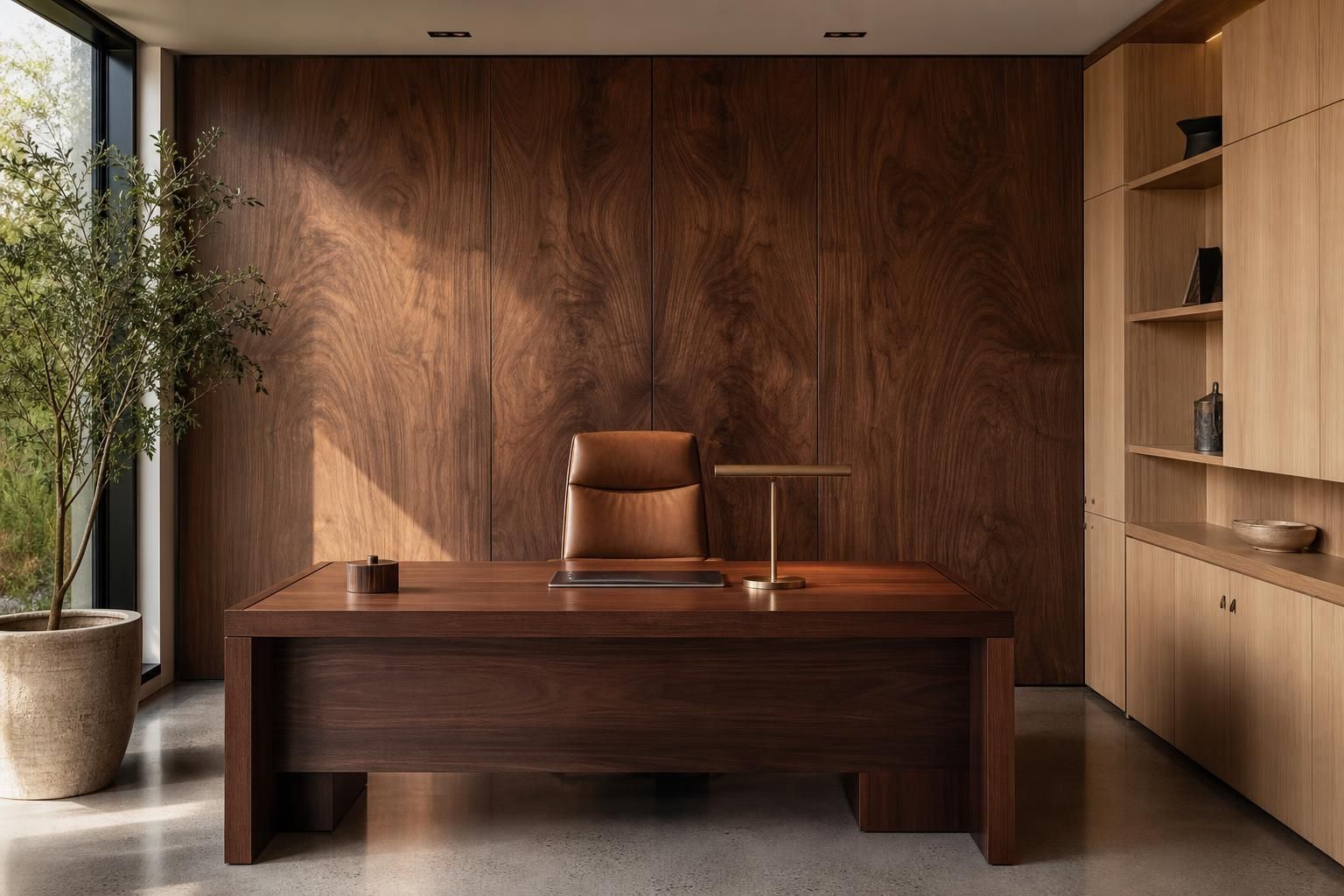
Definition and thickness
Wood veneer is a thin slice of solid timber, typically 0.4mm to 1.5mm thick, glued to a stable substrate (plywood, MDF, particleboard, blockboard) to create panels with the appearance of solid wood at a fraction of the cost and with vastly better dimensional stability. The thinnest commercial veneers are 0.4-0.6mm (face veneers on architectural panels); thicker veneers at 1.0-2.5mm (sometimes called "wood skins" or "constructional veneers") are used on premium furniture and curved laminations.
A single high-value log can yield 30-50 times more square metres of surface as veneer than as sawn boards, which is why rare species such as Macassar Ebony, Burl Walnut, Olive Ash and Madrone are almost exclusively available as veneer rather than solid timber.
How veneer is produced
Step 1 - Log selection and conditioning: veneer logs (peeler logs, slicer logs, flitch logs) are selected for grain, colour and absence of defects, then steamed for 24-72 hours to soften lignin and enable clean slicing. Step 2 - Slicing or peeling: the conditioned log is sliced (flat slicer, quarter slicer, half-round slicer) or peeled (rotary lathe) into continuous sheets. Step 3 - Drying: sheets are dried to 8-12% MC in continuous flat-bed dryers. Step 4 - Clipping and grading: trimmed to standard widths, defects clipped out, sorted by colour and figure. Step 5 - Bundling: leaves are bundled in the original sequence cut from the log ("matched bundles" of 16, 24 or 32 leaves) so that book-matched and slip-matched layups can be assembled by designers.
Substrate pairing
Veneer is never used alone in architectural applications; it is always bonded to a substrate. Common pairings:
MDF: most economical, flattest face, ideal for spray-finished interiors. The GCC default for hotel rooms, retail fit-out and office millwork. Plywood: dimensionally stable across all directions, used where panels must resist humidity changes (bathrooms, beachfront properties) or where edge appearance matters. Blockboard: light weight, good for tall door leaves where MDF weight becomes impractical. Particleboard: economical commercial fit-out where edge banding hides the core.
For luxury hospitality projects in UAE, KSA and Qatar, MDF and plywood substrates dominate.
Where veneer specifies into GCC architecture
Hotel rooms (wall panelling, headboards, wardrobes, vanity units), hospitality F&B (wall cladding, banquette backs, ceiling rafts), corporate boardrooms and executive offices, luxury residential (kitchen cabinetry, library walls, doors), retail fit-out (display fixtures, fitting rooms), yacht interiors, and architectural ceilings.
Across the UAE (Atlantis the Royal, Burj Al Arab, One&Only properties), Saudi Arabia (Red Sea Project, NEOM hospitality, Riyadh hotels), Qatar (Mondrian Doha, hotel pipeline post-WC2022), Kuwait and Oman, veneer-faced panels are the default high-end interior wall and joinery surface.
Specification fundamentals
A complete veneer specification names: (1) species, (2) cut (rotary, flat, quarter, rift), (3) match (book, slip, random), (4) grade (AA, A, B), (5) thickness, (6) substrate, (7) finish (lacquer, oil, UV). Missing any of these creates substitution risk between approval samples and mockup.
TIC Dubai supplies veneer to projects with full species certification, slip sequence preserved, and grade documentation per leaf bundle.