
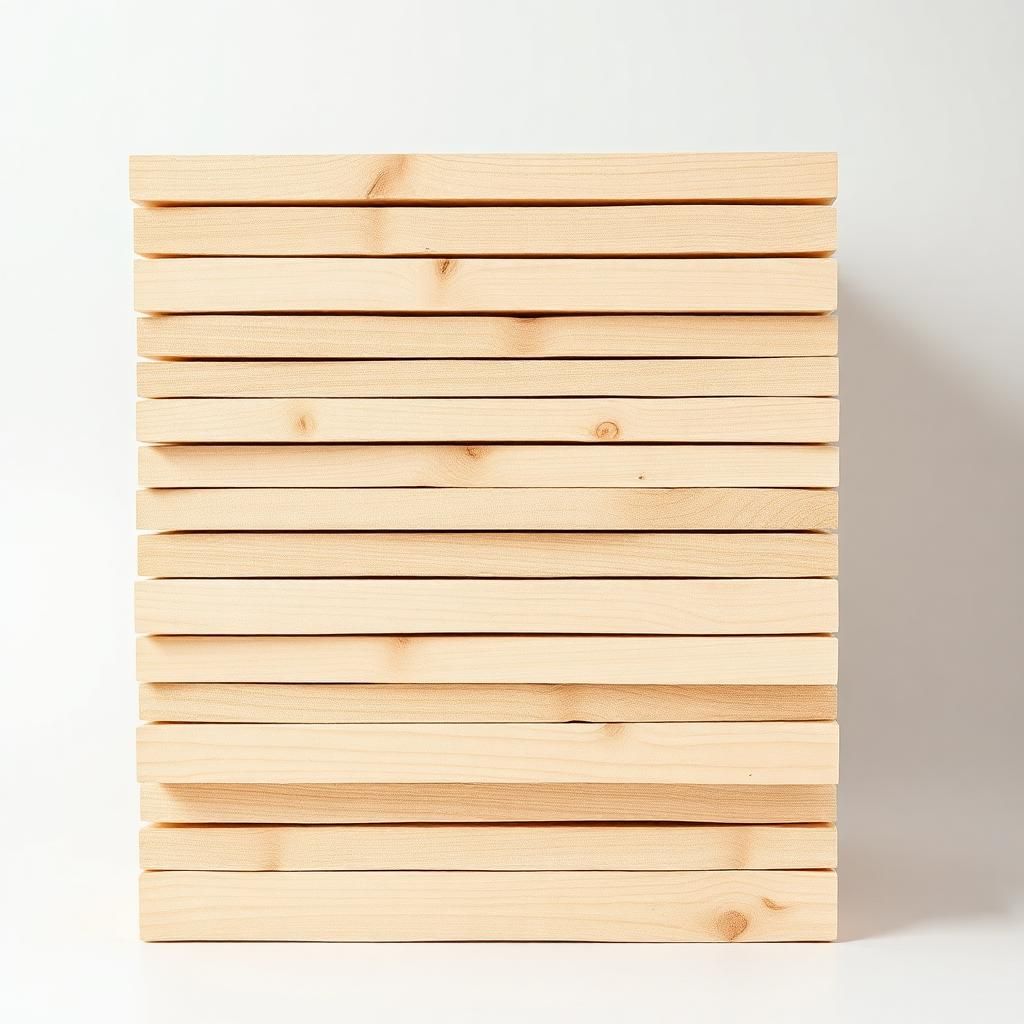
Definition and species composition
SPF (Spruce-Pine-Fir) is a North American commercial grading group that combines several softwood species with closely matched mechanical properties into a single dimensional lumber category. The group covers White Spruce, Engelmann Spruce, Black Spruce, Red Spruce, Lodgepole Pine, Jack Pine, Balsam Fir and Alpine Fir. Because the species share density, strength and machining behaviour, mills grade them under a single SPF stamp under NLGA (National Lumber Grades Authority) rules.
Outside North America, equivalent commercial groupings are sold as European Whitewood (mainly Norway Spruce, Picea abies), Scandinavian Whitewood (Swedish and Finnish spruce/pine mix), Radiata Pine from New Zealand and Chile, Brazilian Pine (Pinus elliottii and Pinus taeda), and Uruguayan Pine. For most GCC construction use cases, these groups are functionally substitutable when graded to equivalent visual or structural classes.
Dimensional properties and density
Average oven-dry density: 400-450 kg/m³ for SPF and European Whitewood, 450-520 kg/m³ for Radiata Pine, 480-560 kg/m³ for southern Brazilian and Uruguayan Pine. Higher density grades carry higher screw and nail withdrawal values, which is why pine is often preferred for fastener-intensive packaging and crating.
Standard structural sizes in the GCC are 2x4 (38x89mm), 2x6 (38x140mm), 2x8 (38x184mm), and metric equivalents 50x100, 50x150, 50x200mm. Lengths run 2.4m to 6.0m in 0.3m increments. Most imports arrive kiln dried to 18-22% moisture, with KD-19 (kiln-dried to <19%) being the GCC project-spec standard.
Grading rules contractors should know
NLGA (Canada/USA): J-Grade (Japan-export premium), Select Structural, No.1, No.2, No.3 for structural; Premium, Standard, Utility, Economy for non-structural. European EN 14081 / DIN 4074: C24 (general construction), C30 (higher strength), C16 (lighter duty). C24 is by far the most-specified structural grade across UAE, KSA and Qatar. Radiata Pine: MGP10, MGP12 (machine-graded), F5/F7 (Australian visual), Clears (knot-free joinery grade).
For carcass framing, false ceiling work and packaging in the GCC, No.2 SPF and C24 Whitewood are the workhorse grades. Joinery and door-frame applications require C24 Clear or Radiata Clears.
Where SPF and Whitewood fit on GCC projects
Construction carcass, formwork timber backing, soffit framing, mezzanine flooring, partition studs, packaging crates, pallets, false ceiling battens, fit-out joinery substrate, and temporary site hoarding. SPF is rarely used as a finish material; it is a structural and substrate timber.
Across UAE, Saudi Arabia, Qatar, Kuwait, Oman and Egypt, whitewood is procured by the container into industrial yards in JAFZA, KIZAD, Dammam Second Industrial City, Sohar Free Zone and Sadat City. TIC Dubai supplies SPF and Whitewood mill-direct from Canada, Sweden, Finland, Germany, Austria, Chile, New Zealand, Brazil and Uruguay.
Treatment and quality requirements for GCC climate
Untreated SPF and Whitewood develop blue stain and surface mould within weeks of arrival in coastal UAE during summer humidity. TIC Dubai supplies all whitewood as AST (Anti-Sapstain) treated by dip or spray, with optional kiln-drying to ≤14% MC for indoor joinery use. For pallets and crates entering KSA, ISPM-15 heat treatment with HT stamp is mandatory under the Saudi customs phytosanitary regime.