
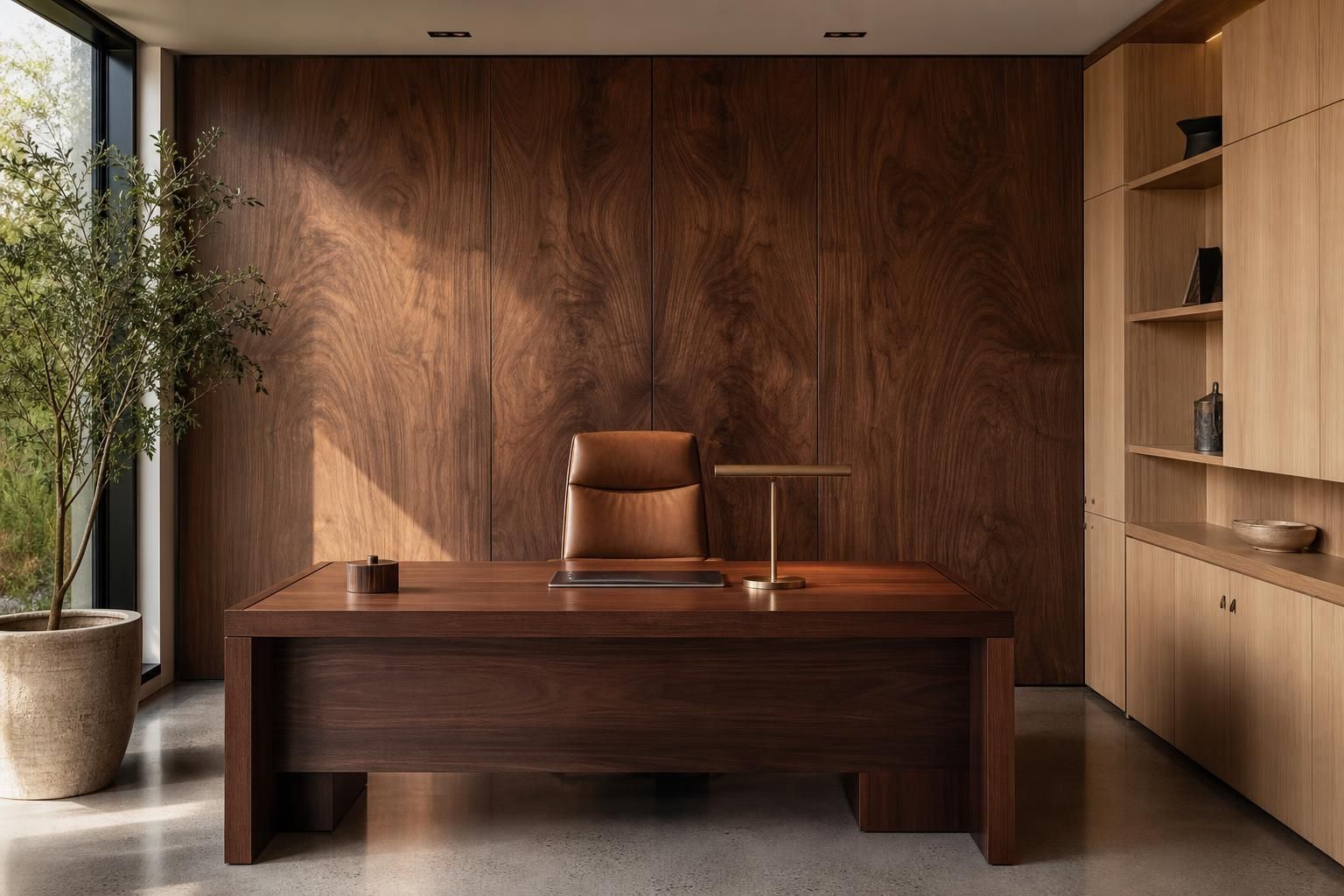
Rotary cut
The log is mounted on a lathe and rotated against a blade, peeling a continuous sheet from the outer surface inward. Produces the widest possible veneer (up to 2440mm or wider) at the lowest cost. Grain appears as broad, irregular swirls because the cut follows growth rings tangentially around the log.
Used for: utility veneer substrates, plywood faces, hidden veneer faces. Rarely specified as the visible face in architectural projects because the grain pattern is considered less refined.
Crown cut (flat cut, plain sliced)
The half-log (flitch) is mounted with the heart facing away from the blade, and the blade slices parallel to the heart. Produces classical "cathedral" grain on the centre of each leaf, with straighter grain at the edges. Leaf width 200-450mm.
The most-specified cut in GCC luxury interiors. Walnut crown, Oak crown, Sapele crown all show the iconic cathedral arches that read as "premium hardwood" to clients and designers.
Quarter cut
The log is split into quarters and each quarter is sliced perpendicular to the growth rings. Produces straight, uniform grain with prominent ray fleck in species such as Oak and Sapele ("tiger fleck", "silver grain"). Leaf width 100-250mm; narrower than crown cut.
Specified for: formal interiors where consistent linear grain is desired, oak-fleck heritage panelling, modern minimalist millwork. Often more expensive than crown cut because yield per log is lower.
Rift cut
A specialised quarter cut where the blade angle is set to avoid the medullary ray fleck. Produces extremely uniform, pin-stripe straight grain with no figure. Used almost exclusively in Oak ("rift Oak"). Leaf width 75-200mm.
Specified for: modern hotels, corporate boardrooms, contemporary residential where a clean linear aesthetic is required. Rift Oak is the most-specified cut in GCC five-star hotel rooms today.
Half-round and lengthwise cuts
Half-round (also called Stay-log) is a hybrid between rotary and crown, used for figured species (Burl, Pommele, Quilted Maple) where the goal is to capture the figure while maintaining wider leaves. Lengthwise (long-grain) cuts run with the log axis and produce specialty veneers used in luthiery and high-end furniture.
Specifying cut on GCC project drawings
Drawings should call out the cut alongside the species: "American Walnut, Crown Cut, Book Match, AA Grade, 0.6mm" rather than just "Walnut veneer". Sample approval should reference the same cut as the bulk order; switching cut between sample and bulk produces visibly different panels even within the same species.