
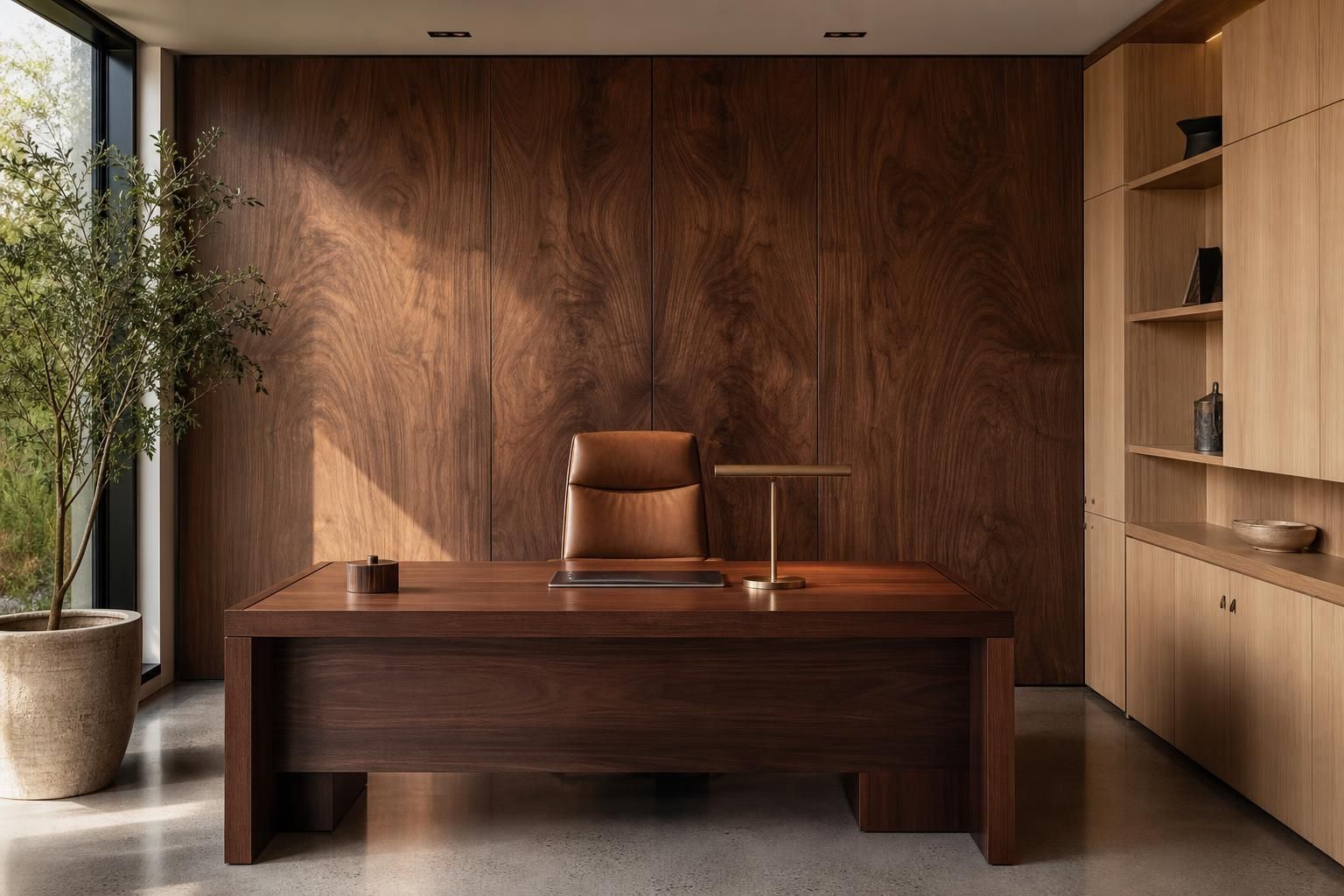
Book match
Adjacent leaves are flipped like pages of a book so that the back of one leaf meets the front of the next at the joint. The grain pattern mirrors across the joint, producing a symmetrical "butterfly" effect. The dominant layup in GCC luxury hospitality and residential.
Strengths: dramatic, classical, the most-recognised "high-end veneer look". Weakness: alternating leaves show their back surface (the "loose face" from slicing) and its tighter grain may take stain or lacquer slightly differently to the front face. Premium specifications either accept this nuance or correct it with sanding sealer.
Slip match
Adjacent leaves are slid sideways into position without flipping, so all leaves show the same face. Grain repeats across the joint without mirroring, producing a progressive, parallel pattern.
Strengths: uniform stain and lacquer acceptance, calm contemporary aesthetic, particularly effective with straight-grained species (Rift Oak, Anigre). Weakness: each joint shows a visible "step" in grain pattern, which can read as repetitive in long runs.
Random match
Leaves are intentionally selected to maximise variation in colour, grain and figure. Joints are not aligned to any pattern. Produces a casual, "barn board" or "reclaimed wood" aesthetic.
Specified for: rustic restaurants, casual retail, accent walls in lofts and mountain-lodge style residences. Less common in GCC five-star projects, more common in mid-market hospitality and F&B.
Reverse diamond, herringbone, parquet patterns
Reverse diamond: four leaves arranged so grain runs diagonally inward from each corner to the centre, producing a four-pointed star. Herringbone: leaves arranged in a 45-degree zigzag, used for floor patterns transferred to wall veneer. Parquet: square or rectangular blocks of veneer arranged in geometric patterns.
Used as feature walls or panel inserts in premium hospitality, particularly in Walnut, Eucalyptus and figured species. Always custom-laid.
Match-end-to-end ('Continuous match')
For walls where the panel sequence must read continuously across a full corridor or room, leaves are kept in the original flitch sequence and laid so that the bottom of one panel reads as the top of the next. Requires careful flitch selection and bundle handling.
TIC Dubai supplies veneer in original sequence bundles with flitch reference numbers preserved so that designers can specify continuous-match runs of 6, 10 or 20+ panels.